AI Personalization at Scale
Marketers who personalize at scale are generating up to 40% more revenue than those who do not, and the gap keeps widening as AI tools make hyper-personalization accessible to teams of every size.
Quick Summary
- AI personalization replaces one-size-fits-all campaigns with unique experiences for every individual user, delivered in real time.
- The three core levers are: dynamic content, product recommendations, and triggered 1:1 messaging.
- Companies excelling at personalization generate 40% more revenue than average competitors, according to McKinsey research.
- Netflix's AI recommendation system saves an estimated $1 billion per year in subscriber retention by keeping people engaged.
- Building this correctly is a data infrastructure project first and a marketing project second.
What It Actually Is
AI personalization at scale means the system, not a human, decides what content, product, or message each user sees, at the exact moment they are most likely to act on it. Instead of one email blast sent to 100,000 people, you send 100,000 variations, each shaped by that person's history, context, and predicted intent.
Think of it like a great bookshop owner who knows every customer by name. When you walk in, they say "the new thriller you would love just arrived", not "here is everything we stock." AI does this at a scale no human team could match: millions of customers, hundreds of data points per person, updated in real time.
The three main levers:
- Dynamic content: web pages, emails, and ads that change based on who is viewing them (location, device, past behavior, purchase stage)
- Product recommendations: AI surfaces the right item at the right moment using collaborative and content-based filtering
- Triggered 1:1 messaging: emails, push notifications, or SMS timed to individual actions, not campaign calendars
Why It Matters (with data)
Generic marketing is becoming structurally ineffective. Batch-and-blast email open rates average below 20%. Generic display ad click-through rates can fall below 0.1%. Audiences have learned to ignore messages that feel irrelevant.
The business case for personalization is now backed by consistent research:
- Companies excelling at personalization generate 40% more revenue from those activities than average players, according to McKinsey's personalization research.
- AI-powered personalization delivers a 10-25% revenue lift for most organizations, with top performers reaching 25%+ when execution quality is high (McKinsey, 2024).
- Automated personalized emails achieve conversion rates 2.5x higher than standard promotional campaigns, while representing just 2% of sends and generating 41% of email revenue (involve.me, 2025).
- Organizations using AI personalization report 1.7x higher conversion rates on campaigns compared to non-personalized equivalents.
- A 2025 HubSpot survey found 96% of marketers say personalized experiences have increased their sales.
- The product recommendation engine market grew to $10.13 billion in 2025 and is on pace for $13.81 billion in 2026, a 36.3% CAGR that reflects how central these systems have become to commerce infrastructure.
The signal is clear: personalization is no longer a nice-to-have feature. It is a core revenue driver for businesses with more than a few thousand active customers.
How It Works: The Playbook
The process has four stages. Get all four right or the system underperforms.
Stage 1: Collect
Gather behavioral signals across every touchpoint:
- Page views, scroll depth, time on page
- Clicks, search queries, filter selections
- Purchase history, cart abandons, wishlist adds
- Email opens, link clicks, unsubscribes
- Device type, location, time of day
The richer the signal set, the better the model. Thin data produces obvious or random recommendations that users dismiss.
Stage 2: Model
Stage 2: Model. Stitch Fix pairs its AI matching engine, which blends collaborative filtering ('clients like you liked these items') with content-based filtering on garment attributes, with a human stylist who reviews every algorithmically generated box before it ships. By 2024, AI-driven recommendations accounted for 75% of the clothing selections sent to customers, with stylists curating and adjusting the AI's shortlist rather than building boxes from scratch.
Result: Average order value rose 40% and annual revenue roughly doubled, from $1.7 billion to $3.2 billion, over four years of AI-personalization investment. (2020-2024).
SourceTrain or connect a pre-built AI to find patterns in the signal data. Two foundational approaches:
- Collaborative filtering: "Users like you also bought X." Finds patterns across similar user profiles. Strong when you have large user bases.
- Content-based filtering: "This item matches attributes you prefer." Works from item attributes rather than user similarity. Better for cold-start situations with new users.
Modern production systems combine both approaches, plus contextual signals (time of day, device, session context, weather). You do not need to build this from scratch, platforms like Bloomreach, Dynamic Yield, Braze, and Segment provide pre-built recommendation engines you configure rather than train.
Stage 3: Deliver
Stage 3: Deliver. Sephora built its AI-powered Virtual Artist AR try-on tool directly into the Sephora app and site so shoppers see personalized, face-mapped shade and product matches at the exact moment they're deciding what to buy, not in a follow-up email. The tool analyzes a shopper's uploaded selfie and product-browsing history to render real-time try-on results and recommend complementary products.
Result: Sephora reported an 11% increase in conversion rate and a 30% reduction in product returns among shoppers who used Virtual Artist before purchasing. (ongoing since 2016 launch).
SourceInject personalized content into every channel at the right moment:
- CMS integration for dynamic web pages
- ESP integration for triggered email flows
- Ad platform APIs for personalized creative
- Push notification platforms for mobile triggers
This requires a personalization engine that sits between your data layer and your delivery channels. A Customer Data Platform (CDP) is typically the connective tissue.
Stage 4: Optimize
Use multi-armed bandit testing rather than traditional A/B testing. A standard A/B test splits traffic 50/50 and waits weeks for a winner. A multi-armed bandit continuously shifts traffic toward whichever variant is winning, at the individual or segment level, so you are capturing revenue during the test, not just after it.
Which platform to start with
If you are in e-commerce with under 50,000 users: Klaviyo or Omnisend for email personalization, plus Shopify's built-in recommendation engine. Between 50,000 and 500,000 users: add a CDP like Segment and explore Bloomreach or Dynamic Yield for on-site recommendations. Above 500,000 users: you need a full personalization stack with a dedicated recommendation engine, real-time event streaming, and a unified data warehouse.
Real Company Examples
Netflix: $1 Billion Saved Annually Through Retention Personalization
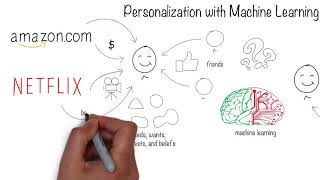
Netflix's recommendation AI does not just suggest the next show. It personalizes the order content appears on the homepage, the thumbnail image shown for each title (testing which artwork drives clicks for each user), the promotional content highlighted in emails, and even the auto-play clips shown while browsing.
The estimated financial impact: Netflix's AI personalization system saves approximately $1 billion per year in customer retention by keeping subscribers engaged long enough to renew rather than cancel. The system analyzes viewing history, time-of-day patterns, device context, and what similar users watch to keep the content feed feeling fresh and relevant. As of 2025, Netflix is also beta-testing a conversational AI search experience that allows subscribers to describe what mood they are in and receive recommendations in natural language.
Netflix thumbnail personalization: the same show, different images for different users
Netflix A/B tests thumbnail artwork at the individual level. A subscriber who watches a lot of romance content will see the romantic leads featured on a thriller's thumbnail. A subscriber who watches action content sees an explosion or chase scene from the same film. The title is identical; the visual entry point is personalized. Internal Netflix research found that the right thumbnail can increase click-through rates by 20-30%. Multiplied across 300 million subscribers, this single personalization layer has a significant impact on total viewing hours and, by extension, retention.
Amazon: 35% of Revenue From a Single AI System
Amazon's recommendation engine is the most financially significant personalization deployment in commercial history. The system analyzes purchase history, browsing behavior, cart activity, search queries, and what statistically similar users bought. It then personalizes homepage layouts, search result rankings, email digests, deal alerts, and the "Frequently Bought Together" and "Customers Also Viewed" widgets.
The result: product recommendations driven by this AI system account for an estimated 35% of Amazon's total annual revenue, a figure analysts have tracked consistently for over a decade. For context, Amazon's 2024 net product sales exceeded $200 billion. That means a single AI recommendation layer contributes roughly $70 billion in influenced revenue.
Spotify Wrapped and Discover Weekly: personalization as a product
Spotify's Discover Weekly playlist, launched in 2015, now has over 30 million listeners per week. The AI analyzes listening history, skips, saves, and playlist additions to build a unique 30-song playlist for each user every Monday. Spotify Wrapped, the annual personalized summary of each user's listening data, has become one of the most viral marketing moments in the industry, generating hundreds of millions of social shares per year purely because users want to share their personalized data with friends. Personalization became the product itself, not just a feature.
Common Mistakes
1. Launching before you have enough data (the cold-start trap)
Most teams underestimate how much behavioral data they need before AI recommendations become useful. If you launch with fewer than a few hundred interactions per user on average, the model has almost nothing to learn from. Early recommendations will be random or blindingly obvious, users will ignore them, and the team will conclude "AI personalization does not work for us." The fix: build your data pipeline first, run the engine in shadow mode for 4-8 weeks to accumulate signal, then switch on live recommendations. Set a fallback strategy, show trending or bestselling items to new users with no history yet.
2. Personalizing four channels at once
Teams that try to simultaneously personalize email, web, ads, and push notifications usually end up with four mediocre implementations instead of one excellent one. Pick the channel where you have the most data and the clearest conversion event. For most businesses, this is email or on-site product recommendations. Get measurable lift, document the playbook, then expand to the next channel.
3. Confusing segmentation with personalization
Sending different emails to "high-value customers" and "new users" is segmentation, not personalization. Segmentation has 2-20 buckets. Real AI personalization has as many buckets as you have users. If your "personalization" strategy is based on manually defined audience groups, you are leaving most of the revenue impact on the table.
4. Ignoring privacy and consent signals
Users increasingly expect control over their data. Personalization that feels intrusive, referencing behavior the user did not expect you to track, or surfacing sensitive browsing history, creates a privacy violation feeling that damages trust. Implement clear consent flows, honor opt-outs promptly, and use data only in ways users would reasonably expect. Regulatory pressure (GDPR, CCPA) makes this a legal requirement, not just an ethical preference.
5. Treating personalization as "set and forget"
User preferences shift over time. A recommendation model trained on 2023 behavior will degrade as user tastes, product catalogs, and market conditions change. Schedule regular model retraining cycles (monthly minimum, weekly for high-traffic commerce). Monitor recommendation diversity, a model that always surfaces the same few popular items has stopped personalizing and started replicating the generic bestseller list.
Key Takeaways
- AI personalization is a data infrastructure project first; the marketing layer comes after the data pipeline is solid.
- The revenue case is proven: 40% more revenue for companies that excel at it, 10-25% lift for most organizations that implement it correctly.
- Start with one channel, measure lift rigorously, then expand the playbook to adjacent channels.
- Collaborative filtering and content-based filtering are the two foundational AI approaches; modern systems combine both with real-time contextual signals.
- Cold-start is the most common failure mode, build data collection before you build recommendations.
- Personalization that feels intrusive destroys the trust it was meant to build; consent and transparency are non-negotiable.