Synthetic Audience Testing: Using AI Personas to Pre-Test Marketing
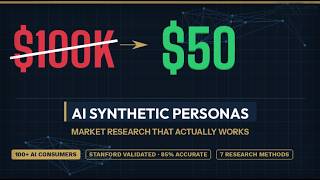
Before 2024, testing a message across different buyer segments required recruiting real people, scheduling interviews or surveys, and waiting weeks for results. In 2025, synthetic audience testing has collapsed that timeline to hours. Teams can now train an LLM with detailed persona profiles, demographics, psychographics, job pains, objections, buying triggers, and query it as if they were actually interviewing that buyer. The output is not a replacement for real user research, but it is a powerful pre-filter that catches messaging failures before they become expensive campaign mistakes.
What Synthetic Audience Testing Is
Synthetic audience testing means using an AI model trained on detailed buyer personas to simulate how real customers would react to your marketing messages, landing page copy, pricing, or product concepts. Instead of deploying a survey to 200 people, you prompt the AI as though it is a specific buyer persona: "You are a CFO at a mid-market SaaS company, concerned about data privacy and ROI measurement. How would you react to this subject line?" The AI, having absorbed the detailed behavioral profile you provided, responds as that persona would.
The outcome is not a prediction; it is a conversation. You get immediate feedback on comprehension, objections, emotional reactions, and alternative framings. You can iterate on copy dozens of times in an afternoon instead of running five rounds of user testing over six weeks.
Synthetic personas are not stereotypes. A synthetic persona is built from real customer data: CRM records, interview transcripts, support tickets, product reviews, and behavioral logs. The AI is not role-playing a guess; it is pattern-matching against your actual customer base. The difference is critical: a stereotype-based persona will mislead you; a data-grounded synthetic persona will catch real objections that your target segment actually raises.
Major Platforms and What They Offer in 2026
Four platforms have emerged as leaders in synthetic audience testing. Each has different pricing, interface, and degree of customization.
Synthetic Users focuses on B2B testing. You upload your customer data (interview transcripts, Slack channels, support tickets), and the platform builds synthetic personas automatically. You then ask those personas how they would respond to marketing assets. The platform claims a 78% correlation between synthetic feedback and real user feedback based on their 2025 validation study.
Persona AI provides a template-based approach. You fill in persona details (role, company size, challenges, success metrics), and the system generates a conversational AI model for that persona. It is lighter weight than Synthetic Users but requires more manual persona input. Good for smaller teams with fewer personas.
Yabble uses AI to conduct automated market research across synthetic audiences. You submit a concept, a headline, product feature, or value proposition, and Yabble tests it against multiple AI-generated personas representing your target segment. The output includes sentiment analysis, top objections, and recommended copy changes. Pricing scales with the number of respondents and personas.
RIWI takes a hybrid approach, combining real-time crowdsourced research with synthetic follow-up. They release real surveys to actual respondents, then use AI to dig deeper on follow-up questions and test variations at scale. Best for teams that want a mix of real + synthetic validation.
All four charge on a per-test or per-month basis. None require engineering resources.
Building Synthetic Personas: The Data-Grounding Step
A 2025 validation study run with PyMC Labs Colgate-Palmolive wanted to know whether AI-simulated consumer panels could substitute for repeat human survey waves without losing reliability. Researchers ran 57 consumer surveys against both real respondents (9,300 total) and data-grounded synthetic panels built to match the same population, then compared results.
Result: Synthetic panels reproduced 90% of human test-retest reliability and kept distributional similarity above 85% across the 57 surveys. (2025 validation study).
SourceA synthetic persona is only as accurate as the data you ground it in. Generic personas, "busy VP of Marketing, age 35, wants to save time", produce generic feedback. Real personas, built from your actual customer base, catch the specific objections and language patterns your audience uses.
Start by collecting three types of data:
Customer Interviews and Transcripts (highest signal). Synthesis these for language patterns: exact words buyers use to describe problems, the order they prioritize concerns, their skepticism triggers, their celebration moments. A synthetic persona trained on interviews will respond in the vocabulary and thought patterns of your customers.
CRM and Purchase Data (historical patterns). Segment your customer base by deal size, industry, role, geography, and conversion velocity. Which segments had the highest close rates? Which personas stalled longest in the sales cycle and why? Synthetic personas built on real winners and real obstacles will react more honestly to your test content.
Support Tickets and Reviews (raw objections). Stack your support tickets by theme: how many customers are worried about integration, compliance, switching costs, or product roadmap commitment? These are the real friction points. A synthetic persona trained on support data will raise those same objections when you test messaging on it, surfacing problems before your real go-to-market campaign hits them.
Once you have collected this data, feed it into your synthetic audience testing platform (or provide it as context to a custom LLM setup). The platform builds a numerical profile that encodes your customers' concerns, language patterns, and decision drivers. Now when you test a message, the synthetic persona responds authentically.
A B2B SaaS Company Tests Pricing Pages
A platform company selling data integration tools had three customer segments: startups (price-sensitive, fast deployment priority), mid-market (want SOC 2 and support), and enterprise (need integrations with legacy systems). They built three synthetic personas from their customer data: 50 interviews per segment, 6 months of support tickets, and purchase history patterns. They then tested five different pricing page variations against each persona. Startups raised "upfront setup cost + training required" as the top objection in the synthetic feedback. Mid-market personas flagged "hidden seat licensing" as confusing. Enterprise personas asked about compliance certifications before pricing was even relevant. The team revised the pricing page to address these specific concerns before launch. Real customer feedback six weeks after launch confirmed the same top three objections that synthetic personas had raised. The test caught messaging failures that generic user testing would have missed.
Core Use Cases for Synthetic Testing
Ad creative validation ahead of a Meta Advantage+ campaign launch FULLBEAUTY wanted to catch weak creative and messaging before committing real media spend to a retail campaign. The retailer ran candidate ad creative through AI synthetic-audience pre-testing to flag comprehension and appeal issues, then only launched the pre-validated versions through Meta's Advantage+ platform.
Result: Pre-tested creative delivered a 45% lift in ROAS, a 22% rise in conversion rate, and a 36% lift in click-through rate against the prior baseline. (2026 retail benchmark report).
SourceMessage Testing and Subject Lines (quickest ROI). Test 10 versions of an email subject line against your synthetic personas in minutes. Each persona tells you which version is confusing, which one appeals to their pain points, and which one they would ignore. You can iterate on copy before sending to real audiences.
Landing Page Copy and Value Propositions (high impact). Present the synthetic audience with your new landing page headline, primary call-to-action, and value proposition. Ask them: Do you understand what this product does? Does this solve your top problem? Is the price fair? Which features matter most? You get qualitative feedback on comprehension and persuasiveness in hours instead of weeks.
Pricing Strategy and Tiers (mission-critical). Test different price points, pricing models (per-user, per-feature, usage-based), and packaging against your synthetic personas. Startups may object to annual contracts. Enterprise personas may refuse anything without tiered support. Mid-market might see value in a mid-tier package your team had doubted. Synthetic testing catches these patterns before you lock your pricing.
Product Concept Validation (discovery phase). You have an idea for a new product or feature. Before building it, test the concept against synthetic personas. "We are thinking of adding a reporting dashboard that exports to Salesforce. How useful would that be to you?" Synthetic personas trained on your customer base will tell you if that feature solves a real problem or if it is a nice-to-have nobody would pay for.
Competitive Messaging and Positioning (differentiation). Present a competitive positioning against your top three competitors. Ask your synthetic personas: Which positioning is more compelling? What concerns are not being addressed? Where is the competition winning? You get feedback on your actual positioning weakness before you send sales reps into the field with weak messaging.
The Limits: When Synthetic Testing Fails
Synthetic audience testing has hard constraints. Ignoring them leads to expensive mistakes.
Cannot predict first-time behavior. Synthetic personas are trained on existing customer data. They cannot tell you how a completely novel audience will react. If you are entering a new market or selling to a customer type you have never served, synthetic feedback will mislead you. You must still do real research in new markets.
Cannot measure emotional or sensory responses. An LLM cannot truly feel the emotional impact of a design, video, or brand experience. It can analyze the framing of copy, but cannot predict emotional resonance the way a human would. Do not rely solely on synthetic feedback for brand positioning or creative direction, always validate with real customers on emotional and design elements.
Cannot predict novelty effects or adoption curves. New products often see initial excitement that does not translate to long-term adoption. Synthetic personas cannot capture the "shiny new" effect that drives early sales but disappears after three months. For entirely new product categories, synthetic feedback tells you if the concept resonates, not if the market will actually adopt it at scale.
Cannot replace compliance or legal validation. If you are in a regulated industry (healthcare, finance, legal), every claim in your marketing must be validated by legal counsel, not an LLM. Synthetic personas can help refine how you frame compliant claims, but they cannot ensure compliance. Still require legal review.
When to Trust Synthetic Feedback vs. When to Run Real Research
Use synthetic testing as a pre-filter: catch obvious messaging failures, narrow down copy variations, validate that your concept is comprehensible.
Use real research when:
- Testing entirely new markets or customer segments you have never served before.
- Validating emotional or brand positioning claims (design, voice, values).
- You are three weeks from launch and you need certainty before spending marketing budget.
- Your competitive landscape has shifted and you need to understand how customers perceive new entrants or shifts in positioning.
- You are building a physical product or one with strong sensory components (hardware, consumer beauty, food).
The hybrid workflow: Start with synthetic testing to iterate on copy and validate core concepts. Then, do one real validation round with 20-30 target customers to confirm. This approach is 4x faster than pure real research and more rigorous than pure synthetic feedback.
The Ethics of Synthetic Data
Synthetic audience testing introduces two ethical considerations that real user research avoids.
Bias reduction benefit: A well-constructed synthetic persona trained on real customer data actually reduces research bias compared to recruiting a small group of volunteers for a user test. Volunteer recruits are self-selected and often not representative. A synthetic persona trained on 100 interviews and 1000 support tickets is more representative than talking to 8 volunteers for 90 minutes.
Model bias risk: LLMs have their own biases baked into their training data. An AI trained on internet text may have stereotypes about certain demographics that your customer data does not have. If you are testing messaging for an audience your model was not explicitly trained on, it may reinforce stereotypes rather than represent your actual customers. Mitigation: always ground personas in your specific customer data, not generic LLM assumptions. Test the synthetic feedback against a small real sample before scaling it.
The rule: Synthetic testing should reduce your overall research bias because it is grounded in your actual customers. But validate the synthetic personas themselves against a real sample to ensure the model is not adding its own biases on top.
Getting Started: A Practical Three-Step Plan
Week 1: Build your persona profiles. Pull customer interview transcripts, support tickets, and CRM data for your top two or three customer segments. Extract key characteristics: role, company size, main challenges, decision criteria, typical objections. Write a 500-word persona profile for each that a third-party could read and understand. This is your grounding data.
Week 2: Test one round on a low-stakes asset. Choose an email subject line, landing page headline, or pricing page you are working on. Pitch it to your synthetic audience. Iterate on copy based on feedback. Do not spend more than 4-5 iterations in this phase, the goal is to learn how the tool works and whether the feedback feels accurate.
Week 3: Validate synthetic feedback against real customers. Send your refined copy to 10-15 real customers (or a small beta group) and compare their feedback to what the synthetic personas said. If the synthetic and real feedback align, you have validated your synthetic setup. If they diverge wildly, revisit your persona profiles, they may not be data-grounded enough.
Do not launch a synthetic-only workflow without doing at least one real validation round. The first iteration of your synthetic personas will have gaps. Real customer feedback tells you where those gaps are so you can refine the personas for future tests.
Key Takeaways
- Synthetic audience testing compresses weeks of real user research into hours by training an LLM on detailed personas grounded in your actual customer data.
- The power of synthetic testing is in iteration speed: you can test 20 variations of copy in an afternoon and surface messaging failures before campaign launch.
- Four mature platforms (Synthetic Users, Persona AI, Yabble, RIWI) offer different pricing models and customization levels; all are no-code and require no engineering resources.
- Data-grounded personas trained on your interviews, support tickets, and CRM outperform generic stereotypes and catch real objections your audience actually raises.
- Synthetic testing has hard limits: it cannot predict first-time behavior, emotional responses, novelty effects, or legal compliance. Use it as a pre-filter, not a replacement for real research.
- A hybrid workflow, synthetic testing for iteration, followed by one small real validation round, is faster and more reliable than pure synthetic or pure real research alone.