Customer Data Platforms (CDPs)
If your stack has six tools that all need the same user data, and each one defines 'active user' a little differently, you do not have an analytics problem, you have a plumbing problem. A CDP is the pipe and the schema. This lesson is for senior marketers, growth engineers, and analytics leads picking or operating one.
What It Actually Is
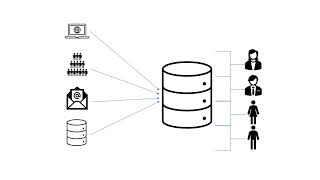
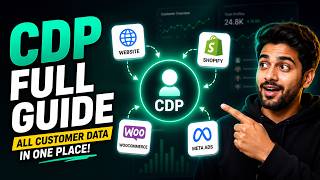
A Customer Data Platform ingests user events from every source (web, mobile, server, warehouse), resolves them into a single persistent profile keyed by user ID, and forwards that data to downstream tools (ad platforms, email, product analytics, support, the warehouse). Concrete example: a user signs up on your web app, opens a push notification on iOS, refunds an order in Shopify, and emails support. A CDP stitches all four touchpoints into one profile, then activates that profile into Braze for lifecycle, Meta CAPI for ads, and Snowflake for analysis, without you wiring four point-to-point integrations.
Why It Matters (with data)
The global CDP market was around USD 4.36B in 2023 and is projected to hit USD 57.81B by 2032, a 33.3% CAGR, driven by first-party data demand under tightening privacy rules (SNS Insider via GlobeNewswire, Nov 2025). Early adopters that finished migration before 2025 reported 15-25% lifts in customer lifetime value and 10-12% improvements in media efficiency after reallocating spend to owned channels.
The vendor landscape shifted hard in 2025. Rokt acquired mParticle for USD 300M in January 2025, joining Lytics and Relay42 in a wave of CDP consolidation (CMSWire, 2025). Meanwhile composable CDPs like RudderStack and Hightouch grew headcount ~13%, faster than legacy players, though they remain under 5% of the market by size (CDP Institute, July 2025 update).
How It Works / The Playbook
The reference architecture has four layers:
- Collection, JS snippet, mobile SDKs, server libraries, and cloud-source connectors (Stripe, Shopify, Zendesk) emit events to a single spec.
- Identity resolution, anonymous IDs get merged with user IDs on signup; deterministic stitching across devices via shared identifiers (email, phone hash).
- Profile and modeling, the canonical user record plus computed traits (LTV, last_purchase_at, churn_risk). On composable CDPs this lives in your warehouse.
- Activation, reverse-ETL or streaming destinations push audiences to ad platforms, ESPs, support tools.
Vendor choice in 2026:
- Twilio Segment, packaged CDP, fastest time-to-value, deepest catalog of ~450 destinations, expensive at scale (per-MTU pricing).
- mParticle (now Rokt-owned), enterprise, strong mobile and consent management, audience engine.
- RudderStack, warehouse-native and open-source core, you own the storage, lowest TCO at high event volume, requires more engineering.
- Hightouch / Census, pure composable, sit on top of your warehouse, reverse-ETL only (no collection).
Allbirds replaced a brittle tag-manager-and-spreadsheet setup with Segment to unify web, retail POS, and email data into one profile per shopper. The team used Segment Personas to build a 'high-LTV repeat buyer' audience and synced it to Facebook and Iterable, which let them suppress paid retargeting on customers already in lifecycle flows. Segment's own case-study work and the broader CDP cohort cited 10-12% media-efficiency lifts post-migration (SNS Insider, 2025).
Common Mistakes
- Buying a CDP before you have a tracking plan. A CDP amplifies whatever spec you give it. Garbage events in, garbage profiles out. Write the event dictionary first.
- Treating the CDP as the source of truth. It is a router and a cache. Your warehouse is the source of truth. Always pipe raw events to S3 or Snowflake on day one so you can replay.
- Ignoring identity-resolution edge cases. Shared devices, B2B accounts where ten users share one workspace_id, and email changes will silently merge or split profiles. Audit identify() calls quarterly.
- Skipping consent. GDPR, CPRA, and the EU AI Act mean your CDP must respect opt-outs across every destination. Use a CMP (OneTrust, Didomi) and wire consent state into every event.
- Choosing packaged when you needed composable, or vice versa. If you already run a warehouse-first stack and have a data team, Segment's per-MTU pricing will burn you at 10M MTU. If you have no data team, RudderStack's open-source path will stall.
Key Takeaways
- A CDP is identity resolution plus a destination router. Profiles in, audiences out.
- The 2025 market split into packaged (Segment, mParticle) and composable (RudderStack, Hightouch). Pick on engineering capacity and event volume, not feature lists.
- Send raw events to your warehouse from day one. The CDP is replaceable; your event history is not.