What a CDP Actually Does
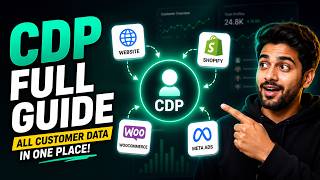
A Customer Data Platform collects data from every touchpoint, your website, app, CRM, email tool, ad platforms, and stitches it into a single unified customer profile. That profile is what powers segmentation, personalization, and activation.
The problem: there are now two very different models for how that unification happens, and choosing wrong costs you either money, flexibility, or both.
The Packaged CDP (The Old Way)
A packaged CDP is an all-in-one system. You connect your data sources to it, and it stores, unifies, and activates all your customer data inside its own infrastructure. Segment, Salesforce Data Cloud, and Tealium are the most common examples.
Packaged CDPs are like a walled garden, everything you need is inside, but so is all your data, on someone else's servers.
The setup is relatively fast because the vendor handles the storage layer. But the tradeoff becomes painful at scale: you are paying to move data out of your warehouse (where it already lives) into the CDP's proprietary store. You end up with a data silo, two copies of your customer data, and a vendor contract that is difficult to exit.
The Composable CDP (The Warehouse-Native Model)
A composable CDP flips the model entirely. Instead of storing your data inside a vendor's system, it sits on top of your existing data warehouse, Snowflake, BigQuery, Databricks, or Redshift. The warehouse is the CDP. No duplication.
The core mechanism is Reverse ETL, a process that takes your already-unified, transformed warehouse data and syncs it back to operational tools in real time. Your audience in Snowflake becomes a Custom Audience in Facebook Ads. A lead score calculated in BigQuery flows into Salesforce without manual export.
Think of composable CDP as: warehouse = brain, Reverse ETL = the hands that push decisions into every tool you use.
According to the CDP Institute's January 2026 Industry Update, composable and warehouse-native vendors grew employment by 7.8% in the second half of 2025, nearly six times the 1.3% industry average. More than 25% of CDPs now support a warehouse-centric architecture.
The Three Core Tools
Hightouch is the market leader for data activation. It connects directly to your warehouse and syncs audiences and computed attributes to 200+ destinations including Meta, Google, Salesforce, and Braze. Hightouch was named a Leader in the 2026 Gartner Magic Quadrant for CDPs, positioned highest in Ability to Execute.
Census built its reputation in RevOps use cases, syncing lead scores, product usage signals, and account health data into Salesforce and HubSpot. Fivetran acquired Census in May 2025 to fold reverse ETL natively into its data movement platform, which is a signal of where the market is heading.
RudderStack is the best option when you need both event streaming (replacing Segment's collection layer) and warehouse-native activation in one open-source-friendly stack. It raised $138M to build out its pipeline-first approach.
What You Can Actually Do With It
The practical use cases are where this gets concrete:
- Audience segmentation: Define a cohort in SQL or a no-code builder, sync it to Google or Meta as a Custom Audience, no CSV exports, no manual refresh
- Email personalization: Push computed product affinity scores from your warehouse into Klaviyo or Braze to drive dynamic content
- Lead scoring: Surface intent signals from your data warehouse into Salesforce so sales teams see enriched records in real time
- Suppression lists: Keep unsubscribes or churned users synced across every ad platform automatically
A SaaS company uses BigQuery to calculate a 'churn risk score' nightly. Hightouch syncs users above threshold 80 into an Intercom segment. The success team sees those users flagged in their queue the next morning, no manual pull needed.
Why Composable Wins in 2026
Data teams already have warehouses. Rebuilding that foundation inside a packaged CDP is redundant. Warehouse-native platforms cut total cost of ownership by 30–50% at scale because you are not paying per-event ingestion fees on top of compute you already own.
The architectural advantages compound fast:
- No vendor lock-in, your data lives in your warehouse regardless of which activation tool you use
- Single source of truth, no reconciliation between CDP profiles and warehouse records
- Full SQL access, data scientists can build models directly on the same data that powers marketing campaigns
- Faster iteration, swap activation tools without migrating data
Real-time activation is still a gap. Forrester found only 25% of composable CDP users achieve sub-minute sync latency due to reverse ETL scheduling constraints. If you need millisecond personalization on a live website, evaluate carefully.
When Packaged CDPs Still Win
Not every team should go composable. If you are a small marketing team with no data engineering capacity and no existing warehouse, a packaged CDP like Segment or Salesforce Data Cloud will get you to segmentation and activation faster with less operational overhead.
The inflection point is typically: when your data team has built a warehouse and the CDP annual contract starts costing more than the incremental tooling to go composable. For most mid-market companies that point arrives around 2–5M events per month.
The Decision Framework
Ask three questions before choosing:
- Do you have a data warehouse already in production? If no, packaged is easier.
- Is your marketing team blocked on data access, or is the data team the bottleneck? Composable accelerates data teams; packaged accelerates marketing independence.
- Is vendor lock-in a concern in your procurement process? Composable wins clearly here.
The market has answered for itself. Composable vendors growing at 6x the industry average is not a trend, it is a structural shift in how customer data infrastructure is built.