Editorial Calendar
In 2025, 63% of businesses still lack a documented content strategy, yet companies with a written plan consistently outperform those without one on every metric that matters. An editorial calendar is the most practical tool for turning intention into published content, on time, every time.
Quick Summary
- An editorial calendar is a shared, dated, owner-assigned plan for every piece of content you intend to publish.
- Only 37% of B2B marketers and 40% of B2C marketers maintain a documented content strategy, creating a massive gap between leaders and the rest.
- Top-performing B2B marketers are 47% more likely to have a documented strategy than their lower-performing peers.
- The best format is the one your team will actually update: a Google Sheet, Notion database, Trello board, or dedicated tool all work.
- A calendar without a weekly review meeting is just a wish list with dates on it.
What It Actually Is
An editorial calendar is a single source of truth for every piece of content your team plans to publish, organized by publish date, channel, owner, and status. Think of it like a train timetable: it does not make the train move, but without it, no one knows when to show up or which platform to stand on.
A real working entry looks like this: "Nov 3, Blog, 'How to audit your Q4 email list', Draft due Oct 28, Owner: Kavya, Status: outline approved." That single row replaces five Slack messages, two follow-up emails, and one panicked Friday afternoon.
The format is secondary. What makes a document an editorial calendar rather than a to-do list is that every row has three things: a publish date, one named owner, and a status the whole team can see at a glance.
Why It Matters (with data)
The gap between teams with a written plan and those without is not subtle.
- Strategy documentation predicts performance. Among the top 22% of B2B content marketers, 47% have a documented strategy. Among lower performers, far fewer do, per Content Marketing Institute's 2025 benchmarks.
- 63% of businesses have no documented content strategy at all, according to Digital Silk's 2025 content marketing statistics roundup. That means the majority of your competitors are publishing reactively.
- Content marketing average ROI in 2025 is $7.65 for every $1 spent, but realizing that return requires consistent publishing rather than sporadic bursts, per In Motion Marketing's 2025 stat compilation.
- 87% of B2B content marketers achieved brand awareness through content in the past 12 months, and 74% generated demand or leads, per CMI. None of those outcomes are accidental, and they all require a plan.
- 42% of marketers with underperforming strategies cite a lack of clear goals as a primary cause, according to CMI. An editorial calendar forces goal clarity because every row requires a topic, a format, and a date.
The pattern: writing the plan down is the single cheapest intervention available to most content teams, and most teams still skip it.
How It Works / The Playbook
A functional editorial calendar has five components and one recurring ritual. Remove any of them and the calendar degrades into a document nobody opens.
Component 1: The Five Required Columns
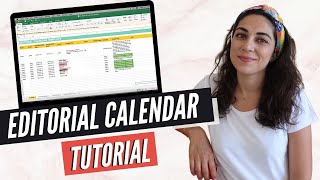
Every row in your calendar needs exactly these fields:
| Field | What It Does |
|---|---|
| Publish Date | Creates a deadline. Without it, everything is "soon." |
| Content Title/Topic | Names the specific piece, not the vague theme. |
| Channel | Blog, email, LinkedIn, YouTube, etc. One per row. |
| Owner | One person's name. "The team" ships nothing. |
| Status | Current stage in the workflow. |
Component 2: A Status Workflow
Content moves through defined stages. Tracking status tells you where things are likely to break before the deadline hits.
A standard workflow: Idea → Brief/Outline → Draft → Review → Revisions → Approved → Scheduled → Live → Archived.
Pick fewer stages if your team is small. The goal is that anyone can open the calendar on any day and know the state of every piece without asking anyone.
Component 3: A Sustainable Cadence
Buffer's own platform data across 200,000+ user accounts and 10 social platforms Wanted to quantify whether consistency or raw volume drives engagement growth Analyzed 52 million+ posts published between January 2024 and December 2025, comparing creators who posted in 20 or more of 26 weeks against those who posted in 4 weeks or fewer
Result: Consistent posters saw roughly 450% more engagement per post than sporadic posters, with the most consistent group seeing up to 5x more engagement (January 2024 to December 2025).
Source- Set a cadence you can sustain on your worst week, not your best week. One long-form piece per week plus two to three short social posts is a better starting point than five blog posts a week that collapses in week three.
- Plan in 12-week blocks, not 12-month plans. A quarter is long enough to build a campaign arc and short enough that your plan still resembles reality at week ten. Annual plans create false confidence and then get abandoned in April.
- Reserve 20-30% of slots as reactive buffers. Algorithm changes, a competitor announcement, a trending topic: if every slot is pre-committed, you cannot respond. Leave deliberate white space in the calendar.
Component 4: A Consistent Theme Layer
Do not plan by channel. Plan by story. A calendar that says "Tuesday: LinkedIn post" produces filler. A calendar that says "Week 12 theme: Q4 planning for growth teams, Blog post + LinkedIn thread + email snippet" produces a coherent content arc that compounds.
Group related pieces under campaign themes, then assign them to channels. The channel decision comes last, not first.
Component 5: The Weekly 30-Minute Review
This is the ritual that keeps the calendar alive. Every Monday (or the first working day of the week):
- What published last week? Did it go live on schedule?
- What is at risk this week? Who needs help?
- What moves, gets dropped, or gets promoted to fill a gap?
Without this meeting, the calendar is a snapshot of your intentions from three weeks ago. With it, it becomes a living document that reflects your actual capacity.
Build your calendar in the tool your team already uses daily. A perfect Notion database that requires a separate login nobody remembers is worse than a simple Google Sheet that is already open on every browser tab. Adoption beats features.
The Setup Sequence (Week by Week)
- Week 1: Audit what you have published in the last 90 days. List topics, formats, channels, and publish dates. This is your baseline cadence.
- Week 2: Define themes for the next 12 weeks. One campaign theme per month works well for most teams.
- Week 3: Populate the first four weeks with specific titles, owners, and draft-due dates. Leave weeks 5-12 at the theme level.
- Week 4: Hold your first weekly review. Check what actually shipped versus what was planned. Adjust cadence if needed.
- Ongoing: Fill the next 4 weeks with specifics every Friday. Keep the calendar 4 weeks ahead in detail and 8 weeks ahead in themes.
Real Company Examples
HubSpot: Consistency at Scale
HubSpot's Marketing, Sales, and Service blogs Blog traffic had plateaued for over a year after a period of chasing month-over-month growth Switched to a quarterly pillar-cluster planning cadence, producing 100+ keyword-researched post ideas per quarter and holding monthly meetings to review organic performance and adjust the plan
Result: Broke the traffic plateau and set a new all-time traffic record across all three blogs, while capturing 6,300+ featured snippets (From the 2017 plateau to a new record by).
SourceHubSpot's blog is one of the most frequently cited examples of editorial calendar discipline. Their team coordinates blog posts, YouTube videos, podcast episodes, and email sequences across multiple product lines from a centralized calendar. The result: consistent publishing multiple times per day for over a decade, driving an estimated 4 million or more monthly organic visits to their blog alone. The calendar is not the reason their content is good; it is the reason their content exists at all, reliably, at scale.
The HubSpot model's key feature is the separation of the "what we plan to create" layer from the "what we distribute where" layer. Topics are planned centrally, then individual channel owners adapt them for their format.
Buffer's 2024 State of Social Media report noted that brands publishing consistently on social media see 3-5x more engagement growth than brands that publish in bursts followed by silence. Buffer's own social team runs a public editorial calendar (visible in their transparency reports), planning content 2-3 weeks ahead and using a status board to track every post from idea to live. Their transparency about this process is itself a content strategy: the calendar becomes a product.
CoSchedule: Data from Their Own Users
CoSchedule, a dedicated editorial calendar tool, published internal data in 2024 showing that teams using a structured content calendar were 3x more likely to report success with their content marketing than teams without one. Among their active users, the median team maintains a calendar that is 6 weeks ahead in detail and 12 weeks ahead in rough themes. Teams that fell below 2 weeks of advance planning showed significantly higher rates of "reactive publishing", content created under deadline pressure with no strategic brief.
Common Mistakes
1. Planning by channel instead of by story. A calendar entry that says "Monday: Instagram Reel" is not a plan; it is a reminder to create something. The topic, the angle, the call to action, and the connection to a larger campaign theme have to be in the calendar before the publishing date, not invented the morning of.
2. No single named owner per row. "Marketing" is not an owner. "The content team" is not an owner. Every row needs one person's name: the person who will be embarrassed if it is not done by the draft-due date. Shared accountability is no accountability.
3. Treating the calendar as a commitment rather than a forecast. If killing a planned piece when a better opportunity appears requires a committee decision, the calendar is running the team rather than serving it. Reactive buffer slots solve this structurally: they give you permission to respond to real-world events without breaking the plan.
4. Letting the calendar go stale for more than two weeks. A calendar that has not been updated since last sprint is not a source of truth; it is a historical artifact. The weekly 30-minute review is not optional overhead; it is what transforms the document from a plan into a system.
5. Hiding the calendar from adjacent teams. Sales, support, and product teams generate the best content ideas, and they are also the first to find out when a published piece contains errors or outdated information. A calendar visible only to the content team misses input from the people closest to customer questions. Make it readable (not necessarily editable) for anyone whose work could inform it.
6. Confusing publishing frequency with publishing quality. A calendar that demands five posts per week from a two-person team will produce five low-quality posts per week. Cadence should be set by what your team can execute well, not by what a benchmark blog post recommends as "ideal" frequency.
Key Takeaways
- A documented content strategy is the single clearest predictor of content marketing success: top performers are nearly three times as likely to have one.
- 63% of businesses still operate without a documented strategy in 2025, meaning a simple, maintained editorial calendar is itself a competitive differentiator.
- The five non-negotiable columns are: publish date, title, channel, owner, and status.
- Plan in 12-week blocks, leave 20-30% of slots as reactive buffer, and run a 30-minute weekly review.
- The calendar format matters far less than whether your team actually opens and updates it every week.
- Content ROI averages $7.65 per $1 spent in 2025, but only consistent publishers realize that return.