The Shift: From Keyword Control to Intent Matching
For 15 years, paid search worked like this: you picked exact keywords, wrote ads, set bids, and Google showed your ad to people searching those words. You had control. You could exclude competitors, avoid brand hijackers, and know exactly what triggered your ads.
That model is dead.
Starting in 2024 and accelerating through 2025, Google dismantled keyword-level control. Exact match now includes close variants and misspellings. Phrase match includes loosely related queries. Broad match, which still exists, now pulls in anything Google thinks is intent-adjacent, not term-adjacent.
The reason: Google's AI is better at understanding what people are actually looking for than the keywords they type. A search for "affordable yoga mats" intent-matches to "budget yoga equipment," "cheap yoga setup," and "affordable fitness mats." Google says: these are the same person trying to solve the same problem.
For performance brands, this is terrifying. For disciplined advertisers, it's the highest ROI era in search history. The gap between winners and losers is wider than ever.
AI Max Campaigns: What Changed
Google AI Max for Search campaigns, search-term matching plus dynamic text customization Royal Canin's global media team wanted to capture specific, long-tail pet-owner queries (like exact feeding-schedule questions) that traditional keyword lists were too rigid to anticipate. Used AI Max's search-term matching to surface long-tail queries and text customization to tailor ad copy directly to the searcher's specific question, rather than running one generic ad across all matched terms.
Result: 263% surge in conversions while maintaining the same spend level, with a 73% reduction in cost per acquisition (Reported via Google's AI Max advertiser case studies).
SourceGoogle launched AI Max in late 2024 and now recommends it for 60% of search advertisers. It's not optional anymore, it's the direction.
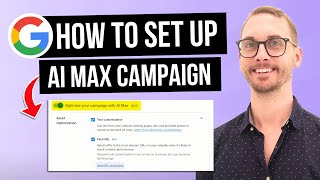
AI Max campaigns replace traditional keyword targeting with asset groups. Instead of keywords, you provide:
- Multiple headlines and descriptions (Google tests combinations)
- Images and videos
- A final URL (Google generates landing page variations)
- Audience signals (your existing customers, website visitors, lookalikes)
- Conversion data (Google's algorithm feeds on this)
Google's AI then decides which asset combination, landing page variant, and bid to show to each person in real time. You don't pick keywords. You don't write one ad. You provide input and the algorithm outputs performance.
Placements: AI Max shows ads on Google Search, Google Shopping, YouTube, Gmail, Google Maps, Google Display Network, and Discover feed. You can't opt out of any placement, only set placement bid adjustments.
Relevance Logic: Google uses search term, device, time, location, audience signals, and historical conversion data to match intent. If someone searches "best running shoes under $100" and your asset group is about marathon training shoes, Google might show your ad. It thinks the searcher has intent to buy running shoes and your content (even if not perfectly matched) addresses that need.
This is why precision is impossible and attribution is harder. You no longer know exactly what triggered your ad. You only see which terms drove conversions, and even that's limited.
Broad Match in 2026: Why It Works Now (But Didn't in 2019)
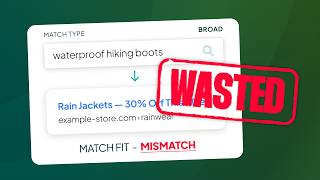
Broad match was the worst thing in 2015–2020. You'd add "yoga mat" and Google would show your ad for "yoga studio jobs," "yoga mat cleaner," "yoga pants for men", anything tangentially related. ROI tanked. Everyone learned to add negative keywords endlessly.
Now, broad match is different. Google's Smart Bidding algorithm is smarter. It looks at:
- Query intent (derived from searcher behavior, not term matching)
- Historical conversion patterns across millions of accounts
- Your audience signals and conversion data
- Seasonality and time-of-day patterns
- Device, location, and demographic context
If you add "yoga mats" on broad match now, Google still shows ads for tangentially related queries, but it bids lower on low-intent stuff and higher on high-intent variants. It learned, through millions of conversions, that someone searching "free yoga videos" has lower purchase intent than someone searching "best yoga mats for sensitive skin." It bids accordingly.
The catch: this only works if you have conversion data. Without at least 30–50 conversions per month, Google's algorithm is half-blind. It defaults to bid high and broad, wasting your budget.
The Correct AI Max Campaign Structure
Google AI Max for Search campaigns, B2B SaaS account with $750+/day budget and 100+ monthly conversions ClickUp's marketing team was one of the first B2B SaaS adopters of AI Max and wanted to validate it before scaling past a single test campaign. Combined search-term matching, text customization, and final URL expansion in a structured test campaign before scaling the approach to more than 400 campaigns.
Result: 20% lift in incremental conversions, 16% higher incremental ROAS, a 22% lower cost per acquisition, and a 15% higher conversion rate (Reported via Google's AI Max advertiser case studies).
SourceDon't just throw assets at Google and hope. Structure matters.
Asset Group Quality: You need 3–5 unique asset groups per campaign. Each targets a different user intent or customer segment.
- Asset Group 1: Budget-conscious buyers (headlines: "Affordable Yoga Mats," "Save on Yoga Gear")
- Asset Group 2: Premium buyers (headlines: "Luxury Yoga Mats," "Professional-Grade Equipment")
- Asset Group 3: Beginners (headlines: "Yoga for Beginners," "Start Your Yoga Journey")
Google tests each asset group separately and allocates budget to the highest-performing combinations. If you only have one asset group, you're forcing Google to pick between cannibalizing the budget-buyer and the premium-buyer. Give it options.
Audience Signals: Upload your customer list, website visitors, and YouTube viewers. Google uses these as lookalike seeds. Conversions from lookalike audiences often convert 2–3x better than cold search because the algorithm understands your customer profile.
Conversion Data: You must have at least 30–50 monthly conversions for AI Max to optimize. Below that, the algorithm is under-trained. Start with a test budget of $1,000–$2,000/month. Once you hit 30+ conversions, increase spend.
Negative Keyword List: Even with AI Max, you still need negatives. Add:
- Competitor names (if you don't want to show when they're searched)
- "Free," "cheap," "discount" (if your product is premium)
- "Job," "career," "hiring" (unless you're recruiting)
- "DIY," "homemade" (unless relevant to your offer)
AI Max respects negatives. Use them to exclude the lowest-intent queries.
AI Max vs Standard Search vs Performance Max: The Decision Framework
You now have three campaign types. Pick the right one.
Standard Search (old-style exact/phrase/broad match campaigns):
- Best for: Brand terms, high-intent queries, competitors bidding high
- Why: You need precise keyword control. Protecting brand is worth the manual overhead.
- Example: Bidding on your brand name, protecting against affiliate bids
AI Max:
- Best for: Performance-focused campaigns, 30+ monthly conversions, multiple customer segments
- Why: The algorithm distributes budget better than you can at scale.
- Example: Core product campaigns, multi-intent campaigns (budget + premium buyers)
Performance Max (Google's full-funnel AI product):
- Best for: Awareness + conversion across YouTube, Display, Gmail, Discover
- Why: You need reach beyond search. PMax reaches cold audiences.
- Example: New product launches, brand building, scaling to $10K+/day budgets
The decision tree:
- Do you have brand traffic you want to protect? → Use Standard Search for brand terms.
- Do you have 30+ conversions/month? → Use AI Max for core campaigns.
- Do you want to scale beyond search and build awareness? → Use PMax alongside AI Max.
Most winners run: Standard Search (brand) + AI Max (non-brand) + PMax (awareness).
Search Term Reporting: Monitoring & Adding Negatives
With AI Max, you lose keyword-level control but gain search term visibility. Google still shows you which search terms drove conversions and clicks, just not in real-time.
Check your search terms report weekly:
- Export search terms from the past 30 days.
- Sort by conversions. Look for patterns in bottom-converting terms.
- Add low-relevance terms as negatives (exact match).
- Identify high-converting term patterns and test as Standard Search brand campaigns.
Example:
- "Cheap yoga mats" → low conversion rate → add negative
- "Best yoga mats for back pain" → high conversion rate → could be its own Standard Search campaign
This feedback loop keeps AI Max focused and prevents budget waste on low-intent variants.
The Minimum Conversion Threshold
This is critical and often missed. Don't launch AI Max without 30 conversions/month baseline.
If you have 5 conversions/month total:
- Don't use AI Max. Use Standard Search instead.
- Build conversion data first. Once you hit 30+, switch to AI Max.
If you have 50+ conversions/month:
- Use AI Max. The algorithm is well-trained.
- Allocate 60–70% of budget to AI Max, 20–30% to Standard Search (brand protection).
If you have 200+ conversions/month:
- Use AI Max for non-brand. Standard Search for brand. PMax for awareness.
- The algorithm has enough data to optimize across placements.
Below the 30-conversion threshold, AI Max optimizes poorly. It guesses. You'll burn budget. Use Standard Search with tight negative keyword lists instead. Conversion data is the fuel. Without it, the engine misfires.
Common AI Max Mistakes, And How to Avoid Them
Mistake 1: Launching AI Max without conversion data. You have 8 conversions/month. You turn on AI Max. Google spends your entire budget in week one because it has no data to guide it. You get 2 conversions total.
Fix: Hit 30 conversions in Standard Search first. Then migrate to AI Max with a 20% budget increase. Let it optimize gradually.
Mistake 2: Only one asset group. You add one asset group targeting "everyone." Google has to pick between budget buyers and premium buyers. It defaults to high CPCs and wastes budget.
Fix: Create 2–3 asset groups per campaign, each targeting a distinct customer segment. Let the algorithm allocate budget intelligently.
Mistake 3: No negative keyword list. AI Max shows your ads to low-intent queries. Without negatives, you burn budget on tire-kickers.
Fix: Start with a solid negative list (free, cheap, DIY, competitors, jobs). Add to it weekly based on search term reports.
Mistake 4: Weak creative assets. You upload generic images and one-liner headlines. Google's algorithm can't work with thin input.
Fix: Create 5–8 headlines (short, benefit-driven), 2–4 images (high contrast, clear product), and 1–2 videos. Give the algorithm something to test.
Mistake 5: Turning off exact match. You think "AI Max means we don't need exact keywords." You turn off exact match and go broad-only.
Fix: Keep exact and phrase match for brand and high-intent terms. Use broad match + AI Max for intent expansion. Never go full broad. It's a supplement, not a replacement.
Mistake 6: Not checking conversion data quality. Your tracking is broken. Google's AI optimizes on garbage data. ROAS collapses.
Fix: Audit your conversion tracking before launching AI Max. Use conversion debugging tools. Ensure all purchase events (web, app, offline) are tracked. Test it.
The New Workflow for 2026
-
Build conversion baseline: Run Standard Search for 30–60 days until you hit 30 conversions/month in your core non-brand keywords.
-
Segment by intent: Identify 2–3 distinct customer types (budget, premium, beginner, solution-seeker). Create one asset group per segment.
-
Launch AI Max: Set a monthly budget 20% higher than you currently spend. Let it run for 14 days. Check daily for overspend. Adjust bids.
-
Protect brand: Simultaneously run Standard Search campaigns on your brand name + competitor names. Bid defensively.
-
Monitor weekly: Check search terms report. Add low-conversion patterns as negatives. Identify high-conversion patterns for future optimization.
-
Refresh creative monthly: Asset groups fatigue. Swap out images and headlines that underperform. Keep videos and top-performing copy.
-
Test PMax for awareness: If ROAS is stable and budget is available, allocate 20–30% to a Performance Max campaign targeting cold audiences on YouTube, Display, Gmail.
The goal is never to have one lever anymore. You're orchestrating: brand protection with Standard Search, performance with AI Max, and scale with PMax. Each campaign feeds the next.
The Competitive Edge
AI Max campaigns are now table stakes. The brands winning in 2026 have:
- Clean conversion tracking
- Asset group strategy (not just one group)
- Regular negative keyword maintenance
- Monthly creative refresh
- Multi-campaign orchestration (brand + AI Max + PMax)
The ones losing are still running single campaigns, ignoring conversion data, and treating AI Max like it's a set-and-forget algorithm.
It's not. It's a partnership between you and Google's AI. You provide structure, data, and creative input. Google optimizes placement, bid, and audience. Both sides need to bring their A-game.