Creative Testing
Creative testing is the practice of running multiple versions of your ad visuals, videos, and copy against each other to find out which one actually gets people to stop scrolling and take action. Instead of guessing which image or headline will work best, you let real audiences decide through their clicks, views, and purchases.
Quick Summary
- Creative drives 49% of incremental sales: more than targeting, reach, or brand, according to NCSolutions research across 450+ studies
- Most marketers underestimate this: they think creative accounts for only 20% of sales impact
- The core loop is simple: form a hypothesis, run one test with one variable changed, read results, scale the winner
- Change only one element per test: otherwise you can't know what caused the result
- Run tests for at least 7-14 days and 50-100 conversions per variant before drawing conclusions
What "Creative" Actually Means
In paid advertising, "creative" means everything a person sees and hears in your ad: the video, the image, the headline, the body text, and the call-to-action button. Think of it as the "what" of your ad, as opposed to the "who" (targeting) and "how much" (budget).
For most of advertising history, the media buy (which platform, which audience, how much to spend) was the main thing marketers controlled. That has changed. Today, ad platforms use machine learning to handle audience targeting automatically. The creative itself is now the primary variable you can actually move.
Research firm NCSolutions analysed nearly 450 sales effect studies and found that ad creative drives 49% of incremental sales, yet when surveyed in 2024, marketers estimated creative at only 19-20%. They are undervaluing their most powerful lever by more than 2x.
Why It Matters: The Numbers
Here is why systematic creative testing is worth building as a habit:
- Creative quality compounds. A 3-star ad (rated by research firm System1) drives 1% long-term market share growth. A 5-star ad drives 3%. That gap widens every year you keep running the better ad.
- Fatigue is real. When the same audience sees your ad repeatedly, click-through rates fall and costs per click rise. This is called "creative fatigue." New tested creatives reset the clock.
- Video format dominates. Video ads get 480% more clicks than static images on average. If you are only testing static images, you are missing the highest-impact format.
- AI is accelerating volume. 39% of digital video ads in 2025 are expected to be developed using AI tools, meaning competitors can produce more creative variants faster than ever. A structured testing process is how you keep up.
Real-World Examples
Seltzer Goods: 785% Revenue Increase in 30 Days (2020)
Seltzer Goods, a puzzle company, ran a focused creative test on Facebook Ads in March 2020. They kept all campaign settings identical and changed only the visual: one ad showed a puzzle box with a ramen design; the other showed someone assembling a dog-themed puzzle.
Results after 30 days:
- 785% increase in monthly revenue
- 9.68x return on ad spend
- $4.87 cost per customer acquisition
- 931% increase in branded search queries
The entire performance difference came from identifying which visual resonated more. Same audience, same budget, same copy, different creative, dramatically different outcome.
Unroll.me: 91% Lower CPAs on Facebook (2024)
Unroll.me, an email decluttering app, ran a structured creative testing program focused on hook variations in short-form video. By testing different opening seconds, the "hook" that determines whether someone keeps watching, they cut their cost per acquisition by 91% on Facebook and 83% on TikTok. The winning hooks all had one thing in common: they showed the problem the user has, not the product, in the first 3 seconds.
What a hook test looks like in practice:
You are advertising a budgeting app. You test three 15-second video ads. The only difference is the opening line:
- Version A: "Introducing BudgetPro, the smart way to manage money"
- Version B: "Do you know exactly where your money goes each month?"
- Version C: [Silent visual of someone checking their bank balance, looking shocked]
Everything else, music, voiceover, product demo, call-to-action, is identical. After 7 days and 200 conversions per variant, Version C wins by 40%. You now know your audience responds to emotional recognition of the problem, not product announcements. That insight applies to every future ad you run.
How the Process Works
Creative testing follows a repeating four-step loop. Most failing programs skip step one (forming a hypothesis) and jump straight to "let's try a different image." That makes results unlearnable.
Step 1: Form a Hypothesis
A hypothesis is a specific, testable prediction. Bad: "let's try a different image." Good: "I believe showing a person using the product will outperform a product-only image because it helps the viewer picture themselves using it."
A written hypothesis forces you to think about why one version might win, and that thinking teaches you something even if you are wrong.
Step 2: Build Your Variants (One Variable Only)
Qeepsake, a digital baby-memory app, ran creative tests inside Meta Ads Manager. They needed to know whether purchase-optimized ad sets or cheap-registration-optimized ad sets actually drove more paying subscribers. They isolated campaign optimization goal as the one variable, holding creative and audience constant, then combined the winning interest audiences into a single 'superset' ad set.
Result: Return on ad spend climbed from 70% in December to over 110% in January, the account's best ROAS on record at the time. (one month, December to January).
SourceChange exactly one element between your control (the current best-performing ad) and your challenger. Common elements to test one at a time:
- Hook: the opening 3 seconds of a video, or the first headline in a static ad
- Visual format: video vs. static image vs. carousel
- Problem vs. product framing: lead with the pain point vs. lead with the solution
- Social proof: with customer testimonial vs. without
- Call-to-action: "Shop Now" vs. "Learn More" vs. "Get Yours"
Run 3-5 variants per test. Fewer gives you limited data; more spreads your budget too thin to reach significance quickly.
Step 3: Run the Test
Use built-in A/B testing tools on the platforms:
- Meta Ads Manager: Experiments > A/B Test
- Google Ads: Drafts and Experiments
- TikTok Ads Manager: A/B Testing in Campaign creation
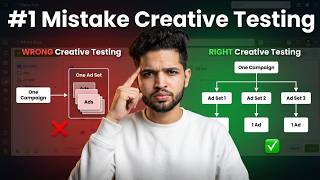
These tools split your audience randomly, which is critical. If you just run two ads in the same ad set and look at results, the algorithm will optimise delivery toward whichever ad it predicts will perform better, you will not get a fair comparison.
Budget tip: aim for enough budget to reach 50-100 conversions per variant within your test window. A rough formula: if your target cost per purchase is $20, you need at least $1,000-$2,000 per variant.
Step 4: Read Results and Act
After 7-14 days with enough conversions, check for statistical significance. Most platforms show this automatically. If significance is below 95%, the difference you are seeing could be random noise, extend the test or accept that neither variant is clearly better.
When you have a winner:
- Pause the losing variant immediately
- The winner becomes your new control
- Document what you learned, why you think it won
- Start the next test
Set a weekly creative testing cadence regardless of current performance. Teams that only test when results drop are always reacting. Teams that test every week always have a pipeline of proven winners ready to scale. Aim for 5-10 new creative concepts tested per month.
What to Test: A Priority List
Grammarly's marketing team, working with the creative agency Ghost Note, built a Gen Z-focused back-to-school YouTube campaign. Their usual straightforward product-benefit messaging wasn't landing with Gen Z students the way it did with older, paying professionals. They tested an authentic, meme-literate, self-aware comedic angle, the 'Future You Thanks You' concept, breaking the fourth wall and mixing humor with product explanation, against their standard tone.
Result: The campaign drove over 150 million views, with viewers actively searching for the full ad despite it airing as a paid placement. (reported June 2023).
SourceNot all creative elements move the needle equally. Test in this order:
| Priority | Element | Why |
|---|---|---|
| 1 | Format (video vs. image) | Biggest potential variance |
| 2 | Hook / opening line | Determines if anyone watches |
| 3 | Core message angle | Problem vs. solution vs. social proof |
| 4 | Visual style | UGC vs. polished studio vs. text-on-screen |
| 5 | Call to action text | Lower impact but easy to test |
| 6 | Headline copy | Fine-tuning once big variables are settled |
Start at the top of the list, not the bottom. Many advertisers spend months testing headline punctuation while never questioning whether video would outperform static in the first place.
The Testing Flywheel
Meta & TikTok creative testing dashboard in Motion Media buyers and video editors lacked granular performance data by hook, creator, and format, slowing down weekly iteration cycles Implemented an element-level testing flywheel in Motion: tagged assets by opening hook style and visual angle, killing fatigued losers weekly and feeding winning hooks into new production briefs
Result: Shipped 4x more winning creative concepts and profitably scaled monthly ad spend (90-day testing cycle).
SourceThe compounding advantage in creative testing comes from building what practitioners call a "testing flywheel": a system where each test feeds the next one automatically.
The key insight: documenting what you learned is as important as the test result itself. If a video showing a real customer outperforms a polished studio ad, write down "authenticity beat production value for this audience." That pattern guides your next 10 briefs, not just your next one.
Common Mistakes
Mistake 1: Testing too many variables at once. If you change the image, headline, body copy, and call-to-action all at once, a winning result tells you nothing useful. You cannot know what caused the improvement, so you cannot repeat it deliberately. One variable per test, every time.
Mistake 2: Stopping tests too early. Seeing one variant ahead after two days and pausing the other is one of the most expensive errors in paid advertising. Platform algorithms are still in a learning phase for the first few days, daily results fluctuate by day of week, and small sample sizes produce misleading signals. Wait for 7-14 days and at least 50-100 conversions per variant.
Mistake 3: Testing new creatives against old winners. Established ads have months of engagement signals, pixel data, and optimisation history baked in. A new creative tested against an old winner is fighting uphill from day one. Instead, test new creatives against each other first, then validate the winner against your established control.
Tools That Help
- Meta Ads Manager Experiments: built-in A/B testing for Facebook and Instagram campaigns (free)
- Google Ads Experiments: campaign-level split testing for Search and Display (free)
- TikTok Ads A/B Testing: native split test tool in TikTok Ads Manager (free)
- Motion (motionapp.com), analytics dashboard specifically for creative performance across Meta, TikTok, and YouTube; helps identify fatigue and surface winners faster
- Facebook Ads Library (facebook.com/ads/library), see competitors' active ads for creative inspiration (free)
The One-Line Takeaway
Creative drives half your ad performance, stop guessing what works and build the habit of testing one variable at a time, every week.
Related Concepts
- Meta Ads, Meta's Ads Manager is where most creative testing in paid social happens; understanding the platform's campaign structure is essential to running clean experiments.
- Ad Copy Frameworks, Structured frameworks for writing ad copy give you a principled basis for generating test hypotheses rather than guessing what to change.
- TikTok Ads, TikTok's algorithm is especially creative-dependent, making it one of the highest-leverage platforms for running creative tests at scale.