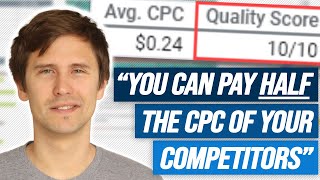
Quality Score & Ad Rank
When you run a Google Search ad, you might assume the advertiser who bids the most money always wins the top spot. That is not how it works. Google runs a behind-the-scenes auction every single time someone searches, and the winner is not always the highest bidder.
It is the advertiser who offers the best combination of price and quality. This system keeps ads useful for searchers and rewards advertisers who do their homework.
Quick Summary
- Quality Score is Google's 1-10 rating of how relevant your keyword, ad, and landing page are to a search query.
- It directly controls your Ad Rank (position on the page) and your actual cost-per-click (CPC).
- A keyword with Quality Score 10 can cost up to 50% less per click than a Quality Score 5 keyword at the same bid.
- A keyword with Quality Score 1-3 can cost up to 400% MORE per click than baseline.
- Three things drive your score: Expected CTR, Ad Relevance, and Landing Page Experience.
What Is Quality Score?
Quality Score is Google's 1-10 rating of how relevant your ad, keyword, and landing page are to a person's search. Think of it as Google grading your homework before the auction starts.
A score of 1 means your ad is a poor match for the keyword. A score of 10 means everything lines up perfectly: the keyword, the ad copy, and what the person sees when they click.
Quality Score is a diagnostic tool, not a goal in itself. Google compares you specifically to other advertisers who have shown ads for the same keyword. A score of 7 already puts you ahead of the majority of advertisers, since the industry average across accounts sits at 5-6.
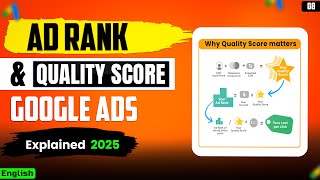
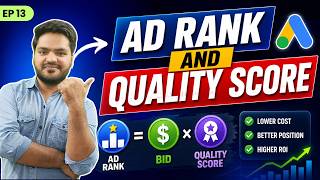
Ad Rank is the actual number that determines your position in search results. Google calculates it roughly like this:
Ad Rank = Quality Score x Maximum Bid + Other Signals
Those other signals include the context of the search (device, location, time of day) and the expected impact of ad extensions like sitelinks or callouts.
What this means in practice: an advertiser bidding $2 with a Quality Score of 10 can outrank a competitor bidding $5 with a Quality Score of 3. Better relevance does not just win placements. It also lowers what you actually pay per click.
How the Three Components Work
Google breaks Quality Score into three parts. You can see each one rated as "Below Average," "Average," or "Above Average" in your Google Ads account under the Keywords tab. Each component has a different estimated weight:
| Component | Weight (estimated) | What it measures |
|---|---|---|
| Expected CTR | ~39% | How likely is your ad to get clicked for this keyword? |
| Landing Page Experience | ~39% | Is your landing page relevant, fast, and helpful? |
| Ad Relevance | ~22% | Does your ad copy match the intent of the search? |
Expected CTR and Landing Page Experience carry roughly equal weight and together account for about 78% of your score. Ad Relevance matters, but it is the smaller lever.
How Quality Score Affects Your CPC
Google Ads account, converting keyword set for a vertical SaaS pricing tool PriceLabs' converting keywords were stuck at Quality Score 5/10, a CPC penalty that was capping the campaign's ROAS at 0.7x Ran a targeted Quality Score improvement pass across the converting keyword set, lifting the account from QS 5/10 to QS 8/10
Result: CPC dropped 32% and conversion volume rose 48% at the same spend, taking ROAS from 0.7x to 2.5x, a 350% improvement (single optimization cycle (exact duration not disclosed)).
SourceThis is where Quality Score gets very concrete. Google applies a multiplier to your cost-per-click based on your score relative to the QS 5 baseline:
- Quality Score 10: Up to 50% CPC discount vs. baseline
- Quality Score 7-9: 20-30% cheaper than baseline
- Quality Score 5-6: Roughly at baseline cost
- Quality Score 3-4: 25-67% premium on every click
- Quality Score 1-2: Up to 400% premium on every click
A fitness brand that raised its Quality Score from 6 to 9 (by rewriting ad headlines to mirror keyword language and rebuilding landing pages around specific offers) cut its CPC by 30% and boosted conversions by 25% in 2024. On a $10,000/month budget, a 30% CPC reduction means roughly 43% more clicks for the same spend.
For high-value industries, the stakes are higher. Legal keywords averaging $40 CPC with 1,000 monthly clicks: moving from QS 4 to QS 8 can save over $12,000 per month in the same budget.
The math is straightforward. The work required to get there is not effortless, but it is entirely learnable.
HubSpot's tight ad group strategy: HubSpot runs Google Search campaigns targeting keywords like "CRM software" and "marketing automation tools." These are among the most expensive keywords in B2B SaaS, where CPCs reach $40-80. To compete without overpaying, HubSpot organized campaigns into small, tightly themed ad groups, for example, one group exclusively for "free CRM," a separate group for "CRM for startups," another for "email marketing software." Each group got its own ad copy that mirrored the exact keyword phrasing. Clicks went to dedicated landing pages matching each offer, not a generic homepage. The result: Quality Scores in the 8-10 range for core terms, which Google estimates can reduce CPC by up to 50% versus a score of 5. On a $50,000/month budget, that efficiency translates to roughly twice the clicks and leads for the same spend.
Why It Matters
Quality Score is one of the highest-leverage levers in paid search. You should actively work on it when:
- CPCs feel too high. A low Quality Score means you are paying a penalty on every single click. Fixing it is often faster and cheaper than increasing budget.
- Ads are not showing for important keywords. Google limits impressions for low-QS keywords even when your bid looks competitive.
- Conversion rates from paid search are disappointing. The landing page component often reveals mismatches that hurt both your score and your conversions at the same time. One fix, two wins.
- You are about to scale spend. Quality Score problems that feel manageable at $1,000/month become extremely expensive at $20,000/month. Fix them before scaling.
How to Improve Each Component
Fix "Below Average" Expected CTR
Google Search campaigns for e-commerce and B2B client accounts Clients were suffering from high CPC penalties due to broad keyword grouping and generic ad copy with below-average Quality Scores (averaging 4/10) Restructured ad groups into tightly themed keyword clusters, rewrote headlines to match exact search query intent, and optimized landing page alignment
Result: Decreased average CPC by 52% by lifting client Quality Scores from an average of 4 to 7 (Within 3 months of account restructuring).
SourceExpected CTR is predicted before anyone even clicks your ad. Google compares your ad's historical click rate for a keyword against what other advertisers have achieved for the same keyword:
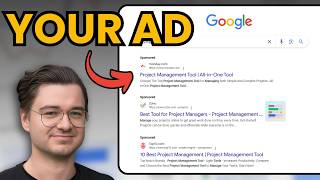
- Write headlines that contain the exact keyword the user searched. If someone searches "project management tool," your headline should say "Project Management Tool", not "Organize Your Workflow Better."
- Add ad extensions (sitelinks, callouts, structured snippets). Extensions increase ad size and give more reasons to click, improving CTR without changing bids.
- Use numbers and specific claims in headlines. "Save 3 hours a week" outperforms "Save time" in nearly every A/B test.
- Pause ads with consistently low CTR. One strong ad per ad group beats three mediocre ones.
Fix "Below Average" Ad Relevance
Google Ads account, project-management SaaS trial funnel Trackxi's broad ad groups were scoring 'Below Average' on Ad Relevance, capping Quality Score at 4/10 and inflating cost per trial signup Restructured broad ad groups into single-keyword ad groups with keyword-matched ad copy, paired with a rebuilt landing page per keyword theme
Result: Quality Score rose from 4/10 to 8/10, driving 4x more trial signups at 51% lower cost per trial (single optimization cycle (exact duration not disclosed)).
SourceAd Relevance measures how closely your ad copy aligns with what the person was searching for. It is the clearest signal of whether your keyword grouping is too broad.
- Organize keywords into tight clusters of 3-5 very similar terms. Avoid putting "running shoes," "trail shoes," and "athletic footwear" in the same ad group. They need different copy.
- Use dynamic keyword insertion (DKI) selectively. DKI automatically inserts the search query into your headline, but only use it when the resulting headline will always read naturally.
- Write separate ad groups for head terms vs. long-tail variants. "CRM software" and "best CRM software for small businesses" have different intent and need different copy.
Fix "Below Average" Landing Page Experience
Google's crawlers evaluate your landing page for relevance to the keyword, mobile-friendliness, page load speed, and transparency (clear contact info, privacy policy). This component also indirectly shows up in your conversion rate.
- Send clicks to a page specifically built for the keyword, not your homepage. A search for "email marketing software" should land on a page about email marketing, not your full product suite.
- Page load time under 3 seconds is the standard. Use Google PageSpeed Insights (free) to identify what is slowing your page down.
- Match the headline on your landing page to the language in your ad. If your ad says "Start your free trial," your landing page should also say "Start your free trial", not "Sign up today."
- Include trust signals: customer logos, testimonials, clear pricing, privacy policy link. These improve Google's transparency rating and conversion rate simultaneously.
The three most common Quality Score mistakes:
-
One big ad group with 50+ keywords. Generic copy that vaguely matches all of them scores poorly on Ad Relevance for every single one. Split into tight groups of 3-5 similar keywords.
-
Sending all traffic to the homepage. Google's crawler sees a page about your entire company, not the specific thing the user asked for. Build dedicated landing pages per theme or offer.
-
Checking the composite 1-10 score and stopping there. The number alone does not tell you what to fix. Always check the three component ratings: they show you exactly which lever to pull.
Reading Quality Score in Your Account
Quality Score is visible in Google Ads at the keyword level. To see it:
- Go to your campaign in Google Ads
- Click "Keywords" in the left menu
- Click the columns icon (top right of the table)
- Add: "Quality Score," "Exp. CTR," "Ad relevance," "Landing page exp."
New keywords start with a default score of 6 and take time to accumulate data. Do not over-optimize based on Quality Score for keywords with fewer than 500-1,000 impressions. The score is statistically unreliable until there is enough data to evaluate.
Quality Score also exists at three levels:
- Keyword-level: what you see in the account, the one you can act on directly
- Account-level: a historical average Google uses internally
- Landing page quality: a separate signal Google tracks independently
The Auction Happens in Real Time
One crucial detail: Quality Score shown in your account is a historical average. The actual quality assessment Google uses in each individual auction is calculated in real time, factoring in the specific user's context. The displayed score is a useful proxy, but the real auction is always slightly more nuanced.
This is why two identical keywords in the same account can perform differently based on the device, location, or time of search. Ad Rank varies auction by auction, not just account by account.
The One-Line Takeaway
A higher Quality Score is a permanent discount on every click you buy, relevance is the cheapest way to beat richer competitors.
Related Concepts
- Google Search Ads, Quality Score only exists inside Google Search campaigns. Understanding campaign setup is the prerequisite for optimizing it.
- Bidding Strategies, Your bid is the other half of the Ad Rank equation. Smart bidding and Quality Score work together to control cost and position.
- Ad Copy Frameworks, Writing headlines that mirror keyword intent is the fastest way to improve Ad Relevance, one of the three Quality Score components.