Retail Media Networks
Retail media is the fastest-growing slice of digital advertising because it puts your ad in front of shoppers at the exact moment they are ready to buy, inside the search bar of the store where they are already shopping. If you sell physical or consumable goods through Amazon, Walmart, Target, Kroger, or Instacart, retail media is no longer optional. It is the bottom of your funnel.
Quick Summary
- Retail media networks (RMNs) let brands buy ad placements directly on retailer platforms like Amazon, Walmart, and Instacart.
- Unlike Google or Meta ads, retail media converts inside the same platform where the purchase happens, giving you clean, real sales data.
- Amazon holds roughly half of all global retail media spend, but Walmart Connect grew 38% year-over-year in Q1 2025.
- The best metric to track is TACoS (Total Advertising Cost of Sales), not just ROAS, because it captures organic sales lift too.
- Your product listing page IS your landing page, fix it before you scale ad spend.
What It Actually Is
A retail media network (RMN) is an advertising platform owned by a retailer. Brands pay the retailer to show ads on its website, app, and sometimes on TV or other websites using the retailer's shopper data.
The retailer wins because it earns ad revenue from the same brands it already sells. The brand wins because it reaches shoppers who are already in buying mode, not just browsing social media.
Concrete example: you sell coffee pods. You bid on the keyword "coffee pods" inside Amazon. When a shopper searches it, your Sponsored Product appears above organic results. They click, they buy. Amazon records the sale automatically. You pay per click and measure return directly against actual purchases, not modeled guesses.
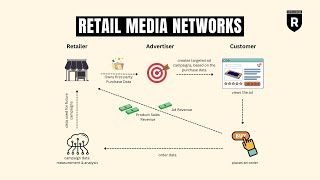
Retail media is called "closed-loop" because the same platform that shows the ad also records the sale. This is far more accurate than running a Facebook ad and hoping your website analytics links it to a purchase.
Why It Matters (the numbers)
Chomps, a meat-stick CPG brand, ran keyword-targeted Sponsored Product campaigns through Instacart Ads Manager, then added Thrive Market-specific placements to reach high-intent grocery shoppers Grocery shoppers on Instacart are already in a buying session, so a keyword-targeted ad reaching them mid-search converts differently than a cold social impression They kept granular keyword-level bid control and layered retailer-specific placements on top of their base campaign instead of running one blanket campaign
Result: A 60% higher click-through rate than comparable search ads and a 5% increase in new-to-brand category purchase rate year-over-year, while lowering cost per click (January 2025 vs. January 2024).
SourceUS retail media ad spend hit $60.32 billion in 2025, up from about $50 billion in 2024, and is forecast to reach $71.09 billion in 2026 (eMarketer). Globally, retail media is on track to surpass $231 billion by 2030.
Amazon Advertising alone reported $56.2 billion in ad revenue in 2024, growing 20% year-over-year. Amazon commands more than half of all global retail media ad spend, making it the third-largest digital ad platform in the world.
Walmart Connect is the fastest-growing challenger. Walmart's global ad business grew 27% in 2024 to $4.4 billion. In Q1 2025 specifically, Walmart's retail media spend climbed 38% year-over-year with click volume up 36% (Skai Q1 2025 Retail Media Report).
Instacart Ads crossed $1 billion in trailing twelve-month ad revenue as of Q3 2025, reaching 95% of North American households across more than 100,000 store locations.
Industry-wide, retail media spend increased 21% year-over-year in Q1 2025, with average ROAS holding at 6.1x for five consecutive quarters, a sign of consistent, predictable returns for brands running well-optimized campaigns.
How Retail Media Works
The diagram below shows the money and data flow inside a retail media network:
The Three Core Ad Formats
All major RMNs use the same basic building blocks with slightly different names:
-
Sponsored Products, keyword-targeted listings that appear inside search results. This is the highest-ROAS format and should be your starting point. On Amazon this runs through Amazon Ads Console; on Walmart it is Walmart Connect; on Instacart it is called "Featured Products."
-
Sponsored Brands / Brand Boost, headline banners showing your logo and 2-3 products at the top of search results. Use these for brand defense (when competitors bid on your brand name) and new product launches where visibility matters more than immediate conversion.
-
Sponsored Display / Off-site, these ads follow shoppers across the open web and connected TV (streaming services) using the retailer's purchase data. Higher funnel, lower immediate ROAS, but powerful for reaching new shoppers before they search.
The Practical Playbook
Step 1, Harvest campaign first. Run auto-targeting for 14 days. Let the platform's algorithm discover which search terms actually convert. Download the search-term report, find the winners, and move them into a manual exact-match campaign with higher bids.
Step 2, Separate branded from non-branded. Branded keyword ROAS (searches for your own brand name) is misleadingly high, those shoppers were already looking for you. Measure incrementality on non-branded keywords, where you are winning customers away from competitors.
Step 3, Win share of voice on your top 5 SKUs. Spreading thin bids across 50 products loses to one competitor who dominates the 5 products that actually sell. Focus budget on your best converters first.
Step 4, Negative match weekly. Long-tail discovery terms with no purchase intent burn budget. Check the search-term report every week and add junk terms to your negative keyword list.
Liquid Death on Amazon (2024): Liquid Death used Amazon Sponsored Products and Sponsored Brands to climb from a niche DTC brand to Amazon's number-1 still-water listing by 2024, hitting $263 million in retail sales that year (Forbes). Their playbook: aggressive bids on competitor branded terms like "Fiji water" and "Smartwater," combined with video Sponsored Brands placements at the top of category searches. They ran a 30%+ ad intensity (ads as a percentage of revenue) during launch, then throttled back as organic rank stabilized and organic sales carried more of the load.
The Major Platforms Compared
Not all retail media networks are equal. Here is a quick map of where each one fits:
Which Platform to Start On
Dreame Tech, a vacuum and home-appliance manufacturer, ran Sponsored Brands and Sponsored Videos on Walmart Connect targeting top category keywords, then increased bids in Search In-grid placements once early data showed which creative worked A large share of vacuum shoppers browse Walmart, not Amazon, and Dreame Tech's online listing had no existing brand recognition there to lean on They led with awareness-building video creative and high-intent keyword targeting rather than starting with a narrow, price-led campaign
Result: 91% new-to-brand buyers and 47% ad-attributed sales across 5.9 million impressions, results strong enough that Dreame Tech used the online traction to justify expanding into physical Walmart stores (November 14, 2024 to January 31, 2025).
Source- Amazon first if your product is in a category with high Amazon search volume (electronics, supplements, household goods, beauty).
- Walmart Connect second to reach the 40% of US households that shop primarily at Walmart, not Amazon. Walmart CPCs are currently lower and click growth is outpacing Amazon.
- Instacart Ads if you are a CPG (consumer packaged goods) brand in food, beverage, personal care, or household, the only RMN with true grocery breadth.
- Target Roundel, Kroger, and others at scale, once you have a proven creative and bid strategy from the big three.
Metrics That Actually Matter
Most beginners track ROAS (Return on Ad Spend). ROAS measures how many dollars in ad-attributed revenue you got per dollar spent. That sounds right, but it has a blind spot.
TACoS (Total Advertising Cost of Sales) is more honest. It divides your total ad spend by your TOTAL revenue, including organic sales that happened because your ad-driven sales velocity pushed you up the organic search rankings.
Example:
- You spend $1,000 on ads
- Ads directly drive $5,000 in sales (ROAS = 5x, looks great)
- But ads also pushed your organic rank up, driving another $10,000 in organic sales
- TACoS = $1,000 / $15,000 = 6.7% (this is the real picture)
Common mistakes that waste budget:
-
Copying Google Ads habits. On Google, the goal is website clicks. On retail media, the goal is unit velocity that lifts your organic search rank on the platform. These require different bidding strategies and different success metrics.
-
Pausing ads to protect margin. Many brands pause during a bad month to save money. Within 30 days, their organic rank collapses because the algorithm sees lower sales velocity. Rebuilding rank costs more than keeping the ads running.
-
Ignoring the product listing. Your product detail page (title, bullet points, images, review count) IS your landing page. A great ad sending traffic to a weak listing is money burned. Fix conversion rate before scaling spend.
-
Running all spend on one platform. Amazon-only brands miss Walmart, Instacart, and emerging networks that have lower CPCs and faster growth right now.
Case Study: Heineken and Retail Media ROI
Heineken ran a retail media campaign targeting shoppers at peak "relaxation moments" using predictive data from a major European retail network. The campaign achieved 38.6% extra ROI compared to their baseline non-retail-media campaigns. The key was timing, showing beer ads when purchase intent signals (like Friday afternoon searches for "snacks" or "party supplies") predicted an imminent shopping trip.
Similarly, Ciucas (a Central European beer brand) used real-time retail media targeting to boost winter beer sales by 69% during a campaign period by combining on-site sponsored placements with off-site programmatic using the retailer's first-party data.
Both cases show the same principle: retail media works best when you use the retailer's unique shopper data to target moments of genuine intent, not just keyword matches.
Industry Trends to Watch in 2025
1. Off-site expansion. Retailers are using their first-party data to serve ads on connected TV (CTV), social platforms, and the open web. Amazon DSP captured 20.7% of total Amazon Advertising spend in Q1 2025, the highest share in five quarters. Advertisers are moving beyond just search ads.
2. In-store digital screens. Physical stores are becoming media channels. Digital screens at store entrances, shelf displays, and checkout areas now carry programmatic ads linked to loyalty card data. Walmart, Kroger, and Target are all building this out.
3. Data clean rooms. Brands and retailers are using secure "data clean rooms", environments where two companies can match customer data without either side seeing the other's raw data, to measure campaign impact more accurately without privacy violations.
4. Measurement standardization. Industry bodies like the IAB and MRC are pushing for standard attribution windows and measurement definitions across all RMNs. Right now every network measures differently, making cross-platform comparison hard.
5. Category-specific growth. In Q1 2025, Food and Grocery retail media spend grew 31% year-over-year, and Beauty and Personal Care grew 26% with CPCs actually falling 10%, meaning better efficiency. If you are in these categories, retail media is becoming the primary acquisition channel.
The One-Line Takeaway
Retail media is the only ad channel where the platform that shows your ad also records the sale, fix your listing first, then let the data compound.