Ideal Customer Profile (ICP)
Most early-stage companies lose months chasing the wrong customers. They sign deals that churn in 90 days, burn sales cycles on prospects who never convert, and build features for buyers who do not represent the majority of their revenue. The root cause is almost always the same: no documented ICP.
A Gartner 2025 survey found that only 42% of B2B companies have a formally documented ICP (Gartner, "B2B Go-to-Market Benchmarks 2025," https://www.gartner.com). That means the majority of teams are targeting based on intuition. The companies that do document their ICP see measurable results: Pipedrive's research showed 68% higher win rates and 36% higher customer retention among ICP-defined accounts (https://www.pipedrive.com/en/blog/ideal-customer-profile).
This lesson teaches you how to build an ICP from scratch, keep it current, and use it across marketing, sales, and product.
Quick Summary
- An ICP describes the company (not the person) most likely to get maximum value from your product.
- Firms with a documented ICP win more deals at lower cost and retain customers longer.
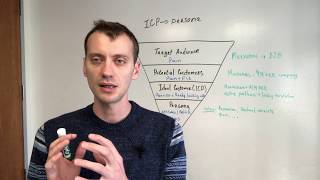
- A strong ICP has five dimensions: firmographics, technographics, behavioral signals, psychographics, and success indicators.
- ICP should be reviewed quarterly, not annually.
- Your ICP is a hypothesis. Validate it against real revenue data every cycle.
What Is an Ideal Customer Profile?
An ICP is a detailed description of the type of company that would derive the most value from your product or service and, in return, provide the most value to your business.
It is NOT a buyer persona. A buyer persona describes an individual (a 34-year-old VP of Marketing named Maya). An ICP describes an organization (a 50-to-200 person SaaS company using Salesforce with a dedicated growth team). Personas live inside the ICP.
ICP = the account you want to win. Buyer persona = the human inside that account you need to convince. Build the ICP first, then map the personas within it.
Why ICP Matters: The Numbers
LogRocket's analysis of B2B and B2C teams found that companies with a well-defined ICP achieved (https://blog.logrocket.com/product-management/ideal-customer-profile-template-examples/):
- 20 to 40% higher win rates
- 15 to 30% shorter sales cycles
- Up to 50% lower customer acquisition cost (CAC)
Growleads 2025 data showed that teams who refresh their ICP quarterly (rather than annually) see 20 to 35% better conversion rates on outbound campaigns (https://growleads.io/blog/icp-refresh-frequency).
The mechanism is straightforward. When sales and marketing agree on who to target, reps spend time on accounts that actually convert. Marketing builds content that resonates with real pain. Product prioritizes features the best customers actually use.
The Five Dimensions of a Strong ICP
1. Firmographics
These are the hard, filterable facts about a company.
| Attribute | Example |
|---|---|
| Industry / vertical | SaaS, e-commerce, healthcare |
| Company size (employees) | 50 to 500 |
| Annual revenue | $5M to $50M ARR |
| Geography | North America, EU |
| Business model | B2B, B2C, marketplace |
| Funding stage | Series A to Series C |
Start here. Firmographics let you build TAM models and filter prospecting lists in tools like Apollo or Clay.
2. Technographics
Developer infrastructure qualification and account tiering across CI/CD environments Individual developers were using free manual cross-browser testing tiers, but sales reps lacked a reliable filter to identify high-value enterprise testing pipeline Integrated technographic signals detecting automated CI/CD pipelines (Jenkins, GitHub Actions, CircleCI) and enterprise SSO deployments to score accounts ready for enterprise device clouds
Result: Expanded from developer-led freemium trials to enterprise contracts reaching over 90% of the Fortune 500, sustaining net revenue retention above 115% (2022-2024).
SourceWhat tech stack does your best customer run? This matters because:
- Your product may require specific integrations to deliver value (e.g., you need a Salesforce customer to activate your CRM sync)
- Buying intent data from tools like Bombora or G2 is organized around tech adoption
- Technographic signals predict readiness to buy
Examples: "Uses HubSpot CRM," "Has Segment installed," "Runs Shopify Plus," "Has at least one AWS service active."
3. Behavioral Signals
Product-led growth expansion triggers in workspace onboarding and activity monitoring Sales and customer success needed an objective threshold to separate casual experimentation teams from high-intent accounts ready for enterprise licensing Identified the '2,000 sent messages' behavioral threshold within a team's first 30 days as the primary activation and retention signal for automated sales outreach and expansion packaging
Result: Teams crossing the 2,000-message milestone achieved a 93% conversion and retention rate to paid plans, powering Slack's 5% week-over-week viral expansion (2014-2019).
SourceBehavioral signals are actions a company takes that indicate they are ready to buy or are experiencing the pain you solve.
- Hiring signals: posting for a Head of Revenue Operations suggests CRM pain
- Funding announcements: Series B companies often expand their tech stack within 90 days of closing
- Product usage: in PLG models, accounts that hit a usage threshold become sales-ready
- Intent data: accounts researching competitors or your category on review sites
A project management SaaS used hiring data as a trigger: any company posting 3 or more "operations" or "program manager" roles in a 30-day window entered their ICP scoring model. That single signal alone improved their outbound reply rate by 22%.
4. Psychographics
Psychographics capture the beliefs, values, and decision-making style of the organization. They are harder to measure but critical for messaging.
- Is this a "build vs. buy" culture? If yes, you need a make-or-buy ROI argument.
- Is the leadership data-driven or relationship-driven?
- Does the company move fast (monthly sprints) or slow (annual vendor reviews)?
- Is the champion in IT or the business unit?
You extract psychographic data from win/loss interviews, Gong call recordings, and G2/Trustpilot reviews. Look for language patterns, objections that keep coming up, and phrases champions use to sell your product internally.
5. Success Indicators (Value Realization Signals)
Your ICP is only complete when you define what "success" looks like for the customer. Success indicators are the metrics your best customers track and improve after adopting your product.
- "Reduced time-to-first-value from 14 days to 3 days"
- "Increased qualified pipeline by 30% in 60 days"
- "Cut manual reporting hours from 20/week to 2/week"
These become your proof points in sales decks, case studies, and onboarding milestones.
The ICP Development Process
Step 1: Start With Your Best Customers
Pull the top 20% of accounts by revenue, lifetime value, or net promoter score. These are the customers you want to replicate. Do not start with all customers or you will average out the signal.
Step 2: Conduct Win/Loss and Customer Interviews
Run 8 to 10 interviews with champions at your best accounts. Ask:
- "What was happening in your business when you decided to look for a solution like ours?"
- "What made you choose us over alternatives?"
- "What would you lose if you had to stop using us tomorrow?"
- "Who else at your company cares about the results we deliver?"
Step 3: Identify Patterns and Build the Hypothesis
Look for patterns across firmographics, tech stack, triggers, and language. Your ICP is a hypothesis about which companies share these patterns and will therefore respond to your outreach and product.
Step 4: Score and Pilot
Load your ICP criteria into your CRM as a scoring model. Assign points to each attribute. Score your existing pipeline. Run a 90-day outbound pilot targeting only high-ICP accounts and measure win rate, cycle length, and CAC against your historical baseline.
Step 5: Refresh Quarterly
Your ICP will drift as your product evolves, as you expand into new segments, and as the market shifts. Growleads 2025 data is clear: quarterly refresh beats annual. Set a recurring calendar event. Pull fresh data. Update the model.
Real Company Examples
HubSpot: Scaling With a Narrow ICP
HubSpot's original ICP (2006 to 2012) was precise: 1 to 100 employee companies, no dedicated IT team, a marketing person who wore multiple hats, and a need to replace manual email outreach. Co-founder Dharmesh Shah has stated publicly that their early hyper-focus on SMB inbound marketing buyers was what allowed them to build product-market fit before expanding upmarket. By 2012 they had 5,000 customers, all tightly aligned to that original ICP.
Slack: Using Signals to Identify the Moment
Slack's PLG ICP was defined not just by company type but by a behavioral trigger: teams that sent 2,000 or more messages in their first 30 days retained at dramatically higher rates. Slack's growth team used this threshold as an ICP signal for expansion and upsell. They documented this in their 2015 S-1 preparation materials and it became the basis of their "magic number" metric.
Figma: Psychographic ICP as a Wedge
Figma's ICP was not just "design teams." It was design teams inside organizations where designers were frustrated by the handoff friction with developers. The psychographic signal was a specific pain (broken handoff workflows) rather than a job title. This let Figma target the same companies as Adobe but with a completely different message. By 2022 their ARR exceeded $400M, and their ICP had expanded to include product managers and engineers in the same account.
Figma's original outbound email did not lead with "design tool." It led with "stop sending red-line screenshots to your engineers." That message only works if you know your ICP's psychographic pain. Firmographics alone would not have gotten there.
ICP Template
Copy and complete this for your own product:
ICP: [Segment Name]

FIRMOGRAPHICS
- Industry:
- Employee count:
- Revenue range:
- Geography:
- Business model:
- Funding stage:

TECHNOGRAPHICS
- Required integrations:
- Existing stack signals:
- Tools they are replacing:

BEHAVIORAL SIGNALS
- Trigger event 1:
- Trigger event 2:
- Intent signals:

PSYCHOGRAPHICS
- Core belief:
- Decision-making style:
- Internal champion profile:
- Build vs. buy tendency:

SUCCESS INDICATORS
- Metric 1 they care about:
- Metric 2 they care about:
- What winning looks like for them in 90 days:

FINANCIALS
- Average contract value:
- LTV target:
- Max acceptable CAC:
- Expected payback period:

OUT-OF-ICP SIGNALS (who to avoid)
- Red flag 1:
- Red flag 2:
Common Mistakes
Mistake 1: Defining ICP by industry alone
"We sell to healthcare companies" is not an ICP. Healthcare includes a 5-person clinic and a 100,000-employee hospital system. Industry is one input, not the output.
Mistake 2: Using persona language instead of account language
Saying "our ICP is a VP of Marketing who cares about ROI" is a persona, not an ICP. Start with the account characteristics, then layer on the persona within the account.
Mistake 3: Never updating it
The most common ICP failure is setting it once and treating it as permanent. Markets shift. Products evolve. Quarterly refresh is the minimum. If you close a major enterprise deal, revisit your ICP that week.
Mistake 4: Building it from lost deals
Some teams build their ICP from all prospects, including churned customers and lost deals. This averages down the signal. Build from your top 20% by revenue or retention. Understand what churn looks like separately so you can add out-of-ICP red flags.
Mistake 5: Keeping it inside the sales team
The ICP must be a shared artifact across marketing (targeting, content), sales (prospecting, qualification), product (roadmap priority), and customer success (onboarding, health scoring). A sales-only ICP means marketing continues generating misaligned MQLs.
If your marketing team and your sales team describe your ICP differently, you do not have an ICP. You have two competing opinions. Align them on a single documented definition before running any outbound campaign.
Checklist Before You Ship Your ICP
- Built from top 20% customers by revenue or LTV, not from the full customer list
- Validated through at least 8 customer interviews
- Includes all five dimensions: firmographic, technographic, behavioral, psychographic, success indicators
- Includes out-of-ICP red flags (who to avoid)
- Loaded into CRM as a scoring model
- Shared with marketing, sales, product, and CS
- Quarterly review date is on the calendar