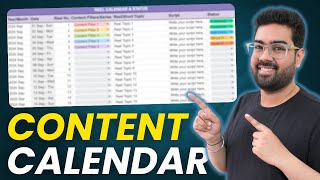
Building a Content Calendar
In 2025, Buffer analyzed 52 million posts and found that accounts skipping even one week of posting consistently underperformed their own baseline growth rates across every major platform. A content calendar is not a nice-to-have organizational tool; it is the single mechanism that separates brands that compound over time from brands that burst and go silent.
Quick Summary
- A content calendar is a shared schedule that maps every post to a date, platform, format, and owner before the week begins.
- Accounts that post 10 or more times per week average 32 additional followers per week compared to weeks with zero posts, per Buffer's 2025 dataset.
- The 70/20/10 split (70% planned, 20% reactive, 10% experimental) is the dominant framework across every major 2025 guide.
- Replying to comments after posting lifts engagement by up to 42% on Threads and 30% on LinkedIn, the calendar has to budget time for this, not just publishing.
- Batch production and a scheduling tool (Buffer, Later, Hootsuite) are the two non-negotiable execution habits.
What It Actually Is
A content calendar is a single source of truth, usually a spreadsheet, Notion database, or scheduling tool, that lists every planned post with: date, time, platform, format, hook or headline, asset filename, and the person responsible. Think of it like a production schedule for a TV show. The writers do not wake up on air day and figure out the episode. Every detail is locked days or weeks in advance so the team can focus on quality, not panic.
Concrete example of one row: Tue 11 Mar, 9:00 AM, LinkedIn, carousel, 'The 3 hires we regret', cover.png, Priya. That single row eliminates a meeting, prevents a missed post, and gives Priya a clear brief. Multiply that across 12 weeks and you have a content machine.
Why It Matters (with data)
The algorithm math is brutal for inconsistent brands. Buffer's State of Social Media Engagement 2025 report, which analyzed over 52 million posts, found that the top 10% highest-engagement accounts posted more frequently and more consistently than median accounts every single week of the year. The gap was widest on text-forward platforms like LinkedIn and X.
Engagement benchmarks by platform in 2025, per Buffer's analysis:
- LinkedIn: 6.2% median engagement rate
- Facebook: 5.6%
- Instagram: 5.5%
- TikTok: 4.6%
- X: 2.5%
Platforms are not equal. LinkedIn carousels hit a 21.77% engagement rate, nearly four times the platform median, making format selection a strategic decision, not a creative one.
According to Sprout Social's Q2 2025 Consumer Pulse Survey, 57% of people on social media say posting original content series is the most important thing brands can prioritize. A content calendar is the only way to sustain a series, because a series requires a commitment made in advance.
Skedsocial's 2025 content calendar guide confirms the 70/20/10 framework (70% planned evergreen, 20% reactive, 10% experimental) as the dominant model used by high-growth accounts. Brands using an evergreen content library of 8-12 foundational pieces and layering seasonal or reactive content on top report more consistent output without burning out their teams.
How It Works: The Playbook
Step 1: Choose your planning horizon
Plan one full month in advance and refresh weekly. Quarterly planning is too rigid to respond to trends. Weekly-only planning keeps you reactive and stressed. Monthly structure plus weekly refresh is the right balance.
Step 2: Define 3-5 content pillars
Pillars are the categories every post maps to. A B2B SaaS might use: customer wins, product education, founder POV, industry data, behind-the-scenes. An e-commerce brand might use: product showcases, UGC/social proof, educational tips, behind-the-brand, promotions. Every post in the calendar must belong to exactly one pillar. If you cannot assign a pillar, the post does not belong in the calendar yet.
Step 3: Set the 70/20/10 content split
Divide your monthly slots before filling any of them:
- 70% planned evergreen content: pillar-driven posts that work any week of the year
- 20% reactive content: leave these slots empty until the week arrives, then fill with trending topics, news responses, or real-time customer stories
- 10% experimental content: new formats, new platforms, new hooks you have not tested before
Duolingo's social team on TikTok, running a pillar-based calendar with a reserved reactive bucket The account needed a way to jump on viral trends fast without abandoning the consistent posting that built its base audience Kept a planned pillar-content foundation running every week while a reserved reactive slot let the team drop trend-responsive posts within hours of a cultural moment emerging
Result: Grew from roughly 100,000 to 1.7 million followers within about a year and reached a 19% engagement rate, well above typical brand benchmarks (within about one year).
SourceStep 4: Commit to a minimum viable cadence
Do not start with daily. Start with three posts per week per platform and hold that cadence for 90 days before scaling up. Missing your own target trains both the algorithm and your audience to expect less. Three reliable posts beats seven followed by silence, every time.
Step 5: Batch produce in one session
Block one 2-3 hour session per week, same day, same time, recurring calendar invite. Use it to draft copy, finalize assets, and schedule the next 7-10 days of posts. Context-switching between creating, designing, writing, and posting is where small teams lose hours. Batching collapses those four modes into one contained block.
Buffer's own marketing team, running its pillar-based editorial calendar on the same scheduler it sells Wanted to prove, with its own accounts, that a batched-and-scheduled calendar outperforms sporadic same-day posting Batched content weekly instead of posting manually, then measured the pattern across 52 million posts from accounts using the same discipline
Result: Maintained top-10% posting-consistency scores across LinkedIn and Instagram for the full year, the highest-engagement tier in the dataset (2025).
SourceStep 6: Schedule, never post manually
Buffer's 2025 data shows manual, same-day posting is the most common reason content calendars fail in execution. Use Buffer, Later, Hootsuite, or the native platform schedulers (Meta Business Suite, LinkedIn Scheduler). The post should already be live by the time you would have remembered to post it manually.
Step 7: Reply to comments within the first 60 minutes
Buffer's 2025 analysis found that replying to comments after publishing delivers significant engagement lifts: 42% on Threads, 30% on LinkedIn, 21% on Instagram, 9.5% on Facebook. Block 15 minutes after each scheduled post time for community management. A calendar that does not budget for replies is leaving engagement on the table.
Step 8: Run a Friday review
Every Friday, spend 20 minutes reviewing the week. Note top-performing and bottom-performing posts by format, pillar, and platform. Kill what flopped. Double down on what worked. Carry one insight into the next week's calendar. Without this loop, the calendar becomes a habit rather than a system.
Buffer ran its 52-million-post analysis for 2025 using the same system it sells. The company operates a pillar-based editorial calendar, batches content weekly, and uses its own scheduler, not inspiration. The result: Buffer's accounts maintained top-10% consistency scores across LinkedIn and Instagram throughout the year. The lesson is simple. The team selling the calendar runs on the calendar.
Real Company Examples
Hootsuite's Always-On Content Engine
Hootsuite publishes daily across LinkedIn, Instagram, and X while maintaining a team of fewer than 10 social media staff. The company attributes this output to a quarterly content calendar mapped to 5 permanent pillars: product education, industry news, community spotlights, data reports, and cultural moments. By batching production two weeks ahead and using its own scheduling platform, the team reduced per-post production time to under 25 minutes by 2024. Their LinkedIn engagement consistently outperforms the platform's 6.2% median benchmark, hitting 8-12% on carousel posts, per publicly shared case studies.
Duolingo's Reactive 20%
Duolingo's social team is frequently cited in 2024-2025 marketing roundups as a masterclass in the 70/20/10 model. About 70% of their content is planned pillar content (language tips, mascot storytelling, product features). The 20% reactive bucket is where the virality happens: the team monitors trends daily and drops the Duo owl into relevant cultural moments within hours. Their TikTok account crossed 10 million followers by Q1 2025 using this structure. The key insight: the reactive posts only work because the 70% foundation keeps the account posting consistently even when no trend is worth jumping on.
The 20% reactive bucket is not improvisation, it is a reserved slot. The difference between Duolingo's viral moments and a brand that embarrasses itself trend-chasing is that Duolingo has a structured decision process for which trends fit their brand pillars. Before filling a reactive slot, ask: does this map to one of our pillars? If not, skip it.
Common Mistakes
- Planning by platform instead of by idea. One strong idea should become a LinkedIn post, an Instagram Reel, and a newsletter blurb. Not three separate ideas invented from scratch for three separate platforms. Start with ideas, then distribute.
- Confusing a calendar with a strategy. A calendar without pillars is just a to-do list. Decide what each pillar is supposed to accomplish (awareness, trust, conversion) before you fill a single slot. The calendar executes the strategy; it does not replace it.
- Locking all 100% of slots. If the entire calendar is planned evergreen content, you cannot respond to a viral moment, a customer win, or a trending topic. The 20% reactive buffer must be genuinely empty until the week arrives.
- Overcommitting in week one. Founders commit to daily posts on five platforms and quit by week three. Start with one primary platform, three posts per week, for 90 days. Prove the system to yourself before scaling.
- Skipping the Friday review. Without a weekly performance loop, you keep scheduling the formats that flop because they were already blocked in the calendar. The review is where the calendar learns.
- Budgeting time for posting but not for replying. Buffer's 2025 data shows up to a 42% engagement lift from replying to comments. If you schedule posts but have no plan for the 15 minutes after each one goes live, you are leaving half the system unbuilt.
Key Takeaways
- Consistency beats volume: 3 reliable posts per week outperform 7 posts followed by two weeks of silence, measured in both algorithmic favor and audience trust.
- The 70/20/10 split gives the calendar structure without making it a cage: 70% planned, 20% reactive, 10% experimental.
- Batch production and scheduling tools are non-negotiable: manual same-day posting is the most common way content calendars fail in practice.
- Replying to comments is part of the calendar, not an afterthought: the first 60 minutes after a post lifts engagement by 21-42% depending on platform.
- Pillars first, slots second: fill the calendar from a strategy document, not from panic in front of a blank grid.
- Run the Friday review every week: the calendar only improves if you feed it data from last week's performance.