Imagine briefing a world-class copywriter who has read every book on marketing ever written, speaks 100 languages, and works at the speed of light. Now imagine that copywriter misunderstands every brief you give them because you never learned how to communicate clearly. That is exactly where most marketing teams sit today with AI: enormous potential, squandered by poor prompting.
Quick Summary
Prompt engineering is the skill of writing precise instructions for AI models so they produce useful, on-brand output. In marketing, this means structuring your prompts with context, role, constraints, and format. Teams that build structured prompt systems see up to 340% higher ROI from AI tools compared to teams that prompt ad-hoc.
Key Takeaways
- The RCTF framework (Role, Context, Task, Format) is the foundation of every effective marketing prompt
- Few-shot prompting (showing examples) improves output quality by 30-50% on average
- Structured prompting reduces AI errors by 76% compared to vague, open-ended instructions
- Prompt libraries, not one-off prompts, are what separate high-performing marketing teams from the rest
Why Prompt Engineering Matters Now
The prompt engineering market was valued at $505 million in 2025 and is projected to reach $6.7 billion by 2034, growing at a 33% CAGR (Precedence Research, 2025). That growth is driven by one hard truth: 78% of AI project failures in organizations are traced back to poor human-AI communication, not model limitations.
Marketing is ground zero for this problem. A 2025 survey of 1,900 marketing professionals found that 62% of firms still have no formal training program for AI prompting. These teams get inconsistent output, burn time on rewrites, and eventually conclude that AI is not ready. The issue is rarely the model.
Structured prompting does not just improve quality. A McKinsey analysis found that marketing teams with documented prompt systems achieved 340% higher ROI from AI tools than teams using ad-hoc prompting.
How It Works: The RCTF Framework
Duolingo Max subscription tier powering the AI Roleplay interactive conversation feature Duolingo needed dynamic, character-driven conversational exercises tailored to individual learner proficiency levels without manually scripting thousands of dialogue trees Engineered structured persona prompts with strict grammar constraints and character backstories for GPT-4, combined with few-shot pedagogical examples
Result: Accelerated course content development speed by 40% and contributed to a 51% surge in Daily Active Users exceeding 40 million (2023-2024 product rollout).
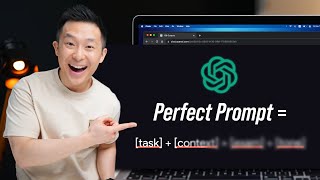
SourceEvery effective marketing prompt has four components. Think of them as the four walls of a brief.
Role tells the AI what expert to embody. "You are a direct-response copywriter specializing in SaaS email campaigns" gets different output than "write an email."
Context gives the AI the information it cannot guess: your brand voice, the audience segment, the product's key differentiator, and any constraints (tone, word count, competitor mentions to avoid).
Task states precisely what you need. One deliverable per prompt. "Write a 60-word subject line and preview text for an abandoned cart email" is a task. "Help me with email" is not.
Format specifies how the output should be structured. JSON, bullet points, HTML, markdown, a numbered list of five options, whatever fits your workflow. If you skip this, you get whatever format the model finds comfortable that day.
Five Prompt Patterns Every Marketer Should Know
1. The Persona Prompt
Assign a specific expert identity before issuing any instruction. The more specific the persona, the tighter the output.
Weak: "Write a LinkedIn post about our new feature."
Strong: "You are a B2B SaaS growth marketer with 10 years of experience writing LinkedIn content for technical audiences. Write a 150-word LinkedIn post announcing a new API rate-limit increase for developers. Lead with the business impact, not the technical spec. Avoid jargon. End with one question to prompt comments."
2. The Chain-of-Thought Prompt
For strategic tasks, ask the AI to reason before it outputs. This dramatically reduces confident-sounding but shallow recommendations.
Pattern: "Before writing the copy, list the three core fears of a first-time online buyer in this category, then write a 100-word product description that addresses each fear."
3. The Constraint Prompt
Restrictions improve output quality. Counterintuitive but consistently true. Constraints force the model away from generic phrasing.
Pattern: "Write a Google Ads headline. Rules: under 30 characters, no exclamation marks, no use of the words 'best', 'leading', or 'innovative', must include the keyword 'inventory software'."
4. The Few-Shot Prompt
Show examples of the output you want before asking for new output. Research from Stanford NLP (2024) found few-shot prompting improves output quality by 30-50% on average across generation tasks.
Pattern:
Here are two subject lines in our brand voice:
- "Your trial ends in 48 hours (here's what you'll lose)"
- "We noticed you skipped onboarding. Let's fix that."

Now write 5 subject lines for a re-engagement campaign targeting users who haven't logged in for 30 days. Match the tone and structure of the examples above.
5. The Iteration Prompt
Never treat the first output as final. Build iteration into your workflow with explicit follow-up prompts.
Pattern: "The second option is closest to what I need. Rewrite it to be 20% shorter, replace the opening question with a bold statement, and make the CTA more urgent without using the word 'now'."
Save your best prompts as templates in a shared document. A prompt library is worth more than any individual prompt. It compounds over time and onboards new team members faster than any training document.
Real Company Examples
Bloomreach built a structured prompt system for their content team. Within six months, content production increased by 113% and organic traffic lifted 40%, without adding headcount. The key was a prompt library with brand-voice context baked into every template, so writers spent time editing and publishing rather than reprompting.
Verizon applied structured prompting to customer service AI. By engineering prompts that incorporated customer history, contract type, and churn risk signals, their system predicted call outcomes with 80% accuracy. The result: 100,000 churn incidents prevented in the first year and a 7-minute reduction in average call handling time. The underlying model did not change. The prompts did.
Common Mistakes Marketers Make
Mistake 1: Treating AI like a search engine. Queries like "best email subject lines" produce generic lists. Prompts like the examples above produce usable drafts.
Mistake 2: No brand context. Without brand voice guidelines in the prompt, every output defaults to the same neutral, slightly corporate tone. Include two or three brand voice adjectives and one example sentence in your context block.
Mistake 3: One prompt, one use. A prompt written for an email subject line will not work for a landing page headline. Match the prompt structure to the specific deliverable.
Mistake 4: Accepting the first output. The first output is a draft, not a deliverable. The iteration prompt pattern above is how professionals use AI. Budget time for two to three rounds of refinement.
Mistake 5: Skipping the format instruction. Without a format instruction, the model decides how to structure output. This creates extra reformatting work downstream, especially when output feeds into a CMS or ad platform.
Mistake 6: Over-prompting in one go. Asking for a homepage, five ad variations, and three email sequences in one prompt produces mediocre output across all of them. One deliverable per prompt, always.
Structured prompting reduces AI errors by 76% (MIT Sloan, 2024), but only if the structure is actually in the prompt. A mental model of what you want is not a prompt. Write it down.
Building Your Prompt Library
Cross-channel marketing workflow connecting Google Sheets, Zapier automation, and OpenAI A lean marketing team needed to scale search-optimized blog posts, email newsletters, SMS alerts, and social copy across multiple public health campaigns Built a centralized prompt template library with fixed brand voice constraints and variable keyword inputs triggered from structured spreadsheet rows
Result: Saved 24 business days of manual drafting time in a single year and achieved #1 organic search rankings for target campaign keywords (Annual campaign cycle).
SourceA prompt library is a shared document (or Notion database, or Slack canvas) where your team stores tested, reusable prompts organized by use case. At minimum, index by:
- Channel (email, paid search, social, landing page, blog)
- Task type (headline, body copy, CTA, subject line, meta description)
- Audience segment (if your prompts vary by persona)
Update the library when a prompt consistently underperforms, and annotate each entry with the model it was tested on. Models update, and prompts that worked six months ago may need revision.