Predictive Analytics for Marketers
Most analytics tools answer one question: "What happened?" A marketer looks at last month's dashboard, sees that conversions dropped on Tuesday, and investigates after the damage is done. Predictive analytics flips this. It uses patterns from historical data to answer a different question: "What is likely to happen next?" That shift from rear-view to windshield is why predictive analytics is one of the fastest-growing areas in marketing technology, with the global market valued at $18.89 billion in 2024 and projected to hit $82.35 billion by 2030 (Statista/MarketsandMarkets).
Quick Summary
- Predictive analytics uses your historical data plus statistical models to forecast future customer behavior before it happens.
- The most valuable use cases for marketers are: churn prediction, lead scoring, customer lifetime value forecasting, and campaign budget optimization.
- You do not need a data science team to start. Google Analytics 4 and HubSpot already have predictive features built in, free to use.
- Amazon's predictive recommendation engine drives up to 30% of total sales. McDonald's Hong Kong used GA4 predictive audiences to cut cost per acquisition by 63% in 2024.
- The biggest mistake marketers make is trusting a model they never validated. Always test predictions against real outcomes.
What Predictive Analytics Actually Is
Predictive analytics is a branch of data analysis that uses statistical algorithms (mathematical formulas that find patterns) and machine learning (software that improves its own predictions the more data it sees) to forecast what a specific customer or group of customers is likely to do next.
The raw ingredients are:
- Historical data, what customers did in the past (purchases, page views, email opens, churn dates)
- A predictive model, an algorithm trained to find patterns in that data
- A prediction output, a score or label for each customer (e.g., "70% likely to churn this month")
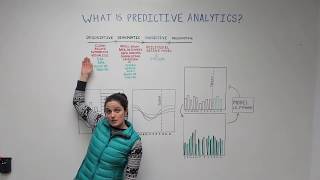
Predictive analytics is different from descriptive analytics (what happened) and diagnostic analytics (why it happened). Predictive analytics is specifically about forecasting the future. A fourth type, prescriptive analytics, goes one step further and recommends what action to take. Most marketing tools combine predictive and prescriptive in the same workflow.
The Five Model Types Every Marketer Should Know
You do not need to build models yourself. But you should understand what type of model is running under the hood so you can interpret the output correctly.
1. Classification Models
These models sort customers into categories. The most common output is a yes/no prediction: will this customer churn or not? Will this lead convert or not?
Example output: "This customer has a HIGH churn risk."
2. Regression Models
These models predict a number rather than a category. How much will this customer spend in the next 90 days? What will our ad campaign revenue be next quarter?
Example output: "Predicted LTV: $420."
3. Clustering Models
These models group customers by similarity without a preset answer. They find patterns you did not know to look for. The output is segments: "Cluster A behaves like this, Cluster B behaves like that."
4. Time Series Models
These models forecast how a metric changes over time. Used for demand forecasting, seasonal budget planning, and traffic prediction.
Example output: "Expect 18% more organic traffic in November based on the last 3 years."
5. Propensity Models
These models score each customer on likelihood to take a specific action. Think of it as a probability meter from 0 to 100. HubSpot's predictive lead scoring is a propensity model.
Example output: "Lead propensity score: 87/100."
The Four Marketing Use Cases That Actually Drive ROI
1. Churn Prediction
Churn (when a customer stops buying or cancels) is expensive. Acquiring a new customer costs 5 to 7 times more than keeping an existing one. A churn prediction model scores every active customer by their risk of leaving in the next 30, 60, or 90 days.
Businesses that implement churn prediction see a 15-25% decrease in customer attrition rates, with a corresponding 20-30% boost in customer lifetime value (CLV).
The model looks at signals like: days since last purchase, declining email open rates, fewer logins, support tickets filed, and payment failures. When a customer crosses a risk threshold, a retention campaign fires automatically.
2. Predictive Lead Scoring
Traditional lead scoring is manual. A marketer decides: "If they visit the pricing page, add 10 points. If they open 3 emails, add 5 points." This is guesswork with a spreadsheet.
Predictive lead scoring feeds your CRM data into a machine learning model. It analyses hundreds of data points from past wins and losses to figure out which signals actually predict a closed deal, not which signals a marketer guessed would matter.
Salesforce reports that companies using its Einstein predictive scoring see 30% higher conversion rates compared to manual scoring.
3. Customer Lifetime Value (CLV) Prediction
CLV is the total revenue a customer is expected to generate over their entire relationship with your business. Predicting CLV lets you make smarter acquisition decisions: spend more to acquire customers who will spend more.
It also lets you segment your marketing budget. Instead of sending the same retention offer to every customer, you send high-value retention offers only to high-CLV customers and low-cost automated flows to everyone else.
4. Campaign Budget Optimization and Attribution
Regression and time series models can forecast how much revenue a given media mix will produce before you spend the money. This is the predictive layer on top of Marketing Mix Modeling (MMM). You test budget allocations in the model first, then spend.
McDonald's Hong Kong, 2024: The team used Google Analytics 4's built-in predictive audiences to target users who had a high purchase probability within the next 7 days. They ran Google Ads campaigns aimed specifically at this predicted segment. Results: 550% increase in app orders and a 63% reduction in cost per acquisition compared to their previous targeting approach. The entire setup used GA4's free predictive features, no custom model required.
Real Company Case Studies
Amazon, Predictive Recommendations
Amazon's recommendation engine is the most commercially successful predictive analytics system in retail history. It uses collaborative filtering (a model that finds customers similar to you and shows what they bought next) combined with purchase history, browsing behavior, and search queries.
The result: predictive product recommendations drive up to 30% of Amazon's total annual revenue. That is not 30% of one campaign, it is 30% of the entire business, predicted and personalized at scale.
Amazon's product pages, homepage, and 'customers who bought this also bought' modules across its retail marketplace Manually curated merchandising cannot scale to hundreds of millions of SKUs and customers with individually different intent Applied collaborative filtering, a predictive model that finds customers with similar purchase and browsing patterns and forecasts what each customer is likely to buy next
Result: Algorithmic recommendations were found to drive 35% of what consumers purchase on Amazon (Ongoing, cited as of Amazon's retail scale in the early 2010s and still referenced as the industry benchmark).
SourceNetflix, Predicted Viewing Preferences
Netflix uses predictive models to decide which shows to surface to each of its 260 million subscribers. The model predicts what any given user will want to watch next based on viewing history, time of day, device, and behavior patterns of similar users.
Over 80% of content watched on Netflix is driven by its recommendation engine, not by active user search. Netflix estimates the system saves over $1 billion per year in customer retention that would otherwise require paid re-acquisition campaigns.
Netflix's homepage and per-title recommendation rows, personalized per subscriber using viewing history, device, and time-of-day signals Reducing subscriber churn is far cheaper than paid re-acquisition once a customer cancels Built a predictive recommendation engine that forecasts what each subscriber is likely to want to watch next, keeping engagement high enough to prevent cancellation
Result: Netflix executives reported the recommendation engine saves the company over $1 billion per year in avoided churn and re-acquisition costs, with over 80% of viewing driven by recommendations rather than search (Ongoing savings estimate reported by Netflix leadership).
SourceThe most common mistake: deploying without validation. A model trained on last year's data may be confidently wrong about this year's customers. Always split your historical data into a training set and a holdout test set before going live. Measure predicted churn against actual churn for 30 days. If your model says "70% churn risk" and 70% of those customers actually churn, the model is working. If only 20% churn, you are sending retention offers to the wrong people and wasting budget.
How to Start Without a Data Science Team
The barrier to predictive analytics has dropped dramatically. Here is a practical starting sequence:
Step 1: Use What You Already Have
Google Analytics 4 includes predictive metrics built into the platform for free:
- Purchase probability (likelihood to buy within 7 days)
- Churn probability (likelihood to stop engaging)
- Predicted revenue (expected revenue from a user in the next 28 days)
GA4 activates these automatically once you have sufficient conversion data (at least 1,000 returning users who triggered the conversion event in the past 28 days).
HubSpot (Professional tier and above) includes predictive lead scoring that analyzes your CRM history to score every contact automatically.
Step 2: Build Predictive Audiences in Your Ad Platforms
Once GA4 identifies high-purchase-probability users, you can export that audience to Google Ads and run campaigns targeting specifically those users. This is predictive targeting without writing a single line of code.
Step 3: Add a Simple Churn Score in Your CRM
Even a basic spreadsheet model counts. Take your last 500 customers who churned. Write down what they had in common: last purchase was over 90 days ago, email open rate below 10%, no login in 60 days. Build a simple scoring rule. This is a rule-based propensity model. It is not machine learning, but it works.
Step 4: Graduate to Dedicated Tools
When you have more data and need more accuracy, look at tools like Salesforce Einstein, HubSpot's AI features, or standalone platforms like Pecan AI or Segments Twilio.
The Data You Need (and How Clean It Has to Be)
Predictive models are only as good as the data they learn from. Garbage in means garbage out.
The minimum viable data set for most marketing predictions includes:
- At least 12 months of customer behavior data
- A clear definition of the outcome you are predicting (churn = no purchase in 90 days, conversion = form submitted, etc.)
- Enough examples of both outcomes (if only 2% of leads ever converted, the model will struggle to find the pattern)
Data quality rules:
- Remove duplicates before training
- Handle missing values explicitly, do not ignore them
- Make sure your historical data reflects current customer behavior, a 5-year-old model trained on pre-pandemic behavior may not apply today
Start with churn prediction rather than CLV prediction. Churn has a clean binary outcome (they left or they did not), which makes model validation straightforward. CLV prediction requires revenue forecasting, which is harder to validate quickly. Win easy first, build confidence in the process, then tackle harder problems.
Key Metrics to Track
When predictive analytics is running, measure these to know if it is working:
- Model accuracy: what percentage of predictions were correct
- Precision: of all the customers you flagged as high churn risk, how many actually churned
- Recall: of all customers who actually churned, how many did your model flag in advance
- Revenue impact: compare cohorts that received predictive-triggered campaigns vs. those that did not
- Cost per retained customer: are you spending less to retain customers than you were before
The One-Line Takeaway
Predictive analytics turns your customer history into a machine that spots who needs your attention before they leave, making every campaign smarter without spending more.