Brand Crisis Management
In 2025, a single food safety video wiped $800 million in market value from a major fast-food chain in six hours, because their response came six hours too late. Speed and preparation are not optional extras in crisis management: they are the whole game.
Quick Summary
- A brand crisis is any event that threatens public trust at scale, from product recalls to viral social content to leadership scandals.
- The average social media crisis costs companies $4.3 million and negative content reaches 50% of its potential audience within 90 minutes (MIT Media Lab, 2025).
- Brands that respond within 15 minutes retain 95% of audience trust. Brands that wait 24 hours retain less than 10%.
- 89% of businesses with a documented crisis plan minimized reputational damage compared to those without one (Amra and Elma, 2025).
- A holding statement published within one hour, even without full facts, is more valuable than a perfect statement published in six.
What It Actually Is
Brand crisis management is the structured process of detecting, assessing, responding to, and recovering from events that threaten public trust in your company. It covers three phases: preparation (before anything goes wrong), response (the first 24-72 hours), and recovery (rebuilding trust over weeks or months).
Think of it like a fire drill. The building you own will almost certainly face a fire at some point. The organizations that survive are not the ones with the best lawyers on call after the alarm goes off, they are the ones who already know where the exits are, who holds the extinguisher, and exactly what to say on the PA system. Crisis management is the fire drill you run before the smoke appears.
Most brands only invest in the recovery phase, which is the most expensive and least effective place to start. The return on preparation is enormous: 73% of brands that invested in crisis management recovered faster after a PR crisis than those that did not (Amra and Elma, 2025).
Why It Matters (with data)
The business case for crisis management is now unambiguous. Here is what the 2025 research shows:
- Trust erodes fast. 65% of consumers expect brands to respond to controversies within one hour on social media (Edelman Trust Barometer). If you miss that window, you are already behind the narrative.
- Silence is the most expensive response. 41% of companies that failed to respond within 48 hours faced lasting reputation damage (Amra and Elma, 2025). That damage compounds: it shows up in acquisition costs, partner confidence, and employee morale.
- Crises are common. 44% of companies experienced at least one major crisis in 2025 (Amra and Elma, 2025). This is not a rare event. It is a statistical certainty for any brand operating at scale.
- Social media accelerates everything. 81% of marketers identify social media as the most critical channel for real-time crisis response (Amra and Elma, 2025). A complaint that would have taken days to reach journalists in 2010 now reaches millions of people in 90 minutes.
- Honesty is rewarded. 83% of consumers prioritize honesty and accountability when evaluating a brand's crisis recovery. 71% abandon brands that deflect responsibility (Amra and Elma, 2025).
- Preparation pays back. 82% of companies with pre-prepared content reduced response delays during actual crises (Amra and Elma, 2025).
The trust retention curve is stark. Responding within 15 minutes keeps 95% of audience trust. Waiting just one to four hours drops that to 55%. At 12-24 hours, you are at 15%. After 24 hours, you are below 10%, and that trust is very hard to rebuild (Institute for Public Relations, via Xpoz, 2025).
How It Works: The Playbook
Effective crisis management follows a four-stage sequence. Each stage has a clear owner and a hard time constraint.
Stage 1: Detect (0-15 minutes)
Set up social listening tools, Brandwatch, Mention, Sprout Social, or even Google Alerts, configured to flag sudden spikes in brand mentions. Define escalation rules in writing so a customer service agent knows exactly when to stop handling something solo and pull in a senior lead. Detection speed is the only variable you fully control before a crisis goes public.
Stage 2: Assess (15-60 minutes)
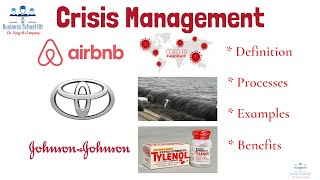
United States, 1982 Tylenol cyanide poisonings Seven people died after cyanide-laced Tylenol capsules reached store shelves, an existential threat to the brand's 35% share of the US over-the-counter pain reliever market. CEO James Burke personally became the single voice of the company, proactively briefing television network heads directly instead of routing through lawyers or issuing 'no comment,' while J&J recalled 31 million bottles nationwide.
Result: Tylenol had recovered 70% of its lost market share within five months of the crisis, a recovery widely credited to consistent, single-source, transparent communication instead of a defensive multi-voice response. (5 months).
SourceNot every complaint is a crisis. Apply a severity score:
- Level 1-2: Isolated complaint or minor negative coverage. Handle via social media or customer service team.
- Level 3: Multiple complaints, local media coverage, or a sensitive topic (diversity, safety, data). Communications lead is notified.
- Level 4-5: National or international coverage, life safety risk, coordinated boycott, or regulatory attention. CEO, legal counsel, and communications lead convene within one hour.
Assign one spokesperson per crisis, not per department. Mixed messaging from multiple voices accelerates damage.
Stage 3: Respond (within 1-4 hours)
Issue a holding statement immediately. This is a short, factual message that:
- Acknowledges the situation directly
- States what action is already underway
- Commits to a specific update time
Example template: "We are aware of reports regarding [issue]. [Audience] safety and trust are our priority. We are actively investigating and will provide a full update by [specific time]."
The specific time commitment is non-negotiable. It forces internal accountability and gives the public a reason to wait rather than amplify speculation. 70% of consumers say a simple acknowledgment within the first hour significantly reduces frustration, even before a resolution is offered (Sprout Social Index, 2025).
Stage 4: Recover (weeks to months)
United Kingdom, 2018 chicken supply-chain shortage A new delivery partner's logistics failure forced KFC to close roughly 750 of 900 UK restaurants for days, with no chicken to serve. KFC ran a full-page apology ad rearranging its own bucket logo to spell 'FCK,' paired with a plain-English explanation and a public switch of delivery partners, sustained with ongoing brand messaging rather than a single statement.
Result: KFC's YouGov brand impression score, which had dropped from -2 to -12 during the crisis, recovered to -1, and positive brand attention rose to 29% from a pre-crisis 7%, with the campaign reaching roughly 1 billion people across press and social within three months. (3 months).
SourceRecovery is not a single press release. It is a sequence of tangible actions:
- Regular transparent updates, even when the news is "we are still investigating"
- A concrete policy, product, or personnel change that shows something actually changed
- Proof-of-change over time: third-party audits, public commitments with measurable targets, or visible leadership behavior shifts
- Reengagement with the specific audiences who were most affected
Words without actions in recovery set you up for a worse second crisis.
Real Company Examples
McDonald's E. coli Outbreak: October 2024
In October 2024, contaminated slivered onions on Quarter Pounders sickened 104 people across 14 US states and killed one person. McDonald's pulled the Quarter Pounder from affected menus the same day the CDC flagged the outbreak and immediately suspended distribution of suspect onions. They communicated openly with investigators and within days launched an alternate supplier to restore the product. Despite this rapid response, foot traffic still dropped nearly 11% and food sales slumped in the following weeks. The lesson: even a fast, transparent response cannot fully prevent short-term damage when the harm is real. But the alternative, delay or deflection, would almost certainly have caused permanent damage. McDonald's brand recovered; the companies that handle outbreaks badly often do not.
Boeing 737 Max 9: January 2024
A door plug panel blew off an Alaska Airlines Boeing 737 Max 9 at 16,000 feet. All 171 passengers survived, but the NTSB investigation found that four bolts meant to hold the plug in place were never reinstalled after maintenance, and Boeing had no records showing the work was done. CEO Dave Calhoun announced he would step down. The crisis compounded years of existing reputational damage from the 737 Max crashes of 2018 and 2019. Boeing's challenge illustrates what happens when a company enters a new crisis with a pre-damaged brand: each incident is evaluated through the lens of the last one. The recovery timeline stretches from months to years, and every subsequent incident is amplified by the accumulated trust deficit.
Delta Air Lines System Failure: July 2024
A major system failure led to over 7,000 flight cancellations across three days and a $550 million loss. Delta's initial response was slow to reach affected passengers directly, and compensation communications were inconsistent. The Department of Transportation launched an investigation into whether Delta had met its refund obligations. This case shows how operational crises become communication crises when the response lags. The system failure itself was recoverable. The perception that Delta was slow to make passengers whole, that is the part that generated regulatory scrutiny and lasting coverage.
Common Mistakes
Mistake 1: The Silence Trap
The most common crisis management error is saying nothing while you "gather more information." Silence reads as guilt. In the absence of your statement, journalists, influencers, and social media users fill the gap with speculation, and their version spreads faster than yours. Issue a holding statement within one hour of detection. You do not need all the answers. You need an acknowledgment, an action statement, and a specific update time.
Mistake 2: Using Passive or Legalistic Language
Phrases like "We regret any inconvenience this may have caused" or "To those who may have been affected" signal that your lawyers wrote the statement, not a human being who takes the situation seriously. 83% of consumers want honesty and accountability in crisis communication. Passive language is read as its opposite.
Mistake 3: Too Many Voices
When multiple executives, departments, or agencies respond separately, each statement gets cross-examined for inconsistencies. Assign one spokesperson. Route all external communication through one channel. Internal disagreements stay internal.
Mistake 4: Confusing Recovery With a Single Statement
Publishing one detailed follow-up and then going silent is not recovery. It is a second silence. Crises require a cadence of updates even when the news is procedural. Audiences who do not hear from you assume nothing has changed.
Mistake 5: Not Running the Pre-Mortem
Only 24% of companies have implemented documented social media policies (Amra and Elma, 2025). The other 76% are improvising during the highest-stakes communication moments of their brand's life. A two-hour annual pre-mortem session, where your communications, legal, and product teams map the five most likely crises and draft holding statements in advance, cuts actual response time from hours to minutes.
Mistake 6: Treating Every Crisis as a Reputation Problem
Some crises are operational failures first and reputation problems second. If your product harmed someone, the first priority is stopping the harm and making it right, not managing the narrative. Brands that get this sequence backwards (reputation management before harm reduction) tend to face regulatory consequences and second-wave media coverage that is worse than the original incident.
Key Takeaways
- A crisis does not end your brand. A slow, silent, or dishonest response does.
- Negative content reaches 50% of its total potential audience within 90 minutes. Your response window is measured in minutes, not days.
- Waiting 24 hours to respond leaves you with less than 10% of audience trust retained.
- 89% of businesses with documented crisis plans minimized damage. The plan is the competitive advantage.
- Issue a holding statement even without full facts. Acknowledge, act, and commit to a specific update time.
- Recovery requires tangible changes, not just apologies. Words without actions make the next crisis worse.