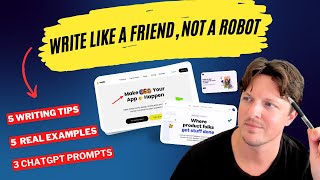
Your reader is a human. Not an audience. Not a user. A person sitting alone, reading your words on a screen. Conversational copy acknowledges that intimacy. It sounds like a friend explaining something over coffee, not a corporation issuing a memo.
Why does this matter for conversion? Trust. Cognitive load. Safety. Corporate copy feels threatening because it sounds like someone has something to hide. Conversational copy feels safe because it sounds honest.
Why Conversational Copy Converts Better
Corporate copy creates distance. "Utilizing our platform's advanced capabilities enables stakeholders to optimize operational efficiency." What? Your brain hits a wall. You re-read. You leave.
Conversational copy closes distance. "We help teams get their work done faster. No complicated setup required." Your brain relaxes. You keep reading.
Distance triggers three psychological brakes. First, reduced trust: formal language signals institutional power imbalance. You're not sure if the company is being truthful or hiding something in jargon. Second, cognitive load: your brain burns energy translating jargon into meaning. You have finite attention; waste it on translation, lose it to distractions. Third, reduced perceived safety: formal tone suggests rules and penalties. Conversational tone suggests partnership.
Conversational copy reverses all three. It says, "This person knows what they're talking about and isn't hiding behind buzzwords." Your brain trusts faster, works less hard, and feels safer exploring the offer.
The Five Techniques of Conversational Copy
Contractions. Write "don't" not "do not." Write "it's" not "it is." Contractions compress language and mimic how humans actually speak. Without contractions, you're already sounding formal. Professional doesn't require formality.
Second person. Use "you" and "your" liberally. Never use "users" or "customers" when you're talking to them directly. "Users benefit from automated workflows" feels detached. "You'll spend 70% less time on admin work" puts the reader at the center, where they already are in their own mind.
Short sentences. The average conversational sentence is 15–17 words. Corporate copy averages 25+. Shorter sentences breathe. They're easier to scan. They feel more confident (long sentences often sound uncertain, hedged, backpedaling). Read yours aloud. If you need a second breath, break it.
Fragments for emphasis. "Really." "Done." "No surprises." Fragments violate grammar rules, and that's the point. They sound like natural speech. They land harder because they're unexpected. Use them sparingly, three or four per 500 words, or they lose impact.
Questions that mirror internal monologue. Your reader's brain is already asking questions. "Will this actually work?" "How long will setup take?" "What if I hate it?" Answer those unspoken questions by posing them first. "Worried setup will take weeks? Most teams are live in 48 hours." The reader feels heard.
The Read-Aloud Test
Before hitting publish, read your copy out loud. Not in your head, actually speak it. If it sounds weird, it's too formal. If you stumble over a phrase, your readers will too.
Corporate copy fails the read-aloud test. "We leverage synergies across verticals to drive meaningful outcomes." Try saying that to a friend at dinner. You'd feel ridiculous. That's your signal that the writing is broken.
Conversational copy passes. "We help teams work together better." That sounds fine spoken. That's the standard.
Diagnosing Corporate Copy Disease
Most websites are sick with corporate copy disease. Here's what to look for:
Passive voice: "Mistakes were made" instead of "We messed up." Passive voice diffuses responsibility and creates distance. Use active voice where the subject acts.
Nominalisation: "We utilise analytics platforms for the optimisation of user engagement" instead of "We use analytics to engage users." Nominalisation converts verbs (use, engage, improve) into nouns (utilisation, engagement, improvement). It's stuffy and wordy. Use verbs instead.
Hedge words: "potentially," "somewhat," "arguably," "in some cases." These weaken your message. If something is true, say it. If you're not sure, find out before publishing. Hedge words signal uncertainty and erode trust.
Buzzword stacking: "Cutting-edge, synergistic, best-in-class solutions." These phrases mean nothing. They're the writing equivalent of static. Readers skip them.
From Corporate to Conversational: A Worked Example
Original (corporate): "Our platform facilitates the optimization of marketing workflows through intelligent automation, enabling teams to achieve superior outcomes via streamlined processes."
Issues: passive voice ("is facilitated"), nominalisation ("optimization," "automation," "outcomes"), buzzwords ("intelligent," "superior"), no "you," no contractions, 26 words of filler.
Rewrite (conversational): "We automate your marketing workflows so your team can focus on strategy. You'll get more done in less time. No busywork. Just results."
Changes: active voice (we automate), verbs not nouns (automate vs automation), removed buzzwords, added "you," added contractions, broke into short sentences (12, 18, 8 words), fragments for emphasis ("No busywork. Just results.").
The rewrite is 40% shorter, clearer, more trustworthy, and easier to read aloud. That's the pattern.
When NOT to Be Conversational
Legal disclaimers require formal language. "By clicking below, you accept our Terms and Conditions" must be bulletproof legally. Conversational tone in legal copy creates liability.
Crisis communications demand formality. "We screwed up and here's how we're fixing it" might sound honest, but during a crisis, stakeholders need certainty. Formal, clear language signals control.
Technical documentation for expert audiences can stay formal. A developer reading API docs expects precision over friendliness. They're in an analytical headspace, not a decision headspace.
But everywhere else, marketing copy, onboarding flows, payment confirmations, error messages, landing pages, conversational wins.
Voice and Tone: The Same Brand, Different Register
Conversational doesn't mean the same tone everywhere. Your homepage voice might be enthusiastic and casual. Your 404 error page voice might be witty but brief. Your payment confirmation voice might be warm and reassuring.
This is the spectrum of conversational register. It's all conversational, all human, all trustworthy, but the energy and attitude shift based on context.
Build a simple voice guide: three short paragraphs describing your brand's personality. Is it playful? Serious? Educational? Irreverent? Then describe how that personality shifts: What does it sound like during customer success (warm, patient)? During product updates (excited, transparent)? During account billing (clear, no surprises)? Different contexts, same brand essence.
That consistency creates familiarity. Your customers recognize you across every touchpoint because your voice feels steady, even when the tone modulates.