Abandoned Cart and Browse Flows
Imagine 100 people walking into your store, picking something off the shelf, and then 75 of them putting it back and walking out without buying. That is exactly what happens online every day. The global cart abandonment rate hit 75.38% in 2025 (Baymard Institute, via Analyzify). Abandoned cart emails are the most direct way to bring those shoppers back, and they generate more revenue per send than any other automated email type.
Quick Summary
- About 75% of shoppers who add items to a cart never complete the purchase, abandoned cart emails win back a portion of that revenue at zero extra acquisition cost
- Three-email sequences generate 6.5x more revenue than single-email flows (Klaviyo 2024 benchmark data)
- Send the first email within 30-60 minutes of abandonment; every hour of delay costs conversions
- Never offer a discount in Email 1, it trains shoppers to abandon carts on purpose to get the coupon
- Browse abandonment flows reach the 95% of visitors who showed interest but never added anything to cart
Why Abandoned Cart Emails Are the Highest-ROI Email You Can Send
Every visitor who abandons a cart already cost you money. You paid for the ad click, the SEO ranking, or the social post that brought them to your site. The acquisition cost (the money spent getting a visitor to your store) is already spent. A recovery email turns that sunk cost into actual revenue.
The numbers back this up. Klaviyo's 2024 benchmark report found that abandoned cart flows drive:
- A placed order rate (share of emails that lead to a purchase) of 3.33%
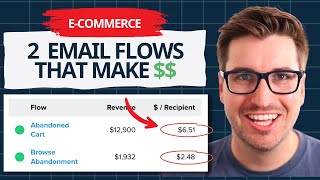
- Average revenue per recipient of $3.65, the highest of any automated email flow
- High-performing brands push that figure to $28.89 per recipient
Amundsen Sports (a Norwegian outdoor apparel brand) saw their abandoned cart flow account for 10.8% of total Omnisend-attributed revenue in 2025, from just 0.9% of total sends. That is a wildly efficient use of email.
The global cart abandonment rate in 2025 was 75.38% on average, but mobile shoppers abandon at an even higher rate of 80.2%. If a large portion of your traffic is mobile, your recovery emails need to be mobile-first in design: large product images, short copy, and a thumb-friendly CTA button.
Why Shoppers Abandon in the First Place
Before writing any recovery email, understand what you are recovering from. The most common reasons shoppers bail (Baymard Institute, 2024):
- Unexpected extra costs like shipping, taxes, or fees: 48% of abandoners
- Having to create an account before buying: 25%
- Price comparison (checking if the item is cheaper elsewhere): 30%
- Slow or uncertain delivery times: 24%
- Website errors or a checkout that is too long: 22% and 17% respectively
Knowing this tells you what to put in your emails. Email 2 should address the top objections for your specific product. If you sell apparel, mention your return policy. If you sell electronics, highlight your warranty.
The Standard 3-Email Cart Abandonment Flow
Email 1: The Reminder (30-60 minutes after abandonment)
Show the exact item left in the cart. Include a product image, the product name, the price, and a clear "Return to cart" button. Keep copy short, two or three sentences maximum. No discount.
Most first-time abandoners were genuinely distracted (their phone rang, the meeting started, their Wi-Fi dropped). A simple reminder converts this group without giving away margin.
Subject line examples that work:
- "You left something behind"
- "Still thinking it over, [First Name]?"
- "[Product name] is waiting in your cart"
Email 2: Social Proof and Objection Handling (22-24 hours later)
Reinforce the purchase decision with customer reviews, star ratings, or user-generated photos. Address the most common objection for your product. Free shipping offer goes here if it is operationally possible. No percentage discount yet.
Creality Store (a 3D printer retailer) achieved a 54% open rate and 8.25% click rate on their second cart email in 2025 by pairing a product image with a visible trust badge and a 24-hour countdown showing a 5% discount. Their approach: make the offer feel time-pressured without being aggressive.
Email 3: Urgency or Incentive (48-72 hours later)
Create real scarcity ("Only 3 left in stock", only say this if it is true) or offer a one-time incentive. A 10-15% discount or free expedited shipping both work. Make the offer explicitly time-limited (expires in 24 hours). This is your final recovery attempt.
Do not offer a discount in Email 1 or Email 2. Brands that lead with discounts train their best customers to abandon carts intentionally to collect coupons. Analysis across multiple ESP (email service provider) datasets shows that leading with a discount recovers roughly the same number of carts as waiting, but at 10-15% lower margin on every recovered sale. Hold the incentive until Email 3.
Browse Abandonment: Reaching the Other 95%
Custom closet-system ecommerce brand running Klaviyo browse abandonment flows iOS privacy changes were causing browse-abandonment events to go untracked, so shoppers who viewed products never entered the flow Deployed Polar Analytics' Klaviyo Flows Enricher to recapture missed browse-abandonment events, especially during the launch of a new wardrobe product line with a high browse-to-no-cart rate
Result: 54% increase in Browse Abandonment Flow email revenue, with 4,188 additional flow emails sent (28 days).
SourceOnly 3-5% of ecommerce visitors ever add anything to a cart. Browse abandonment flows reach the other 95% who looked at a product page but never took any action. Since these visitors gave a weaker buying signal, the tone must be softer.
Email 1 (1-4 hours after browsing): Reference the product or category they viewed. Keep it low-pressure. No incentive.
Email 2 (24-48 hours later): Add social proof, editorial content ("why customers love this"), or a "customers also bought" block to build interest.
Email 3 (3-5 days later): Light urgency. Mention limited stock or a related promotion. A small incentive (free shipping) is acceptable here.
A Real Worked Example
Amundsen Sports (outdoor apparel, Norway) ran their abandoned cart automation through Omnisend in 2025. Their flow accounted for 10.8% of all email-attributed revenue while representing only 0.9% of total email sends. The math: their cart emails were about 12 times more revenue-efficient per send than their broadcast (bulk) emails. Their approach included a product-focused Email 1 at 45 minutes, a user review block in Email 2 at 24 hours, and a free shipping offer in Email 3 at 72 hours, no discount code. The free shipping offer in Email 3 added the incentive without training shoppers to expect a percentage off.
Technical Requirements Before You Launch
Skincare and lifestyle ecommerce brand using Klaviyo for cart and browse abandonment flows A large share of returning shoppers were arriving anonymously (no cookie match, no logged-in session), so they never qualified for existing abandonment flows even though they had shopped before Added Tie's visitor identification layer on top of the existing Klaviyo setup to re-identify returning, previously-anonymous shoppers and route them into abandoned cart and browse abandonment flows
Result: 18% more Klaviyo profiles qualified for abandonment flows, recovering $520,947 in revenue across 4,754 orders (not disclosed in the published case study).
Source-
Identity resolution: The shopper must be both cookied (tracked via browser cookie) and identified (logged in, or has submitted their email before). Anonymous visitors cannot receive triggered email. This is why capturing email at cart entry matters.
-
ESP-to-store integration: Platforms like Klaviyo, Omnisend, Drip, and ActiveCampaign have native Shopify and WooCommerce connectors. They fire the trigger automatically when cart abandonment is detected.
-
Suppression logic: Cancel the entire sequence the moment the shopper completes a purchase. Sending a recovery email to someone who already bought is a trust-damaging error. Also suppress anyone currently in a welcome series to avoid message collision.
-
Dynamic product blocks: Email 1 must display the exact product(s) in the cart using live product data pulled from your catalog. A static email without the cart contents converts far worse.
-
Send-time logic: Avoid sending between 10 PM and 6 AM. If someone abandons at midnight, queue the Email 1 for 7 AM the following morning. Omnisend's 2025 data shows peak open rates at 8 PM, scheduling around that window improves performance.
Segment your cart abandonment flow by cart value. Shoppers with a cart over $200 respond better to a personal Email 2 written in a conversational tone, from the founder or a support rep who offers to answer questions directly, rather than a polished promotional template. High-ticket abandoners often have specific objections about sizing, return policy, or whether the item will be right for them. A helpful, direct tone outperforms a promotional one for this segment.
Key Metrics to Track
| Metric | Industry Average (2025) | Strong Performance |
|---|---|---|
| Open rate | 35-39% | 50%+ |
| Click-through rate | 8-23% | 25%+ |
| Conversion rate | 1.5-3.3% | 5%+ |
| Revenue per recipient | $2.54-$3.65 | $10+ |
| Average recovered order value | $168 | varies |
Data sources: Omnisend 2025, Klaviyo 2024 benchmark report, Analyzify 2025.
The One-Line Takeaway
Send a reminder at 60 minutes, add social proof at 24 hours, and hold the discount until 72 hours, those two extra emails will recover 6.5x more revenue than sending just one.