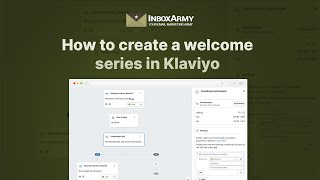
The Welcome Series
A welcome series is an automated sequence of emails sent to new subscribers in the days right after they join your list. Unlike a single welcome email, a series uses multiple touchpoints to introduce your brand, build trust, set expectations, and nudge the subscriber toward a first purchase or meaningful action. "Automated" is the key word: once you set it up, every new subscriber receives the same carefully crafted journey without any manual effort from your team.
Quick Summary
- Welcome emails average a 51% open rate, higher than any other email type (Klaviyo, 2025).
- A series of 3 emails generates up to 90% more orders than a single welcome message.
- Send Email 1 within 5 minutes of signup while attention is at its peak.
- Use Email 1 to welcome, Email 2 to build trust, Email 3 to convert.
- Add a conditional split so buyers automatically skip the discount email.
Why Welcome Emails Are Special
Your subscribers are never more interested in you than the moment they sign up. That interest drops off fast. Research from Klaviyo shows that most subscribers who will ever buy from you do so within 10 days of joining your list. That window is your highest-leverage opportunity in all of email marketing.
Welcome emails get 4x higher open rates and 5x higher click-through rates than standard marketing emails (Omnisend, 2024). The average welcome email open rate across the industry sits at 51%, compared to around 21% for regular campaigns. Your audience is primed. A weak welcome series throws that away.
Why a Series Beats a Single Email
Most brands send one welcome email. That is a mistake, and it is a measurable one.
- A series of 3 welcome emails generates 90% more orders than a single message (Klaviyo, 2025).
- Sending multiple welcome emails drives 51% more revenue per new subscriber than one email alone (Omnisend, 2024).
- Welcome flows generate an average of $2.35 revenue per recipient across Klaviyo accounts.
- Automated emails make up just 2% of total email volume but drove 37% of all email-generated sales in 2024.
Think of it this way: a single email is a hello. A series is a relationship.
Real-World Results
Island Olive Oil (a specialty food ecommerce brand) built a three-email welcome series and measured the results against their standard promotional emails. The welcome series produced a 998% higher click rate, an 11% average conversion rate, and a 3,274% revenue lift per email (Omnisend case study, 2024). This is not an outlier, it reflects what happens when a brand shows up consistently in the first week instead of going silent after one generic "thanks for subscribing" message.
Vitrazza (a glass office chair mat brand) worked with an email agency to rebuild their welcome flow. Within four months, the new welcome series generated $564,200 in incremental revenue. Email open rates for the welcome flow exceeded 50%, click-through rates improved by 20%, and overall email revenue rose by 55%. The key changes: a better brand story in Email 2, single-use personalized discount codes in Email 3, and a conditional split that sent buyers to a post-purchase flow instead of the discount email.
How the Series Works
The standard welcome series structure (based on Klaviyo's analysis of thousands of ecommerce accounts) is three emails delivered over seven days. For B2B or content brands, four to six emails spaced two to three days apart is common. Here is the framework high-performing brands follow:
Email 1, Immediate (within 5 minutes of signup) Confirm the subscription, deliver any promised incentive (a discount code, lead magnet, or free guide), and introduce your brand in one or two sentences. Keep it short. This is not the email to sell. It is the email to say "you are in the right place."
Subject line patterns that work: "Here's your [X]% off code," "Welcome, here's where to start," "You're in. Here's what happens next."
Email 2, Day 2 or 3 Tell your brand story or address the subscriber's core problem. This is the "why we exist" email. Include social proof (reviews, press mentions, customer numbers) to build credibility. A good Email 2 answers the unspoken question every new subscriber has: "Can I actually trust these people?"
42% of consumers say brand values matter more to their buying decisions in 2025 than they did before (Klaviyo). Use Email 2 to show what your brand stands for.
Email 3, Day 5 to 7 Convert. Restate the offer (if there is one), add urgency, and make the call to action unmissable. Use single-use, personalized discount codes generated per subscriber rather than a shared code that can leak onto coupon sites.
Conditional Splits: The Feature Most Brands Ignore
A conditional split (a branch in your automation that sends different emails based on what a subscriber did) is the single highest-impact feature in a welcome series. Every major platform supports it: Klaviyo, Mailchimp, ActiveCampaign, ConvertKit.
The most useful splits to add:
- Has the subscriber purchased already? If yes, skip the discount email and send a post-purchase onboarding email instead. This prevents the awkward experience of someone buying at full price and then immediately receiving a 15% off code.
- Did the subscriber open Email 1? If not, send a resend with a new subject line 24 hours later. This one tactic alone can recover 20 to 30% of subscribers who missed the first email due to inbox clutter.
- What lead magnet did they sign up for? If you have multiple opt-in offers, tailor the welcome series content to match what they originally wanted.
Subject Line Strategy
Welcome email subject lines should be direct and expectation-setting. Avoid clickbait. The subscriber already opted in, they do not need to be tricked into opening. Keep subject lines to around 7 words. Personalize by acquisition source (how they found you) rather than just their first name.
High-performing subject line patterns from 2024-2025:
- "Here's what to expect from us"
- "Your [X]% off code is inside"
- "Welcome, here's where to start"
- "[First name], your download is ready"
Why This Also Protects Your Deliverability
Deliverability (whether your emails land in the inbox or get sent to spam) is determined partly by how Gmail and Outlook rate your sender reputation. A subscriber who opens and clicks your welcome email signals to those inbox providers that your mail is wanted. That early positive signal protects all your future sends, not just the welcome series.
Subscribers who never open your welcome series are unlikely to engage with anything later. Identifying them after the series ends lets you suppress or re-engage them before they drag down your sender score.
The Timing That Matters Most
74% of people expect to receive a welcome email immediately after subscribing (Omnisend, 2024). If you wait hours or days to send Email 1, a significant portion of your list will have already forgotten who you are.
- Email 1: Within 5 minutes of signup (use trigger-based sending, not batch delivery)
- Email 2: 2 to 3 days after Email 1
- Email 3: 5 to 7 days after signup
During the welcome series, suppress these subscribers from your regular campaign sends. You do not want to confuse someone mid-welcome-flow with an unrelated promotional blast.
Common Mistakes to Avoid
Mistake 1: Sending only one email. The data is unambiguous: a series of three outperforms a single welcome email on every metric. One email is a hello. Three emails build the kind of familiarity that drives purchases.
Mistake 2: Putting the discount in Email 1 and stopping there. If your entire welcome strategy is "give them 10% off immediately," you are training subscribers to wait for discounts and skipping the brand-building that creates loyal customers. Deal-hunters take the code and unsubscribe, hurting your list quality with no long-term value. Reserve the discount for Email 3 after you have had a chance to tell your story.
Mistake 3: Sending your welcome series AND your regular campaigns at the same time. New subscribers will receive a disjointed mix of onboarding and promotional content. Suppress them from regular sends until the series is complete.
Mistake 4: Using a shared discount code. A single code that goes to every subscriber will end up on coupon aggregator sites within days. Use single-use codes generated per subscriber, every major email platform supports this.
The One-Line Takeaway
A three-email welcome series set up once converts strangers into customers every single day, without you ever touching it again.