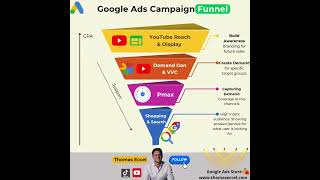
What Is Demand Gen (And What Did It Kill)?
Google Demand Gen officially replaced Discovery Ads in March 2024, then absorbed Video Action Campaigns in July 2025. If you ran Discovery campaigns before, every single one was auto-migrated, you are already running Demand Gen whether you know it or not.
The core idea: reach people who are close to wanting something but haven't searched yet. Think of it as the gap between a YouTube pre-roll building brand awareness and a Google Search ad capturing ready-to-buy intent.
Discovery Ads only supported image and carousel formats. Demand Gen adds video, lookalike audiences, carousel ads, enhanced conversion-lift reporting, and AI-powered creative optimisation, all in one campaign.
Where Your Ads Actually Show
Demand Gen runs across four Google-owned surfaces, all inside a single campaign:
- YouTube in-feed, appears in search results and the homepage feed
- YouTube Shorts, vertical video, up to 60 seconds
- YouTube in-stream, skippable pre-roll before videos
- Gmail, collapsed native-style ads in the Promotions and Social tabs
- Google Discover, the personalised content feed on Android home screens and the Google app
This inventory totals over 3 billion monthly users. The strength is that these are logged-in, identity-verified users, Google knows their purchase history, search behavior, and app usage. That signal quality is what separates Demand Gen targeting from most social platforms.
The Mid-Funnel Position
LG Electronics ran Google Demand Gen campaigns to reach appliance and electronics shoppers earlier in their research journey than Search ads could reach them, comparing results directly against its paid social prospecting campaigns. LG wanted a channel that could warm consideration-stage shoppers who weren't searching yet, without paying paid-social CPMs for the same audience quality. LG shifted mid-funnel prospecting budget from paid social into Demand Gen, using Google's cross-surface YouTube, Discover, and Gmail inventory to reach the same behavioral-intent audience.
Result: 91% lower cost per acquisition and 48% higher click-through rate than its paid social campaigns (2025 Google Ads case study).
SourceDemand Gen sits between brand awareness campaigns (YouTube reach, Display) and bottom-funnel campaigns (Search, Performance Max). The people it targets are not actively searching but show behavioral signals that suggest they are in a consideration phase.
A consumer who watched three cooking videos and browsed a meal-kit site last week is a textbook Demand Gen target for a food brand. They are not Googling "meal kit delivery" yet, but they are open to the idea.
This mid-funnel positioning means Demand Gen works best as a feeder for Search and Performance Max. It warms audiences who later convert through lower-funnel campaigns.
Campaign Setup: Audiences That Matter
The three audience strategies that drive the best Demand Gen results:
Customer Match, upload your CRM list (emails, phone numbers). Google matches these to logged-in accounts. Use this to re-engage lapsed customers or build seed lists for lookalikes.
Lookalike Audiences, Google's equivalent of Meta's "Lookalike" feature, rebuilt for Demand Gen in 2023. You provide a seed list (your converters, your best customers), and Google finds users with matching behavioral profiles. Sizes range from narrow (close match) to broad (wider reach).
Optimised Targeting, when enabled, Google expands beyond your defined audiences if it predicts a conversion is likely. Best for accounts with 50+ conversions per month; risky for accounts with sparse data.
Start with Customer Match as your seed list. A CRM list of 5,000+ matched emails gives Google enough signal to build a high-quality lookalike. Never launch Demand Gen cold with only interest categories.
Creative Requirements
Away, the DTC luggage brand, ran a Demand Gen campaign during its 2025 holiday push and used Demand Gen's Creator partnerships boost feature to run YouTube creator Emma Topp's travel content as ad creative. 78% of U.S. viewers say YouTube has the most trusted creators for product recommendations, and Away wanted creative that read as trustworthy content, not a traditional ad, inside a mid-funnel campaign. Away supplied Emma Topp's organic travel content as Demand Gen creative alongside its own video and image assets, targeting travel-savvy audiences already engaging with creator content.
Result: A Google Conversion Lift study showed a 78% jump in incremental sales and a 16% lift in brand searches, with engaged site visits up 230% and add-to-carts up 140% (Holiday 2025 campaign).
SourceDemand Gen supports more format variety than any prior Google campaign type. You need to supply all of these to let the algorithm find the best-performing combination:
Video (required for YouTube placements):
- Landscape (16:9), minimum 5 seconds, ideal 15–30 seconds
- Portrait (9:16), for YouTube Shorts; same duration rules apply
- Square (1:1), optional but recommended for feed placements
Images:
- Landscape 1200×628, for Discover and Gmail
- Square 1200×1200, for multi-surface compatibility
- Portrait 960×1200, optional
Carousel: 2–10 cards, each with its own image, headline, and URL. Works well for product catalogues and sequential storytelling.
The algorithm needs contrast between formats to test effectively. Uploading one video and two images is not enough, provide at least two videos in different aspect ratios and three to four image variants.
Bidding: Two Modes, Different Jobs
Demand Gen supports two bidding strategies:
Maximize Conversions, Google spends your full budget to drive as many conversions as possible, with no cost-per-conversion target. Use this during the learning phase (first 2–4 weeks) or when your CPA data is thin.
Target CPA (tCPA), you set a cost-per-conversion ceiling and Google optimises toward it. Switch to tCPA once you have at least 50 conversions in the last 30 days. Setting tCPA too low too early causes under-delivery.
A practical rule: launch with Maximize Conversions, let it run for 3–4 weeks, review your actual CPA, then set tCPA at 20–30% above that observed CPA. Tighten the target over the next 4–6 weeks as data accumulates.
Demand Gen vs Performance Max: The Actual Difference
This is the most common point of confusion. Here is the clean version:
| Demand Gen | Performance Max | |
|---|---|---|
| Funnel stage | Mid-funnel (consideration) | Full-funnel, skews bottom |
| Inventory | YouTube, Gmail, Discover | All Google channels including Search, Shopping |
| Audience control | High, you define and manage audiences | Low, Google decides targeting |
| Creative control | High, you choose which formats run | Low, Google mixes assets automatically |
| Best for | New audience prospecting, re-engagement | Maximising conversions from existing demand |
Performance Max is aggressive about bottom-funnel traffic and will cannibalise Search campaigns if left unchecked. Demand Gen will not, it stays in its inventory lanes and respects your audience definitions.
The 2025 consensus from Google itself: run both. Demand Gen fills the top of the funnel with warmed prospects; Performance Max and Search close them. Advertisers running Demand Gen alongside Performance Max reported a 26% increase in conversions per dollar in 2025 versus Performance Max alone.
Do NOT use Performance Max as your only prospecting tool. It optimises for conversions, which means it will mostly reach people already close to buying, it cannot build new demand. That is Demand Gen's job.
Real Benchmarks to Plan Against
Based on 2025–2026 industry data across e-commerce and lead-gen accounts:
- CTR: 0.5%–2.0%, higher on YouTube in-feed, lower on Gmail and Discover
- CPC: $0.30–$1.50 depending on vertical and competition
- CPM: Demand Gen on YouTube Shorts runs ~40% lower CPM than comparable Meta Reels placements (Google-cited figure, confirmed by independent agency data)
- Conversion rate: 0.5%–2.0% for product-feed campaigns actively optimising for conversions
- ROAS: 2x–5x after the learning period stabilises
An e-commerce brand selling $60 supplements ran Demand Gen with a lookalike audience seeded from 8,000 purchasers. After a 3-week learning phase on Maximize Conversions, they switched to tCPA at $28. By week 8, CPA was $19 with a 3.2x ROAS, outperforming their Meta prospecting campaigns at a lower CPM.
What to Watch in Your Dashboard
Three metrics that tell you if Demand Gen is working:
- View-through conversions, users who saw your ad but converted later via another channel. A high view-through rate means your creative is building intent even without direct clicks.
- New visitor rate, available in GA4 when you link your account. If Demand Gen is not bringing in new visitors, your lookalike seed is too narrow.
- Assisted conversions, in the conversion path report, how often does Demand Gen appear before a Search or Shopping conversion? High assisted conversion numbers confirm the mid-funnel thesis is working.
If you see high impressions and low CTR, the creative is the problem, not the audience. Demand Gen creative needs a hook in the first 3 seconds for video and a clear value proposition in the image headline.