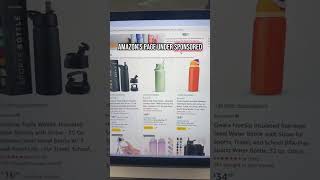
Why Amazon Ads Are Different
Google captures intent. Meta captures attention. Amazon captures wallets.
When someone searches on Amazon, they are not browsing, they are shopping. That purchase intent is why Amazon has become the third-largest digital advertising platform globally, behind only Google and Meta. In 2025, Amazon's ad business generated over $56 billion in revenue, representing 11% of total global digital ad spend, and Q3 2025 alone hit $17.7 billion, a 24% year-over-year jump.
The conversion rate tells the story: Amazon ads convert at nearly 10%, compared to 1–3% on most other platforms. Shoppers on Amazon already have their credit card saved and their Prime membership active. Your job as an advertiser is simply to show up at the right moment.
The Three Core Ad Types
HP's EMEA retail media team added Sponsored Brands video to its existing Sponsored Products and Sponsored Brands mix across its Amazon storefronts. Static Sponsored Brands banners were driving clicks but not showing shoppers the product in use, a gap video could close at the moment of comparison shopping. HP built Sponsored Brands video creative for its printer and laptop categories and scaled investment behind the format year over year.
Result: 80% year-over-year increase in revenue and a 60% increase in units sold, with purchase paths that included video showing a 954% higher purchase rate for printers and a 709% higher purchase rate for laptops (Year-over-year 2023 results).
SourceAmazon's self-serve advertising breaks into three formats, each serving a different goal in the purchase funnel.
Sponsored Products are the workhorses, keyword-triggered ads that appear in search results and on product detail pages, looking nearly identical to organic listings. They are the best starting point for any new advertiser because they drive direct sales with measurable return.
Sponsored Brands let you advertise your brand, not just a single product. They appear as a banner at the top of search results with your logo, a custom headline, and up to three products. Use these to capture category-level searches and pull shoppers into your brand store.
Sponsored Display extends reach beyond search. These ads retarget shoppers who viewed your product but did not buy, and can appear on Amazon, third-party sites, and apps. Think of it as Amazon's built-in retargeting layer, no pixel setup required.
Amazon DSP: Beyond the Marketplace
Amazon DSP (Demand-Side Platform) is a different beast entirely. It is a programmatic ad-buying platform that uses Amazon's first-party shopping data to reach audiences anywhere on the web, not just Amazon.com.
DSP unlocks access to streaming TV via Amazon Fire TV, audio ads on Amazon Music, and display ads across thousands of third-party publishers. The key advantage is the data: Amazon knows what people searched, viewed, and bought. That makes DSP audience targeting far richer than cookie-based retargeting on other platforms.
DSP has traditionally required a minimum spend of $35,000 through a managed service, though Amazon has been opening self-serve access to smaller advertisers. Even brands that do not sell on Amazon use DSP to reach Amazon audiences and drive traffic to their own sites.
Keywords and Bidding: Not Like Google
Amazon keyword match types look similar to Google's but behave differently. Broad, phrase, and exact match all exist, but Amazon's broad match is more literal, it does not expand to synonyms the way Google does. You need to be explicit with your keyword list.
The real power move on Amazon is the auto vs. manual campaign split. An auto campaign lets Amazon's algorithm find keywords for you by matching your product listing to relevant searches. A manual campaign gives you full control over which keywords you bid on and at what price.
The pro strategy: run auto campaigns to discover converting search terms, then mine the search term report weekly to identify winners. Harvest those winning terms into a manual campaign where you control bids precisely. Let auto campaigns keep discovering; let manual campaigns drive efficiency.
Amazon's bidding also offers dynamic bidding, you can tell Amazon to raise bids when a conversion is more likely or lower them when it is not. This is worth enabling once you have enough conversion data to trust the algorithm.
ACoS and TACoS: Amazon's Core Metrics
Mine Stamp, working with agency Roicos, was running Sponsored Products with an ACoS high enough to erase most of its margin. An unstructured campaign was spending broadly across keywords of wildly different quality, so profitable and unprofitable search terms shared the same bids. Roicos rebuilt Mine Stamp's account around a dedicated Sponsored Brands strategy layered on top of restructured Sponsored Products campaigns, separating proven converting terms from discovery spend.
Result: ACoS dropped from 73.5% to 29.7% while total sales grew 560% and advertising sales grew 630%, with ROAS improving 25% (May to October 2022).
SourceIf you are used to ROAS from Google or Meta, Amazon has its own vocabulary.
ACoS (Advertising Cost of Sale) is the percentage of ad-attributed revenue spent on ads. If you spend $30 on ads and those ads generate $100 in sales, your ACoS is 30%. Lower ACoS means higher profitability from ads alone, a healthy target for established products is 15–25% depending on your margins.
TACoS (Total Advertising Cost of Sale) is the metric that actually reveals business health. It divides ad spend by total revenue, both ad-attributed and organic sales. TACoS of 5–15% is considered healthy for a mature product. If your TACoS is declining while ACoS stays flat, it means your ads are building organic rank, a very good sign.
New launches are expected to have high ACoS (30–50%) for the first 8–12 weeks. You are buying sales velocity to climb organic rankings. The goal is for ACoS to fall as organic rank improves, pulling TACoS down with it.
Watch TACoS over time, not ACoS week-to-week. A rising ACoS with falling TACoS often means strong organic growth, that is a success story, not a problem.
Campaign Structure Best Practices
A clean campaign structure makes optimization far easier. The standard framework uses three campaign layers:
- Discovery, auto campaigns or broad/phrase manual campaigns to find new search terms
- Performance, exact match manual campaigns on your proven best-converting keywords
- Defense, campaigns targeting your own product listings to prevent competitors from stealing your page visitors
Keep each ad group tightly themed around one product or a closely related product set. Mixing unrelated products in one ad group muddies your data and makes bid management nearly impossible.
Bid on your own brand name. Competitors absolutely will, and losing your brand keywords to a rival on your own Amazon page is an easy loss to prevent.
Amazon Attribution: Off-Amazon Traffic Counts
Amazon Attribution is a free tool that lets you track how traffic from outside Amazon, Google Ads, Meta, email, influencers, converts on Amazon. You get a tracking tag for each external source, and Amazon reports on clicks, detail page views, purchases, and revenue.
This matters for two reasons. First, it closes the measurement gap for brands running cross-channel campaigns. Second, Amazon reportedly rewards products that drive external traffic with organic ranking boosts. Bringing customers from outside Amazon to your listing is a legitimate growth lever.
Who Should Use Amazon Ads
The obvious users are brands that sell on Amazon: consumer packaged goods (CPG), home goods, apparel, electronics, supplements. If your product is on Amazon and you are not advertising, your competitors are showing up above your organic listing.
But Amazon Ads are increasingly relevant outside the marketplace. Brands in adjacent categories use Amazon DSP to reach Amazon shoppers after they leave the site. A hotel chain can target people who bought luggage. A gym brand can target people who bought protein powder. The shopping signal is the targeting advantage.
Even direct-to-consumer brands with no Amazon presence use DSP for the data quality. Amazon's first-party purchase data does not disappear with cookie deprecation, it is one of the most durable audience signals in digital advertising.
Amazon's average conversion rate of nearly 10% is 7–8x higher than typical e-commerce sites. The intent gap between Amazon shoppers and general web browsers is real and measurable.
Getting Started: The 30-Day Playbook
Launch an auto Sponsored Products campaign with a moderate daily budget. Let it run for two weeks without touching it, you need data. Pull the search term report, identify the top 10–15 converting search terms, and move them into a manual exact match campaign with controlled bids. Pause or lower bids on irrelevant terms in the auto campaign. Set a weekly rhythm: review, harvest, optimize. By day 30 you will have a working flywheel, auto campaigns discovering, manual campaigns converting efficiently.