Every quarter, sales teams lose deals they believed were winnable. They fill in CRM fields, write up call notes, and move on. The problem: according to Anova Consulting and Klue's 2025 research, 60% of sellers are wrong about why they lost, and 85% of CRM loss reasons are flat-out inaccurate. Salesforce adds that 91% of CRM data is incomplete and 70% goes stale within a year. Win-loss analysis fixes this by going directly to the source: the buyers themselves.
Quick Summary
- Win-loss analysis means interviewing real buyers after deals close to understand the true decision drivers
- CRM self-reported data is unreliable; only direct buyer interviews reveal what actually happened
- A structured program covers wins, losses, and no-decisions across all deal sizes and segments
- Insights feed product roadmaps, sales training, competitive positioning, and messaging
- Companies running win-loss programs for 2+ years see an 84% win-rate improvement rate, versus 63% for all programs (Clozd, 2025)
What It Actually Is
Win-loss analysis is the discipline of conducting structured interviews with buyers after a deal closes, in any direction, then synthesizing those conversations into actionable intelligence.
Think of it as the flight data recorder for your revenue process. After every flight, airlines pull the data regardless of whether the plane landed safely. They do not wait for crashes. Win-loss works the same way: you analyze wins to understand what to replicate, losses to understand what to fix, and no-decisions (the buyer chose neither you nor a competitor) to understand where your category is losing to inertia.
The core artifact is an interview, not a survey. Surveys get polite answers. Interviews, conducted by someone independent from the sales rep who worked the deal, surface what buyers actually thought.
Why It Matters
The gap between what companies believe and what buyers experienced is wide.
Corporate Visions research found that 53% of lost B2B deals were actually winnable: the buyer was persuadable but something broke down in the sales or positioning process. The same research shows that sellers who receive direct buyer feedback see 40% better win rates than those relying on internal debriefs alone. [Source: Corporate Visions, corporatevisions.com/growth-programs/targeted-solutions/buyer-insights/]
Hyperbound's 2025 benchmarks put the average B2B win rate at 20-21%. A two-point improvement in win rate, say from 20% to 22%, generates roughly $4 million per year on a $10 million quarterly pipeline. That is the math behind why enterprises like Medallia, Qualtrics, and AuditBoard invest in dedicated win-loss programs. [Source: Hyperbound, hyperbound.ai]
User Intuition's loss driver analysis across B2B deals breaks down the reasons buyers choose someone else:
- Product gaps: 23.8%
- Sales execution issues: 21.3%
- Timing and budget: 16.9%
- Competitive displacement: 11.4%
- Trust and credibility: 8.5%
- Other: 17.1%
This distribution matters because most companies over-index on product roadmap fixes when nearly as many losses come from sales execution, and a combined 25% come from timing, trust, and positioning factors that have nothing to do with features.
The Four-Stage Win-Loss Playbook
Stage 1: Program Design
Step 1: Define your interview scope. Decide which deals qualify. A common starting rule: all deals above a revenue threshold (often 25th percentile of ACV), plus a random sample of smaller deals. Include wins, losses, and no-decisions. Aim for a 20-30% sample rate overall.
Step 2: Set up your interviewer model. Deals interviewed by the account executive who owned them produce biased data. Buyers soften feedback to avoid awkwardness. Options:
- Internal program manager (product marketing or CI function)
- Third-party firm (Clozd, Primary Intelligence, Crayon)
- Customer success rep who did not touch the deal
Third-party interviewers consistently yield more candid responses. Use them for enterprise deals at minimum.
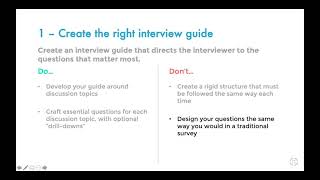
Step 3: Build your question framework. Core questions to answer in every interview:
- When did the evaluation start and what triggered it?
- Who were the other vendors considered?
- What were the top three decision criteria?
- How did each vendor perform against those criteria?
- What was the tipping point in the final decision?
- What could the losing vendor have done differently?
- What would make you reconsider them in the future?
Stage 2: Interview Execution
Step 1: Contact buyers within 90 days of deal close. Memory fades. Emotions cool. Ninety days is the outer limit for accurate recall. Sixty days is better.
Step 2: Send a pre-interview brief. Email the buyer explaining the purpose (improving your company's process, not relitigating the deal), the format (30 minutes, conversational), and confirming that their rep will not see the raw transcript. This increases show rates and candor.
Step 3: Run a semi-structured interview. Start with context questions, move to decision criteria, then probe for the emotional and relational factors that rarely appear in proposals. Silence is a tool. When a buyer pauses after "what could we have done better," wait. The answer after the pause is usually the real answer.
Step 4: Record and transcribe with consent. Tools like Gong, Otter, or Grain produce searchable transcripts. Tag for themes: product, sales, price, competitive, timing, relationship.
Stage 3: Analysis and Synthesis
Step 1: Code themes across interviews. After 10 or more interviews, patterns emerge. Use a spreadsheet or qualitative analysis tool (Dovetail, Aurelius) to tag each interview excerpt with a category from your taxonomy.
Step 2: Segment your findings. Break results by:
- Deal outcome (win, loss, no-decision)
- Deal size (SMB, mid-market, enterprise)
- Industry vertical
- Competitive context (head-to-head with specific competitors)
- Sales rep cohort (top performers versus average)
Segmentation reveals insights that aggregate data hides. You might find that you win 70% of head-to-head deals against Competitor A in financial services, but lose 60% of those same matchups in healthcare. That is an actionable positioning insight.
Step 3: Quantify themes. Count how often each theme appears across wins versus losses. A theme that appears in 40% of losses and 5% of wins is a priority signal. A theme in 30% of wins and 35% of losses is noise.
Stage 4: Distribution and Action
Riskalyze's revenue organization, running an ongoing win-loss program with Clozd CMO Craig Clark's team wanted to know whether win-loss findings, distributed to sales and used to close the loop on positioning and process fixes, actually moved the win rate rather than just producing a quarterly report. Built a continuous program feeding buyer-interview findings back into sales messaging and process changes, then tracked win rate before and after adopting the program.
Result: Win rate rose from the 30% range to more than 50%, over a 20-point improvement attributed to the program (comparing the pre-Clozd period to the post-adoption period).
SourceStep 1: Build a findings brief for each stakeholder. Product gets the feature gap analysis. Sales enablement gets the objection patterns and competitive intelligence. Positioning gets the language buyers used to describe their decision criteria. Leadership gets the win rate trend and revenue impact estimate.
Step 2: Run a monthly or quarterly win-loss review. Bring together product, marketing, sales leadership, and enablement. Walk through the latest findings. Assign owners to action items with deadlines.
Step 3: Close the loop. Track whether actions taken in response to win-loss findings move the metrics. If you updated your competitive battlecard for Competitor B based on three loss interviews, measure whether win rates in Competitor B matchups change over the next two quarters.
The 90-day contact window is a hard constraint, not a guideline. Anova Consulting's research on buyer recall shows that after three months, buyers reframe their decision rationale to align with the outcome, they convince themselves the choice was obvious. You stop getting the actual decision story and start getting a post-hoc narrative.
Real Company Examples
AuditBoard's product marketing team, running a win-loss program with Clozd Their CRM data showed deals were mostly lost to 'no decision,' but not why. A struggling product line needed a specific, evidence-based fix, not another guess. Ran buyer interviews and surveys, discovered a pattern of unclear value messaging, then spent a year rebuilding ROI-focused sales frameworks, training, and marketing materials around that specific finding.
Result: The struggling product line had its best quarter ever, with win rate up more than 5 percentage points (over roughly a year of program execution).
SourceAuditBoard built a formalized win-loss program as part of their competitive intelligence function. They used third-party interviews for enterprise deals, segmented findings by competitor, and fed outputs directly into quarterly battlecard updates. Their product marketing team credits the program with identifying a recurring objection around implementation timeline that was not appearing in CRM notes, the issue was real but reps were not logging it because they did not recognize it as a pattern. The fix was a new proof-point package around time-to-value that reduced that objection's appearance in later-stage deals.
Corporate Visions' research across 300+ B2B organizations found that the primary differentiator between high-performing win-loss programs and low-performing ones was not the number of interviews but what happened after. Companies that distributed findings to sales within two weeks of interview completion saw measurably better win-rate improvement than companies that held insights in a quarterly report. Speed of distribution matters as much as quality of analysis.
Clozd's 2025 State of Win-Loss report, covering data from hundreds of B2B programs, found that companies running programs for two or more years reported an 84% win-rate improvement rate. First-year programs reported 63%. The implication: the program compounds. Each cohort of interviews adds context that makes the next cohort's analysis more precise.
A SaaS company losing 55% of competitive deals against one specific challenger builds a win-loss program. Six interviews later, they discover the real issue is not the competitor's features, it is that the competitor's sales team is presenting an ROI model that their own team is not using. The fix is a sales tool, not a product roadmap item. Without buyer interviews, they would have spent two quarters building features that were not the actual decision driver.
Common Mistakes
1. Using CRM data as a substitute. Sales reps filling in loss reason fields are guessing, reporting what they were told in the final call, or recording what is least embarrassing. Anova and Klue's finding that 85% of CRM loss reasons are inaccurate is not surprising to anyone who has run both a CRM audit and a buyer interview program simultaneously.
2. Having the account executive run the interview. Even well-intentioned reps change how buyers respond. The buyer does not want to criticize the person they might work with in the future. Third-party or internal non-rep interviewers consistently surface harder feedback.
3. Interviewing only losses. Win interviews are equally valuable. They tell you what is actually driving buyers to choose you, which is often different from what your marketing says. If buyers consistently cite a benefit you are not emphasizing, that is a positioning fix worth more than any feature.
4. Waiting for a large enough sample before acting. Five interviews showing the same theme is enough to take a first action. You do not need statistical significance to update a battlecard or add a new proof point to a sales deck.
5. Not closing the loop with stakeholders. Win-loss programs die when contributors, the buyers who gave their time, the reps who flagged deals, see no evidence that anything changed. Publish a monthly one-page summary of actions taken. Show the program is doing something.
Key Takeaways
- 60% of sellers are wrong about why they lost; direct buyer interviews are the only reliable fix
- Contact buyers within 90 days of deal close, memory accuracy degrades significantly after that
- Third-party or non-rep interviewers yield substantially more candid feedback than account executives
- Segment findings by deal size, vertical, and competitor, aggregate data conceals the most actionable patterns
- Win interviews matter as much as loss interviews, they reveal what is actually driving your success
- Programs compound over time; two-year-old win-loss programs show 84% win-rate improvement rates versus 63% for all programs