System 1 and System 2 Thinking
Every purchase your customer makes is the result of a quiet fight between two minds. One is fast, automatic, and emotional. The other is slow, deliberate, and lazy. If you do not know which mind your marketing is talking to, you are guessing, and most of the time you are guessing wrong.
The Origin (Real Research)
The framework was popularised by Nobel laureate Daniel Kahneman in his 2011 book Thinking, Fast and Slow, but its roots go back to his collaboration with Amos Tversky in the 1970s, most famously the 1979 paper Prospect Theory: An Analysis of Decision under Risk (Econometrica, 47(2)), which has been cited more than 90,000 times.
Kahneman did not invent the dual-process idea, psychologists Keith Stanovich and Richard West coined the labels "System 1" and "System 2" in a 2000 paper in Behavioral and Brain Sciences, but Kahneman synthesised decades of cognitive experiments into a practical model. As Wikipedia summarises, the book argues that roughly 95% of human cognition runs on System 1, while System 2 is what we mistakenly believe is in charge.
How It Actually Works
Search results and product pages, load-time engineering System 1 abandons a task the instant it feels like work, and a slow page is felt as friction before a shopper consciously registers 'this is slow' Amazon engineer Greg Linden's internal A/B test found that adding artificial delay to page load directly reduced sales, and Amazon has treated milliseconds as a revenue lever ever since
Result: Every 100 milliseconds of added latency cost Amazon roughly 1% in sales (Finding first reported 2006, still cited as the founding data point for web performance optimization).
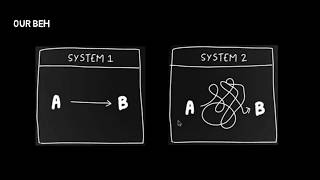
Source- System 1 is fast, automatic, emotional, and effortless. It recognises faces, completes "bread and ___", and decides you trust a brand within 50 milliseconds of seeing its homepage.
- System 2 is slow, effortful, logical, and expensive. It does long division, compares two mortgage offers, and writes the rationale you give your spouse for buying the thing System 1 already chose.
The catch: System 2 is lazy. It only switches on when System 1 hits something it cannot solve, a surprise price, a confusing checkout, a claim that feels off. Most of the time, System 2 just rubber-stamps whatever System 1 already wanted.
Why Marketers Care (2024/2025 examples)
Enterprise sales, ROI calculator and a commissioned Forrester Total Economic Impact study A System 1-driven individual signup is one thing, but an enterprise buyer's finance and procurement teams are pure System 2, they need a defensible number before they will approve a contract Slack commissioned Forrester Consulting's 2023 Total Economic Impact study of Slack for sales teams, then built an ROI calculator so every prospect's System 2 gets a specific, third-party-validated number to bring into a budget review
Result: The Forrester study found sales teams using Slack closed 5% more deals and closed them 13% faster, averaging $904K in added annual revenue for companies with about $514M in average revenue (2023 study, still the basis of Slack's live ROI calculator).
SourceEvery interface decision is a bet on which system you want active.
- Booking.com is a System 1 cathedral: red urgency banners, "Only 2 left!", "27 people are looking at this property". The point is to fire System 1 before System 2 asks "do I actually need to book in the next 90 seconds?". Ipsos notes that most category choices are made in seconds with minimal deliberation.
- Apple's product pages flip the script. Big imagery and clean type seduce System 1, then long spec tables give System 2 the ammunition it needs to justify a $1,599 laptop to itself.
- Amazon's 1-Click checkout (patented in 1999, expired in 2017) is the textbook System 1 play: remove every micro-decision that could wake System 2 up. Baymard Institute's 2024 checkout research still pegs average cart abandonment at around 70%, and most of it happens when System 2 boots up at a surprise shipping cost.
- Spotify Wrapped is pure System 1 fuel, colour, motion, social identity, which is why it generated billions of social impressions every December from 2022 through 2024.
In 2024, Klarna reported that retailers using its "pay later" widget saw average order values rise 41% and conversion lift in the 20–30% range. The mechanism is dual-process: splitting $200 into "4 x $50" lets System 1 process it as a small number, before System 2 calculates the actual obligation.
How to Apply It Ethically
- Pick the system that matches the purchase. A $4 snack is a System 1 sale, use imagery, colour, and one-tap checkout. A $40,000 enterprise contract is a System 2 sale, use case studies, ROI calculators, and comparison tables.
- Reduce cognitive load at the moment of action. Every extra form field, unexpected fee, or jargon word wakes System 2 and gives it a reason to walk away. The Decision Lab calls this "cognitive ease".
- Give System 2 a ladder. Even impulse buyers want a story to tell themselves later. One bullet of "why this is rational", a guarantee, a review count, a certification, is usually enough.
- Test creative for emotional response, not just recall. System 1 buys; System 2 fills out the survey. Ipsos, Kantar, and System1 Group all sell facial-coding products built on exactly this gap.
Where It Backfires / Ethical Limits
System 1 marketing crosses into dark-pattern territory the moment it suppresses information System 2 would need. Fake urgency timers that reset on refresh, "drip pricing" that hides fees until the last screen, and confirm-shaming opt-outs ("No thanks, I hate saving money") all exploit System 1 by denying System 2 a fair shot. The EU's Digital Services Act (in force since 2024) and the US FTC's 2023 "Click-to-Cancel" rule both explicitly target these tactics, and fines in 2024 reached tens of millions of euros for repeat offenders.
A useful test: if you removed the urgency, the hidden fee, or the dark pattern, would the customer still buy? If yes, you are using System 1. If no, you are manipulating it.
Key Takeaways
- System 1 makes almost every purchase decision; System 2 mostly writes the receipt.
- Match the system to the price and risk: cheap and habitual = System 1, expensive and considered = System 2.
- Cognitive ease beats clever copy. Every friction point is an invitation for System 2 to say no.
- The ethical line is information: persuading System 1 is fine; hiding what System 2 needs to know is not.