AI Marketing Tools Overview
The AI marketing stack exploded from a handful of writing assistants in 2023 to a sprawling, overlapping ecosystem by 2026. If you are a marketer trying to decide what to actually adopt, the problem is not finding tools, it is mapping them to jobs. This lesson gives you a category map and the criteria for picking inside each category.
What It Actually Is
"AI marketing tools" is a loose label for software that uses generative models (LLMs, diffusion models, speech models) to do work a marketer used to do manually: drafting an email, producing a hero image, cutting a video, summarizing customer interviews, or routing a lead. Example: instead of briefing a designer for a 30-second product ad, you describe the scene in Runway or LTX Studio and get a draft clip in minutes.
Why It Matters (with data)
Sandler's sales and marketing teams, running email campaigns and landing pages Generic, unpersonalized email and landing page content was producing weak engagement and a slow sales cycle The team used HubSpot's Breeze AI Assistant to personalize email content and landing page copy at scale instead of hand-writing every variant
Result: Email click-through rates rose 25%, sales-qualified leads quadrupled, landing page engagement time grew from under a minute to 3-4 minutes, and the sales cycle shortened from 90 days to 45 (Reported in HubSpot's published case study).
SourceThe adoption curve is no longer optional. HubSpot's 2026 State of Marketing Report puts daily AI use among marketers worldwide at 78%, with adoption highest in e-commerce (87%) and B2B SaaS (82%). 61% of marketers say AI is driving the biggest disruption to the profession in 20 years.
The money is following the behavior. Statista projects AI-in-marketing revenue at roughly $47B in 2025, scaling past $107B by 2028. ChatGPT leads tool usage at 90%, Google Gemini at 51%, and Claude at 33%.
The barriers are real too: 40% of marketers cite data privacy as their top blocker, and 38% cite a lack of in-house expertise. Picking tools without a governance plan is the fastest way to end up on a security review.
How It Works / The Playbook
Slate, a digital publishing platform's advertiser-sales and marketing team The team needed to find qualified advertiser prospects and route them into their CRM without a person manually searching, formatting, and re-entering leads all day They built a Zapier AI Agent that searches the web for prospects matching their target advertiser personas, organizes them in Google Sheets, and automatically routes qualifying contacts into their CRM for immediate follow-up
Result: Generated over 2,000 qualified leads in one month and saved 100+ hours of manual prospecting work, with the team still working through the pipeline months later (One month to generate the initial 2,000+ leads).
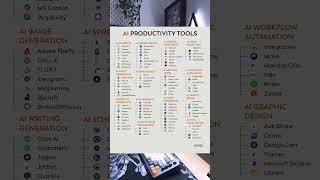
SourceThink in five categories. Pick one tool per category, learn it deeply, then expand.
- Writing and copy. ChatGPT, Claude, and Gemini for general drafting. Jasper ($49-125/mo) for brand-voice-trained marketing copy at scale. Use these for briefs, ad variants, email sequences, and SEO outlines.
- Images and design. Midjourney and Adobe Firefly (bundled with Creative Cloud at $55/mo) for production-grade visuals. Canva's Magic Studio ($13/mo Pro) for templated social assets that non-designers can ship.
- Video. Runway, LTX Studio (free to $100/mo Pro), Synthesia for avatar-led explainers, and Creatify for one-image-to-ad workflows. VEED handles AI subtitles and clean-audio post-production.
- Research and analysis. Perplexity and Claude for competitive teardowns and SERP research. NotebookLM for synthesizing customer interview transcripts. ChatGPT's Deep Research for multi-source briefs.
- Automation and orchestration. Zapier AI Actions, Make, and n8n to chain LLM calls into CRM updates, lead scoring, and content workflows. HubSpot Breeze and Salesforce Agentforce embed agents inside the CRM itself.
Rule of thumb: start with one tool in writing plus one in automation. That covers 70% of weekly time savings before you touch image or video.
Coca-Cola's 2024 "Create Real Magic" campaign used a custom GPT-4 plus DALL-E pipeline that let consumers generate branded holiday artwork. The platform produced over 120,000 user submissions in the first month and was cited by Coca-Cola's CMO as a template for future creative workflows. Source: Coca-Cola newsroom.
Common Mistakes
- Buying a tool before defining the job. Teams subscribe to Jasper, Writer, and Copy.ai simultaneously and use none of them past month two. Pick the job, then the tool.
- Ignoring data residency and PII. Pasting customer lists into a consumer ChatGPT account is the #1 reason 40% of marketers list privacy as a blocker. Use enterprise tiers with zero-retention agreements.
- Skipping the human review layer. Brands that publish unedited AI output get caught (Sports Illustrated's fake-author scandal in 2023 is the cautionary tale). Treat AI as a first-draft engine, not a publisher.
- Tool sprawl without integration. Five disconnected AI tools beat zero, but one tool wired into your CRM beats five disconnected ones. Automation is where ROI compounds.
Key Takeaways
- AI marketing tools cluster into five jobs: writing, image, video, research, automation. Map tools to jobs, not the other way around.
- 78% of marketers now use AI daily, and the market is on track to roughly double again by 2028. Falling behind has a real cost.
- Start with one writing tool and one automation tool. Add image, video, and research as specific campaigns demand them.
- Privacy, governance, and editorial review are not optional. Build them in before scaling adoption.