Segmentation, Targeting, Positioning
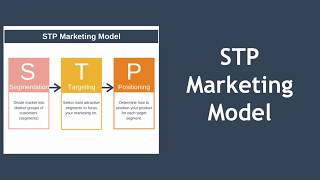
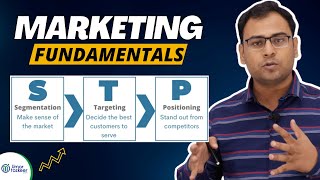
Not everyone is your customer. That sounds obvious, but most early-stage marketers behave as if the whole world is their audience. They write ads for everyone, build landing pages that try to say everything, and wonder why nothing converts. STP is the framework that fixes this. It stands for Segmentation, Targeting, and Positioning. It is how every serious marketer decides who to talk to and what to say.
Quick Summary
- STP stands for Segmentation, Targeting, and Positioning: three steps that run in order.
- Segmentation divides a broad market into smaller groups that share a problem, behavior, or life stage.
- Targeting means picking which group you will actually pursue (usually one or two at first).
- Positioning means crafting a message that speaks directly to that group and sets you apart from competitors.
- Trying to speak to everyone means you resonate with no one.
Why It Matters
STP is not just strategic theory. It is the most practical framework in marketing, and you reach for it constantly.
- When launching a product: STP forces you to define exactly who you are building for before you spend money on ads or content.
- When a campaign is not converting: Revisiting your targeting often reveals you have been speaking to the wrong group, or using a message that does not land.
- When entering a competitive market: STP helps you find the underserved pocket, the segment competitors are ignoring or serving poorly.
- When scaling: STP tells you which segments to expand into next, so you do not grow in all directions at once and dilute your brand.
71% of consumers expect personalized communication from brands, and 76% get frustrated when they do not receive it (McKinsey). Personalization is not possible without first doing the STP work. You cannot personalize a message until you know exactly who you are talking to. STP is the foundation, not an optional extra.
A separate finding from B2B marketing research: 81% of B2B marketers use firmographic data (company size, industry, revenue) to define their target markets. And behavioral email campaigns that are properly segmented can drive up to 760% more revenue than generic "blast everyone" campaigns. That gap, between targeted and untargeted, is what the STP framework is designed to close.
The Three Steps
Step 1: Segmentation
Canva's enterprise go-to-market and product tiering architecture Individual creators and small teams adopted Canva's free and Pro tiers rapidly, but large organizations required administrative controls, brand governance, and enterprise-grade security to prevent fragmented asset creation across global teams Canva segmented its user base into three distinct tiers (Individual Creators, Small-to-Medium Businesses, and Large Enterprises) and launched a dedicated Canva Enterprise product with centralized brand kit governance, SSO, and SCIM provisioning
Result: Canva penetrated 95% of the Fortune 500 and surpassed $3 billion in annualized revenue, with enterprise seat expansion growing over 100% year-over-year (2024-2025).
SourceSegmentation means dividing a broad market into smaller groups. Each group should share something meaningful: a shared problem, a shared behavior, or a shared situation in life. There are four main ways to slice a market:
- Demographic: age, income, gender, job title, company size
- Geographic: country, city, urban vs. rural, climate zone
- Psychographic (values and lifestyle): what people believe, how they spend their time, what they aspire to
- Behavioral: how often they buy, how loyal they are, what features they use most, where they are in the buying cycle
The best segmentations combine two or three of these lenses. A software company might segment by company size (demographic) and by whether the team already uses a competing tool (behavioral). Each combination creates a group with different needs and different willingness to pay.
A useful mental test for any segment you create: can you describe what this group worries about on a Sunday night? If yes, the segment is real enough to market to. If not, it is probably too broad.
Step 2: Targeting
Once you have your segments mapped, targeting asks you to pick one or two to pursue first. Many marketers skip this step and try to run campaigns for all segments at once. That is expensive and ineffective. Instead, score each segment against four questions:
- Size: Is this segment large enough to justify the investment?
- Reach: Can you find and engage them at a reasonable cost per acquisition?
- Advantage: Do you have a real edge over competitors in serving this group?
- Growth: Is this segment growing or shrinking over the next three to five years?
You are looking for the overlap between "segment we can win" and "segment worth winning." A small segment you can dominate is more valuable than a large segment where you are one of fifty competitors.
The most common targeting mistake is choosing a segment that is still too broad. When your first target feels almost uncomfortably specific, you are probably in the right zone. Dominate a small pond first, then expand. Dollar Shave Club did not try to beat Gillette across all razor buyers from day one. They won frustrated young men first, then grew from there.
Step 3: Positioning
Freshworks (Freshsales and Freshdesk) positioning against legacy enterprise CRM Incumbent CRM providers like Salesforce focused on deep enterprise customizability and complex architectures that demanded months of expensive implementation consultants, leaving SMBs and mid-market teams overburdened Freshworks positioned its suite as the 'affordable, easy-to-adopt modern SaaS' engineered for rapid time-to-value, transparent pricing, and zero required implementation overhead
Result: Scaled to over 67,000 global customers and achieved a $13 billion Nasdaq IPO (FRSH) in September 2021, generating $371M in FY2021 revenue (2011-2021).
SourcePositioning is where strategy becomes creative. A positioning statement is an internal document (never shown to customers directly) that answers three questions:
- Who is this for?
- What alternatives exist, and why are we different from them?
- Why should our target segment believe us?
From that statement come your messaging, your creative direction, your pricing logic, and your channel choices. Everything in your marketing should trace back to a positioning decision, which traces back to a targeting choice, which traces back to a segmentation step.
A classic positioning statement template looks like this:
For [target segment], who [has this problem or need], [Product] is a [category] that [key benefit]. Unlike [main alternative], we [key differentiator].
This statement never appears in your ads. It is the internal compass that ensures every piece of marketing you make is pointing in the same direction.
Real-World Examples
Dollar Shave Club: Segment by Attitude, Not Just Age
Dollar Shave Club launched in 2012 targeting a specific segment: men aged 18 to 34 who were frustrated with overpriced razors at the drugstore. They did not try to win the premium end (Gillette held that) or the cheap disposable end (Bic had it locked). They targeted the annoyed middle, guys who felt they were being ripped off and would switch if someone made it easy.
Segmentation: Razor buyers who feel the category is broken and overpriced.
Targeting: Men aged 18 to 34 who shop online and respond to irreverent humor.
Positioning: "Our blades are f***ing great" at $1 per month, not premium, not disposable, just honest value with attitude.
Result: The launch video cost $4,500 to produce and drove 12,000 orders in 48 hours. By 2016, Dollar Shave Club held 15% of the US cartridge razor market by dollar share and sold to Unilever for $1 billion.
The lesson: they did not try to out-feature Gillette. They out-positioned them with a completely different emotional story for a segment Gillette had stopped caring about.
Airbnb: Expand into Adjacent Segments with STP
Airbnb's original segment was budget-conscious leisure travelers who wanted a more "local" experience than a hotel offered. As that market matured, the company needed growth without cannibalizing its core positioning.
Using STP analysis, Airbnb identified business travelers as a distinct and underserved segment. Business travelers had different needs: consistent WiFi, flexible cancellation policies, proximity to offices, receipts formatted for expense reports. So Airbnb created dedicated landing pages, filters, and email campaigns built entirely around that segment's needs rather than the leisure traveler's.
The result: bookings from business travelers increased by over 30% in 2024. That growth came not from changing the product, but from running a separate positioning track for a separate segment using the same underlying inventory.
Spotify: Position on Feeling, Not Features
Spotify competes with Apple Music, YouTube Music, and Amazon Music. All of them have roughly the same catalog. Spotify's positioning is not "more songs." It is "the platform that knows you", built around personalized discovery through Wrapped, Discover Weekly, and algorithm-driven playlists. That positioning targets a specific psychographic: listeners who care about discovering new music and sharing their taste as part of their identity.
The outcome: Spotify's personalization positioning drove a 25% improvement in user retention in 2024, and Spotify consistently outperforms competitors on the "best for discovery" dimension even though catalog size is essentially identical across platforms.
Segmentation Types: A Deeper Look
Most powerful segmentations use two lenses together. Some combinations that consistently work:
- Demographic + Behavioral: "Mid-market SaaS companies (200 to 1,000 employees) that are currently using spreadsheets for a task we automate." This tells you not just who they are, but what pain they are actively experiencing.
- Psychographic + Geographic: "Urban millennials who prioritize sustainability and shop locally." This captures a mindset concentrated in a geography you can efficiently target.
- Demographic + Psychographic: "Senior executives who believe their industry is about to be disrupted by AI." This creates a high-urgency segment even if the demographic profile is broad.
Common Mistakes
"Our product is for anyone who needs X" is not a target. It is a sign the segmentation work has not been done. When you aim at everyone, your message resonates with no one. The market leader can afford to be broad. If you are not the market leader, you cannot. Pick a segment you can actually dominate, even if it feels uncomfortably small at first. Broad campaigns with no targeting consistently underperform: companies that properly segment and target see conversion rates 20 to 30% higher than companies running untargeted campaigns.
Confusing segments with personas. Segments are groups defined by shared characteristics and data. Personas are fictional individuals who represent those segments. Both are useful, but building personas without first doing rigorous segmentation means you are creating characters without data behind them. Start with the segment, then build the persona to give it a human face.
Positioning in features, not in feelings. "We have more integrations" is a feature statement. "We are the CRM your sales team will actually use" is a positioning statement. Features can be copied. A feeling of fit, the sense that a product was made specifically for you, is much harder to replicate. The best positioning statements describe an emotional outcome, not a technical capability.
Forgetting to revisit STP as the market evolves. The segment that was perfect for your launch a few years ago may be saturated, commoditized, or shrinking today. STP is not a one-time exercise. High-performing marketing teams revisit their segmentation and targeting at least annually, and re-examine positioning every time a major competitor makes a move.
The One-Line Takeaway
Pick the smallest group you can actually dominate, earn their obsessive loyalty, and let them do the selling for everyone else.
Related Concepts
- Buyer Personas, Personas are the human face of your target segment; build them after you have done the segmentation work
- Positioning, The third step in STP: once you have chosen your segment, positioning defines how you want to be perceived relative to alternatives
- Value Proposition, Your value proposition is the customer-facing expression of your positioning; it answers "why you, why now" for your target segment