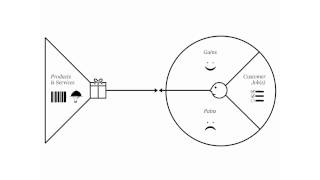
The Value Proposition
What It Is
A value proposition is a clear statement that explains what your product does, who it helps, and why it is better than the alternatives. Think of it as the answer to the question every potential customer silently asks: "Why should I care about this?" It is not a slogan, a tagline, or a mission statement. It is a specific, grounded promise that tells someone exactly what they will get if they choose you.
Quick Summary
- A value proposition answers the customer's silent question: "Why should I care about this?"
- Write it from the customer's point of view, not the company's. Describe the outcome, not the features.
- Every touchpoint (homepage, ad, pitch deck) carries your value proposition whether you wrote one or not.
- A strong value proposition names a specific customer, a specific problem, and a specific outcome.
- The best value propositions are written in the customer's own words, borrowed from reviews and interviews.
The best value propositions are written from the customer's point of view, not the company's. Too many businesses describe what they built. A value proposition describes what changes for the person using it. The shift sounds small, but it is the difference between "We offer AI-powered scheduling software" and "Stop losing hours to back-and-forth emails, book meetings in one click." The second version speaks to a felt problem and a concrete outcome.
Every touchpoint a potential customer sees, a homepage headline, an ad, a pitch deck cover slide, carries your value proposition whether you wrote one or not. If you have not made it explicit, the market will fill in the blank for you. The answer is usually "I am not sure what this is for." A deliberate value proposition prevents that uncertainty and gives every marketer on your team a shared north star for every message they write.
Why this matters for conversions: B2B marketing research (2025-2026) shows that companies with clear, compelling value propositions capture 46% more market share and achieve a 74% higher return on marketing investment (ROI). Furthermore, clarifying a muddled value proposition on a landing page is the single fastest conversion rate optimization win, typically driving a 32% relative increase in conversions without changing the product, pricing, or visual design.
Why It Matters
A strong value proposition is not just a writing exercise, it is a strategic tool marketers reach for constantly.
- When you are launching something new. A value proposition forces you to name the specific job your product does and for whom, before you spend a dollar on ads.
- When your conversion rate (the percentage of visitors who take action) is low. If people visit your site and leave, a muddled value proposition is usually the first suspect. Visitors could not figure out what was in it for them.
- When you are entering a crowded market. A value proposition is where differentiation (standing out from competitors) lives. It answers: "Why you and not the other five options I am considering?"
- When your team is sending mixed messages. Sales says one thing, marketing says another, the website says a third. A documented value proposition aligns everyone around the same story.
According to a 2025 Shopify study, 38% of shoppers abandon a purchase when messaging differs across a brand's website, and 42% leave without proof of claims or social proof (reviews, testimonials). Both problems trace directly back to a weak or inconsistent value proposition.
How It Works
The classic framework for building a value proposition has four parts: the customer segment (who exactly you are targeting), the problem or job (what they are struggling with or trying to accomplish), the outcome (what life looks like after they use your product), and the differentiator (why you deliver that outcome better than the alternatives). You need all four. A statement missing any one of them sounds either too broad to be believable or too vague to be compelling.
Start by writing down the most painful problem your target customer faces right before they would reach for your product. Be ruthlessly specific. "Small business owners who lose track of invoices and get paid late" is more useful than "businesses with cash flow problems." Then describe the outcome in the customer's own language, not in product features. Features are how you deliver the outcome. The value proposition is the outcome itself.
Once you have a draft, run it through the "so what?" test. After every sentence, ask: so what does that mean for me, the customer? Keep asking until you reach something that connects to a real feeling, relief, confidence, status, savings, or time back. That is where your value proposition lives.
The Four Levels of a Value Proposition
Most people think a value proposition is one statement that lives on the homepage. In practice, you need value propositions at four different levels, and each serves a different job.
- Company level: Why your brand exists and what it stands for overall. ("We make merit-based hiring accessible to every company.")
- Product level: Why this specific product delivers results. ("Our resume screening tool cuts time-to-hire by 40%.")
- Process level: Why your way of doing things is better. ("Every client gets a dedicated account manager, not a ticket queue.")
- Prospect level: Why this is the right choice for this specific person right now. The most powerful, but hardest to write. It requires knowing the individual's situation.
LinkBuilder.io discovered this in practice. After adding product-level case studies showing specific results to their website, they saw an 18% increase in qualified inquiries, and prospects began referencing those case studies during initial sales calls as benchmarks they expected to hit.
Real-World Examples
Dropbox (2009): Simplicity Beats Features
Dropbox launched in 2008 into a market full of complicated file-syncing tools that required manual setup and technical knowledge. Their value proposition was almost absurdly simple: "Your stuff, anywhere." Not "cloud storage with enterprise-grade encryption", just the plain-language outcome.
When Dropbox launched its referral program in 2009, its value proposition was concrete enough that users could explain it to a friend in one sentence: "It puts your files on all your computers automatically." That clarity powered a referral loop that grew the user base from 100,000 to 4 million users in 15 months, a 3,900% increase. The product was good, but the pitch was the on-ramp. Users knew exactly what they were getting and exactly what to tell the next person.
Montefiore Health System (2020): Audience-Specific Value Props Win
During 2020, Montefiore Health System built a Covid-19 microsite with three separate value propositions aimed at three different audiences: Covid patients, non-Covid patients, and their own employees. Each message spoke directly to that group's specific fears and needs. The campaign generated 2.2 billion impressions across all channels. A nurses' celebration video reached nearly 500,000 people organically. One video alone earned over 5 million YouTube views. The lesson: one generic value proposition tries to speak to everyone and moves no one. Audience-specific versions work dramatically better.
Death Wish Coffee: Specificity Builds a Category
Death Wish Coffee did not say "great coffee for coffee lovers." They said "The World's Strongest Coffee", a specific, provable claim aimed at a specific person: someone who needs serious caffeine, not a gourmet experience. That focus turned a small roaster into a brand that eventually collaborated with NASA and landed Super Bowl exposure. Specificity created a category they could own.
Common Mistakes
Mistake 1: Writing for yourself, not your customer. The most common mistake is describing the product from the inside out, listing features, technology, or company achievements. Customers do not buy features; they buy outcomes. Rewrite every draft by asking: "What does this mean for the person reading it?" If your value proposition could live on a competitor's homepage without changing a word, it is not specific enough.
Mistake 2: Trying to appeal to everyone. A value proposition that speaks to everyone speaks to no one. When you broaden the customer segment to avoid excluding anyone, you dilute the message until it means nothing. "Helps teams work better" is not a value proposition, it is a placeholder. Name the specific type of team, the specific friction they feel, and the specific way that friction disappears.
Pro tip: Steal your language from your customers. The highest-converting value propositions are often assembled from exact phrases that real customers used in reviews, support tickets, or interviews. Search your G2, Capterra, or Amazon reviews and look for the words customers repeat when describing the moment your product helped them. Those words already passed the "does this resonate?" test before you spent a minute on copywriting. Shopify research found that 71% of product returns in 2025 stemmed from inaccurate or misleading product descriptions, meaning the value proposition promised something the product did not deliver. The fix is not better copy, it is honest copy.
How to Write Your First Draft
Follow these five steps in order. Do not skip to step 3.
- Pick one customer. Not "small businesses", "freelance graphic designers who invoice clients late because they forget to follow up."
- Name their worst moment. The specific frustration they feel right before your product becomes relevant.
- Write the after state. What does life look like after your product solves that frustration? Be concrete. "No more chasing clients for payment" beats "improved cash flow management."
- Add your differentiator. Why you and not the alternative they are already using? One specific reason is stronger than three vague ones.
- Cut it in half. Whatever length you have, cut it. Every extra word weakens the signal.
Then test it. A/B test (split test, showing version A to half your visitors and version B to the other half) two versions of your homepage headline. Even a 20% lift in conversion rate, sustained over a year, compounds into a significant revenue difference. MarketingSherpa's research shows that simply intensifying the clarity of a value proposition on a page, without redesigning anything else, can drive a 32% relative increase in conversions.
The One-Line Takeaway
If your value proposition could describe any competitor, rewrite it, specificity is the only thing that makes a promise believable.
Related Concepts
- Positioning, Positioning is where your value proposition lives in the market landscape. Your value proposition is the customer-facing expression of your position.
- Buyer Personas, You cannot write a sharp value proposition without knowing exactly who you are writing it for. Personas define the "who" your value proposition must speak to.
- Jobs to Be Done, The Jobs to Be Done framework gives you the language to describe what your customer is actually trying to accomplish, which is the beating heart of any strong value proposition.