Growth Loops
In 2025, the fastest-growing products are not winning because they spend more on ads -- they are winning because they designed systems where every user automatically creates the next user. If your growth strategy still depends on pouring money into the top of a funnel, you are running a machine that stops the moment the budget does.
Quick Summary
- A growth loop is a closed system where the output of one cycle becomes the input of the next -- no fresh spend required to keep it spinning.
- Funnels are linear and finite; loops are exponential and self-reinforcing.
- The four loop types are: viral/UGC, paid, content/SEO, and sales-assisted.
- Every loop can be quantified with a single "loop factor" -- below 1.0 it leaks, above 1.0 it compounds.
- Dropbox used a viral loop to grow 3,900% in 15 months. Canva hit 220 million monthly active users in 2025 running three interlocking loops simultaneously.
What It Actually Is
Airbnb's referral program, rebuilt from scratch by the growth team in 2014 Early referral flows underperformed because they weren't tied to the moments guests and hosts naturally wanted to share; the rebuild used Gmail/Android 'Recommended Contacts' and supported mobile-native sending and accepting since most referral emails were read on mobile A redesigned referral loop where referred users, who booked more often, spent more per booking, and retained better than average, went on to refer others themselves, closing the loop
Result: a 300% increase in daily bookings and signups immediately after launch, with referrals driving 5-15% of all guest growth for years afterward (Rebuilt in 2014; referral contribution sustained through the following years).
SourceA growth loop is a closed, self-reinforcing system where user actions produce outputs that directly generate new users, who then produce more outputs, feeding the next cycle. It is not a marketing campaign with a referral bonus bolted on -- it is a structural feature of how the product grows.
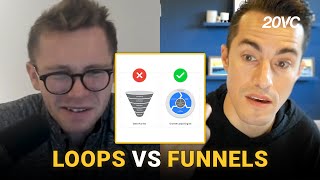
The clearest analogy: a flywheel. You push it hard at first, but once it is moving, each rotation makes the next one easier. The energy from the last turn drives the next. A funnel, by contrast, is a water slide -- entertaining while it lasts, but someone has to carry water back to the top every single time.
The four core loop types:
- Viral / UGC loops -- users create content or share artifacts that attract new users (Canva, TikTok, Duolingo streaks)
- Paid loops -- revenue from one cohort funds acquisition of the next cohort at a profitable LTV:CAC ratio (Booking.com, HelloFresh)
- Content / SEO loops -- user activity generates indexable pages that rank and pull in organic traffic (Pinterest, Glassdoor, Reddit, Tripadvisor)
- Sales-assisted loops -- customers refer colleagues or expand usage inside their organization (Slack, Notion, Figma)
Most durable companies run more than one loop. They start with one, get it above a 1.0 loop factor, then layer a second on top.
Why It Matters (with data)
HelloFresh's TikTok influencer program, run with unique promo codes for direct attribution across UK, Canada, Australia, New Zealand, Spain, France, Netherlands, and Belgium Facebook and Instagram acquisition costs were rising, and the team needed a repeatable, trackable channel where revenue from converted subscribers could keep funding the next round of creator payouts Working with 200-300 influencers monthly, each with a unique trackable promo code, generating roughly 5 million monthly video views feeding new-subscriber signups
Result: a 30% average reduction in customer acquisition cost across several markets compared to other paid social platforms (Ongoing multi-market program).
SourceThe math behind loops is the argument. Brian Balfour and the Reforge team stated it plainly: funnels are "too micro a view to answer how your product grows" because they treat acquisition, product, and monetization as separate silos. Loops force you to see them as one connected system. Growth Loops are the New Funnels -- Reforge
The compounding difference becomes dramatic over time. A one-time campaign delivering 500 new users is dead after week one. A loop starting with 20 users and growing 10% week-over-week is producing thousands per week by month twelve -- without any additional spend. Growth Loops vs Funnels: Building Self-Reinforcing Systems -- UpGrowth
Real 2025 numbers that show what loops produce at scale:
- Canva reached 220 million monthly active users in early 2025 (up from 130 million in 2023), driven by three simultaneous loops: the watermark viral loop, a paid affiliate loop, and a template-sharing community loop. Canva Statistics -- The Social Shepherd
- TikTok hit 1.59 billion monthly active users in 2025. 92% of global users take an action (like, share, follow, or post their own video) after watching content -- which feeds the creator loop directly. TikTok Statistics 2025 -- Proxidize
- Dropbox used a double-sided referral loop (both referrer and invitee got 500MB free storage) to grow from 100,000 to 4 million users in 15 months -- a 3,900% increase -- with a viral coefficient of 0.35, meaning every 10 users brought in 3.5 more. Dropbox Referral Program: 3900% Growth -- GrowSurf
- Notion reached 100 million users in 2024, generating $400 million in annual recurring revenue -- a 60% increase year-over-year -- fueled largely by a template-sharing loop where power users create and share templates that onboard the next wave of users. Notion Statistics 2025 -- ElectroIQ
Companies implementing structured growth loops report reducing customer acquisition costs by up to 40% compared to pure funnel-driven strategies, with loop-powered products showing 10%+ monthly growth versus 3-5% for funnel-driven startups. Growth Loops vs Funnels: Which Strategy Wins in 2025? -- SocialChamps
How It Works / The Playbook
Before writing a single line of code or spending a dollar, map your loop in four parts:
- Input -- what triggers one cycle? (a new signup, a published piece of content, a dollar of revenue collected)
- Action -- what does that input do inside your product?
- Output -- what artifact, signal, or asset does the action produce?
- Re-investment -- how does that output become a fresh input for the next cycle?
If you cannot complete all four steps without saying "and then we run an ad," you have a funnel, not a loop.
Then quantify each step:
- Conversion rate -- for every 100 inputs, how many complete the action?
- Yield rate -- for every 100 actions, how many produce a shareable or re-investable output?
- Loop velocity -- for every 100 outputs, how many convert into new inputs?
Multiply the three percentages together. That product is your loop factor.
- Loop factor below 1.0: the loop is leaking -- each cycle produces fewer inputs than the last. You have a funnel with extra steps.
- Loop factor at 1.0: the loop sustains itself but does not compound. Flat growth.
- Loop factor above 1.0: each cycle produces more inputs than the last. Compounding growth.
The goal in the first 90 days is not to build the perfect loop -- it is to identify which of your four steps has the lowest rate and fix that bottleneck first.
Step-by-step audit process:
- Pick one loop type that fits your product's natural behavior (do not force a viral loop on a B2B SaaS used privately)
- Map the four steps with sticky notes or a whiteboard before touching data
- Instrument each step with a measurable event in your analytics stack
- Calculate your current loop factor -- most teams discover it is below 0.5 on first measurement
- Run one focused experiment per step, starting with the weakest link
- Reforecast loop factor quarterly because algorithms change and channels decay
Dropbox's 3,900% growth in 15 months came from one insight: the natural output of using Dropbox (sharing a folder) was the perfect re-investment mechanism. They added double-sided rewards (500MB free for referrer AND invitee), embedded the prompt at the exact moment users hit their storage limit, and made sharing one click from inside the product. The loop factor crept above 1.0 and compounded for years. The key was that the output (a shared folder) was intrinsically tied to product value -- not a separate "refer a friend" bolt-on.
TikTok's content loop is the most studied viral loop of the last five years. A creator posts a video. The For You Page algorithm tests it on a small batch audience. Strong retention (average watch-time above 80%) triggers a wider distribution push. New viewers follow the creator, share the video externally, or -- critically -- post their own video in response. That last action feeds the creator side of the loop with fresh supply. With 1.59 billion MAUs in 2025 and 92% of users taking some action after watching, the loop compounds on both the supply (creators) and demand (viewers) sides simultaneously. TikTok Statistics 2025 -- Proxidize
Real Company Examples
Canva: Three Interlocking Loops at 220 Million MAU
Canva does not rely on one loop -- it runs three that reinforce each other.
Loop 1 (Viral): User designs a poster, presentation, or social graphic. They export it with a "Made with Canva" watermark or share it via a Canva link. Viewers see the design, click through, and sign up to make their own. The watermark is the product's most powerful acquisition channel.
Loop 2 (Affiliate/Paid): Canva's affiliate program pays referrers for every paying user they bring in. Revenue from new paid subscribers funds the next round of affiliate payouts, which funds the next round of acquisition. The paid loop finances itself.
Loop 3 (Community/Template): Power users create templates and publish them to the Canva template library. New users discover Canva through template searches, use the templates, and some become power users who publish their own -- feeding the supply side. Canva reached 220 million MAU in 2025, growing from 130 million in 2023, without ever having relied on performance advertising as its primary driver. Canva Statistics -- The Social Shepherd
Notion: The Template-Sharing Loop and 5x Growth in Two Years
Notion's growth from 20 million users in 2022 to 100 million in 2024 was driven heavily by its template ecosystem. A power user builds a complex workspace template (a CRM, a content calendar, a habit tracker), publishes it publicly, and links to it from Twitter, Reddit, or YouTube. New users land on the template page, duplicate it with one click, and are immediately inside a working Notion setup -- dramatically reducing time-to-value and early churn. That reduced churn improves retention metrics, which improves word-of-mouth, which feeds the next wave of template creators.
The financial result: $400 million ARR in 2024, a 60% increase over 2023 and nearly 500% growth from $67 million ARR in 2022. Notion Statistics -- ElectroIQ
Common Mistakes
-
Calling a one-time referral campaign a loop. If the referral fires once per user and offers a one-time reward with no re-investment mechanism, it is a campaign with a sharing button. A real loop has continuous re-investment built into the product behavior, not a marketing overlay.
-
Optimizing a single step while ignoring the loop factor. You can double your signup conversion rate and still have a loop factor of 0.3. Always measure the full cycle -- input to output to re-investment -- not just the most visible step.
-
Building two or three loops simultaneously. Almost every early-stage team that tries this fails. Resources get split, none of the loops reaches above 1.0, and the team concludes that loops "do not work." Pick the loop most natural to your product, get it above 1.0, then add a second.
-
Ignoring loop decay. Loops degrade. Algorithms change (TikTok's ranking signals shifted three times between 2023 and 2025). Channels saturate. Watermarks get cropped. Reforecast your loop factor every quarter and treat decay as a normal operating expense, not a failure.
-
Confusing virality with a loop. A piece of content can go viral without producing a loop. Virality is a spike. A loop is a repeating cycle. The question is not "did this spread?" but "did the spread create inputs for the next cycle?"
Key Takeaways
- Funnels stop the moment spending stops. Loops keep spinning because users generate the next users.
- Every loop has four parts: input, action, output, re-investment. If you cannot map all four without buying an ad, you do not have a loop yet.
- Your loop factor (conversion x yield x velocity) is the single most important growth metric you are probably not tracking.
- A loop factor below 1.0 is a leaky funnel in disguise. Above 1.0 is a compounding asset.
- Dropbox hit 3,900% growth by making the natural product action (sharing a folder) the re-investment mechanism. The loop was not bolted on -- it was the product.
- Start with one loop, instrument every step, fix the weakest link first, then layer a second loop only after the first is compounding reliably.