AI Overviews & GEO
Google search used to give you a list of links. Now, millions of searches return an AI-written paragraph at the very top of the page, a direct answer pulled from multiple websites, before a single link appears. That paragraph is called an AI Overview. Generative Engine Optimization (GEO) is the practice of writing and structuring your content so that AI search engines choose YOUR material when generating those answers.
Quick Summary
- AI Overviews appeared on about 47% of Google queries in Q1 2026, up from 32% a year earlier, and queries that trigger one see zero-click rates averaging 83% (rising to 93% inside Google's newer AI Mode).
- GEO (Generative Engine Optimization) means making your content easy for AI to find, quote, and credit, not tricking it.
- Structure beats length: a two-sentence definition followed by a numbered list beats a 500-word essay every time.
- Trust signals matter as much as format: named authors, cited research, and schema markup all increase your odds of being cited.
- Ahrefs' 2026 study of 75,000 brands found web mentions predict AI Overview citation roughly 3x better than backlinks, and cited sources still earn 35% more organic clicks and 91% more paid clicks than uncited ones on the same query.
What Changed in Search
The zero-click shift is real. Searches that trigger an AI Overview end without a click around 83% of the time, and that number climbs to roughly 93% inside Google's separate AI Mode experience (see the companion lesson, 'Optimizing for Google AI Mode'). For informational queries (how-to, what-is, why-does), the rate runs even higher. This does not mean SEO is dead, it means the game changed. Getting cited inside the AI answer is now the new 'ranking number one.'
Here is what the AI Overview process actually looks like under the hood:
The model that powers AI Overviews is doing three things: retrieving pages, evaluating their trustworthiness, and synthesizing a clear answer. If your page fails at step two or makes step three hard, you are invisible, even if you rank on page one.
Why GEO Matters Right Now
Localized Reddit community campaigns in the French and German markets HubSpot's AEO team found off-site brand mentions correlate with AI citation far more than backlinks, so it recruited community advocates to discuss the product naturally on Reddit instead of building more links. Launched market-specific Reddit engagement in France and Germany, tracking HubSpot's mention rate inside relevant threads.
Result: French Reddit mentions of HubSpot went from 0% to 33.5% of relevant threads within one month; German mentions went from 0% to 17.1%. Platform-wide, Reddit citations of HubSpot grew from 178 to 146,000 between May and December 2025. (May 2025 - December 2025).
SourceThe numbers make this urgent:
- AI Overviews reached about 47% of qualifying Google queries in Q1 2026, up from 32% a year earlier, citation inside that box is quickly becoming the default battleground for informational search.
- Google's own AI Mode passed 1 billion monthly users by May 2026, less than a year after launch, and its queries are still doubling roughly every quarter. These are not bots, these are your potential customers asking questions.
- Perplexity processes hundreds of millions of queries per month and continues to grow fast. AI-native search is exploding.
- Pages ranked fifth in traditional search saw a 115% visibility increase in AI responses after adding proper citations and structured formatting (Princeton/Georgia Tech research, 2024).
- Reddit accounted for roughly 44% of Google AI Overviews' social citations in early 2026, proving that community-format content gets cited heavily.
- Web mentions predict AI Overview citation about 3x better than backlinks. Ahrefs' 2026 analysis of 75,000 brands measured a 0.664 correlation for branded web mentions versus 0.218 for backlinks, the metric that matters most has shifted.
How GEO Actually Works
GEO is not a replacement for SEO, it is an extension of it. Here is the core logic:
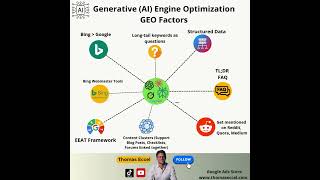
Answer-first structure. Every major section should open with a direct, quotable sentence that states the key point. Then back it up. AI systems are built to lift the clearest statement from a page. If your direct answer is buried in paragraph four, the AI will use paragraph one from a competitor instead. Max 20 words for that opening sentence.
Structured formatting. Numbered lists, definition blocks, comparison tables, and FAQ sections are the formats AI retrieval systems parse most efficiently. A wall of prose is hard to excerpt cleanly. A numbered how-to list is trivially easy.
Credibility signals. AI Overviews draw from the same trust signals Google has always used, named authors with credentials, links to primary research, current publication dates, and schema markup (machine-readable labels that tell the AI what type of content a page contains). Think of each page as a potential deposition: every claim should be citable, sourced, and unambiguous.
Brand mentions over backlinks. The research is clear: getting your brand name mentioned in context across Reddit threads, YouTube comments, review sites, and forums is now more valuable for AI visibility than collecting backlinks. AI models are trained on the whole internet, not just link graphs.
Content depth and topical authority. A niche blog with Domain Rating 30 can outrank Forbes (DR 90) in AI answers if it covers a topic more precisely. Breadth of related content matters too, a site with 20 interlinked articles on email marketing is more likely to be cited on any email marketing question than a site with one article.
Real Company Examples
A dedicated FAQ glossary answering awareness-stage definitional queries like 'what is marketing automation?' Long, narrative glossary pages buried the actual definition; AI retrieval systems need the answer in the first sentence to extract and cite it. Rebuilt glossary entries as direct-answer blocks, each opening with a one-sentence definition before any elaboration.
Result: Citation share for the glossary content rose 60%, and brand visibility for awareness-stage AI prompts increased by 35 percentage points. (2025-2026).
SourceHubSpot, 28% lift in branded impressions (2024). HubSpot restructured over 200 pillar blog posts to include concise definition blocks, numbered how-to steps, and named research citations. After Google launched AI Overviews, HubSpot's blog appeared as a cited source for competitive terms like "what is a CRM" and "inbound marketing strategy." Internal data shared at INBOUND 2024 showed pages with this structure achieved a 28% increase in branded impressions in Search Console, brand visibility went up even as traditional click-through rates fell. The lesson: format changes alone, on content you already have, can move the needle.
Virayo SaaS client, 20+ free trial signups per month from ChatGPT (2025). A B2B SaaS company worked with agency Virayo to build content clusters around their core use cases and systematically earn citations in ChatGPT responses. The result was more than 20 free trial signups per month sourced directly from ChatGPT citations, a channel that did not exist two years earlier. The key tactic: identifying the exact questions prospects ask ChatGPT before buying, then creating content that directly answers those questions with clear attribution.
Worked example, "How to build an email list from scratch":
A generic answer: "You can build your email list by using lead magnets, pop-ups, and landing pages."
A GEO-optimized answer block:
Definition: An email list is a collection of opted-in contacts who have given you permission to send them messages.
How to build one (5 steps):
- Create a lead magnet, a free resource (PDF, template, mini-course) that solves one specific problem for your target reader.
- Build a landing page with a single opt-in form and no distractions.
- Add an exit-intent pop-up to your highest-traffic blog posts.
- Promote the lead magnet in your social bio and in relevant Reddit or forum threads.
- Set up a welcome email sequence that delivers value immediately.
The second version is structured for both humans and AI retrieval. The AI can quote any of those steps verbatim. The first version is a vague sentence that gets skipped.
Common Mistakes
Burying the answer. If the first two sentences of a section do not contain a direct, quotable answer to the implied question, the AI will likely skip your passage. Long narrative introductions, clever hooks, and meandering context paragraphs are the enemy of GEO. Every H2 section should be able to stand alone as a mini-answer.
Treating GEO as separate from E-E-A-T. Adding bullet points and FAQ schema to thin, untrustworthy content does not work. AI Overviews draw from the same authority signals Google has always used. A site with anonymous authors, no cited sources, and sparse external recognition will not be cited no matter how well formatted it is. Fix the trust signals first, then optimize the format.
Add a TL;DR block to every long article. A two-to-three sentence synthesis at the top of your article is the single highest-leverage GEO tactic. It is exactly the format AI systems prefer to quote verbatim. It also improves the human reading experience, so there is no downside. Write it as a self-contained mini-answer, not a teaser.
Monitor your brand in AI answers. Use tools like Brandwatch, Mention, or the free tool at GEOJon.com to check how ChatGPT, Perplexity, and Google AI describe your brand. AI models sometimes hallucinate wrong pricing, wrong features, or outdated positioning. Catching and correcting these descriptions, by publishing authoritative content that sets the record straight, is now a critical brand protection task.
Your GEO Action Checklist
For every important page on your site, run through these:
- Does the first sentence of each H2 section directly answer the implied question? (If not, rewrite the opener.)
- Are key how-to processes written as numbered lists, not paragraphs?
- Is there a TL;DR or Key Takeaway block near the top?
- Does the page have a named author with a bio and credentials?
- Are statistics cited with source names and years?
- Is schema markup (Article, HowTo, FAQ) implemented?
- Has the topic been discussed authentically on Reddit, forums, or YouTube?
- Are there 5+ interlinked articles on related sub-topics pointing to this page?
The One-Line Takeaway
Structure your expertise so clearly that an AI has no excuse to cite anyone else.
Related Concepts
- E-E-A-T, the trust and expertise framework Google uses to evaluate sources, which directly determines whether your content is eligible to appear in AI Overviews
- Schema & Structured Data, machine-readable markup that helps AI systems understand what type of content a page contains and how to attribute it correctly
- Content Clusters, building deep topical coverage across interlinked pages, which signals the breadth of expertise AI models look for when selecting authoritative sources