When someone Googles your brand name, they're already curious. They're not comparing, they're validating. What Google shows in those first 10 results is your second chance to convince them you're worth their time and money.
That screen is called your Brand SERP, and it's the highest-intent search real estate you own. Unlike generic queries ('best CRM software'), where you compete with hundreds of players, your brand query is yours to lose. Yet most companies leave it to chance, letting negative reviews, outdated links, and unverified information scatter across the page.
This lesson shows you exactly how to own it.
What a Brand SERP Is, and Why It Matters
A Brand SERP is Google's answer to a search for your company, product, or personal name. It's the first impression for warm leads, returning customers checking you out, recruits researching your company, and investors due-diligence-ing your legitimacy.
Unlike cold search traffic (SEO for generic terms), Brand SERP visitors are already in buying mode. They've heard about you through word-of-mouth, LinkedIn, ads, or a friend. Now they're Googling to verify: Is this company real? Are they trustworthy? Do people like them?
The conversion rate on Brand SERP clicks is 3-5x higher than generic keywords. A single negative review pinned to your Brand SERP can cost you deals. Conversely, a polished Brand SERP with trust signals stacked on top of each other turns that first impression into confidence.
The 10 Elements of a Brand SERP
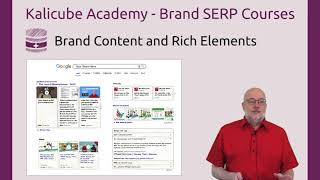
Google doesn't just show blue links for brand queries. It shows a rich ecosystem of signals designed to answer one question: Should I trust this brand?
1. Knowledge Panel, the grey box on the right (desktop) or top (mobile) with your logo, website, social profiles, and description. This is your first impression. If it's wrong, it's wrong for millions of people.
2. Sitelinks, 4-8 blue links directly under your main result, pulling users to key pages (pricing, blog, contact, about). You don't control which pages Google picks, but strong internal linking signals which ones matter.
3. Aggregate Review Score, the 4.5-star rating showing below your main result. Comes from Google Business Profile, Google Reviews, or third-party aggregators. Potential customers see this before anything else. A 2-star rating is a dealbreaker.
4. News Results, if you publish content regularly or have media coverage, Google may show a news carousel. Industry leaders and companies with active PR see this; most don't.
5. Images, a carousel of photos of your product, office, team, or brand imagery. These come from your website, social profiles, and Google Images. A generic or outdated image pack makes you look abandoned.
6. People Also Ask, 4 common questions about your brand ('Is [brand] legit?', '[Brand] vs [competitor]', '[Brand] pricing'). Answering these in your own content lets you own the answers instead of letting competitors claim them.
7. Social Profiles, verified links to your LinkedIn, Twitter, Instagram, Facebook. If these are missing or outdated, you look less established.
8. Videos, YouTube videos of your product, tutorials, or testimonials. Video engagement is rare but powerful on Brand SERPs.
9. Related Searches, the bottom row of suggested searches ('Brand name pricing', 'brand name reviews'). These tell you what searchers want to know. Ranking for these is a secondary win.
10. Paid Ads, if you run Google Ads for your brand name, they appear at the very top. Most companies do; it's cheap insurance that competitors don't poach your traffic.
These 10 elements are the classic Brand SERP. There's a newer one worth watching closely.
AI Overviews now show up on a meaningful share of brand queries too, not just informational ones. Google's AI-generated summary synthesizes a paragraph about your company from whatever sources it trusts most, and it doesn't always frame you kindly.
AI Overviews can be a harsher judge of your brand than a chatbot. BrightEdge's March 2026 analysis of billions of monthly searches found Google AI Overviews are 44% more likely than ChatGPT to surface negative brand sentiment overall (roughly 2.3% of brand mentions versus 1.6%), and the two engines disagree on which brands deserve criticism 73% of the time. Separately, Seer Interactive's 2026 study of 53 brands and 5.47 million queries found that being cited inside an AI Overview earns a brand +120% more organic clicks per impression than showing up on the same SERP without a citation. Your Brand SERP strategy now has to account for a summary you don't write, pulled from sources you may not fully control.
Winning the Knowledge Panel
The Knowledge Panel is non-negotiable. It's the first thing people see on mobile and mobile traffic is 60%+ of all searches.
Google Business Profile, the easiest signal. Verify your business, fill out every field, add high-quality photos (your office, product, team), and keep hours and contact info current. This is the primary source for Google's knowledge panel on local/service businesses.
Wikipedia, if you're a notable company or person, a Wikipedia article lends credibility. You don't write it (others do), but you can support it with media coverage and verifiable facts. Wikipedia's information flows into Google's Knowledge Panel automatically.
Wikidata, a machine-readable database that feeds Google. Adding your company to Wikidata (structured facts like founding date, CEO, headquarters) takes 30 minutes and ensures Google has the right info to display.
Schema Markup, structured data on your website (Organization schema with name, logo, contact, social profiles, address) tells Google which info to surface. This doesn't guarantee Knowledge Panel inclusion, but it validates the info you want shown.
If your Knowledge Panel is wrong (wrong phone number, outdated description, missing social links), you can request changes directly in Google Business Profile or submit feedback through Google Search Console.
Managing Review Aggregate Scores
G2, the B2B software review marketplace A free G2 profile was collecting reviews passively, but FlippingBook wanted its Brand SERP and buyer research moments to actively convert instead of just existing. Upgraded from a free G2 profile to a paid plan, adding profile video, CTA buttons, and downloadable content, then ran a structured review-collection push through email, support chat, and email signatures.
Result: 111% increase in sales sourced from G2 leads in year one, with G2 leads converting to sales conversations at a 33% rate versus 25% for other channels. (First 12 months on the paid plan).
SourceA 2.8-star rating on your Brand SERP is worse than no rating. Potential customers see the number before reading a single review.
Google Reviews, the primary source. Most searchers trust Google Reviews most. One negative review can drag your average down; you need a steady stream of 4-5 star reviews to keep your average above 4.5.
G2 and Capterra, B2B software companies see these aggregators prominently. If you're a SaaS, these matter as much as Google Reviews. Run a review campaign pushing customers to G2.
Trustpilot and TrustRadius, industry-specific but powerful. A 4.8-star rating on Trustpilot on your Brand SERP builds trust faster than any copy.
Strategy, don't chase reviews indiscriminately. Target happy customers post-success, make the review process frictionless (direct links to review pages), and respond to every negative review professionally within 24 hours. Responding to a 2-star review publicly shows future readers you care about feedback.
Controlling the Image Pack
If the images on your Brand SERP are a mix of old blog posts, user-generated content, and random screenshots, you look disorganised.
Google pulls images from your website (screenshots, logo, team photos), Google Business Profile (storefront photos), your social profiles, and Google Images (anything indexed). The algorithm favours images with high engagement and recent publication dates.
Strategy, publish recent, high-quality images on your website and social accounts. Use alt text with your brand name and industry keywords. Pin your best image on Google Business Profile. If negative or unflattering images rank, create and publish 10-20 new, high-quality alternatives and wait for Google to reprioritise.
Suppressing Negative Results
You can't delete a bad Glassdoor review or a critical article. But you can drown it out.
Create more positive, authoritative content, every new press mention, case study, or thought leadership article pushes negative results further down. If a negative review is ranking #2 on your Brand SERP, publish 5 substantial pieces of content on your website, LinkedIn, and industry publications. In 30-60 days, that review will be on page 2.
Respond publicly, if a major negative result (forum post, review site, criticism) is ranking, a public, factual response published on your own website or social profiles signals to Google that there's a counter-narrative. Google likes freshness and multiple perspectives.
Legal only as last resort, DMCA takedowns and legal threats work only for genuine defamation or false claims. Overusing them signals weakness and often backfires (the criticism gets reprinted elsewhere with more visibility).
Brand Keyword Strategy
Zapier's own domain, via dedicated app-integration landing pages Generic homepage and blog content couldn't capture the thousands of specific, high-intent 'connect [App A] with [App B]' searches Zapier's own users were already typing. Built a dedicated landing page for every app-integration combination on the platform, a brand-and-product-adjacent keyword strategy applying the same logic as a '[Brand] vs [competitor]' or '[Brand] pricing' page: answer the exact-match query yourself instead of leaving it to a third party.
Result: These integration pages alone drive 16% of Zapier's entire organic traffic. (Ongoing, measured as of the case study's publication).
SourceYour Brand SERP doesn't end at your company name. Extend it to:
- '[Brand] vs [competitor]', 'HubSpot vs Salesforce', 'Slack vs Microsoft Teams'. Rank for these with a dedicated comparison page written from your perspective.
- '[Brand] pricing', answer this on your website. If you don't, searchers see a Google Featured Snippet from a third-party pricing aggregator, which may be outdated.
- '[Brand] reviews', own this with a page highlighting your best reviews and ratings from multiple platforms.
- '[Brand] jobs', if you're hiring, rank for this with a careers page.
- 'Is [brand] legit?', a common worry for newer companies. A single credible article answering this can shift perception.
These queries have lower volume than generic keywords but 10x higher intent. Ranking for 'Slack pricing' brings a customer one step closer to buying than ranking for 'project management software'.
Which Element to Fix First
Not every Brand SERP problem deserves the same urgency. Sort by impact versus effort before you touch anything:
| Element | Typical fix effort | Impact if broken | Fix first if... |
|---|---|---|---|
| Review aggregate score | Weeks (ongoing campaign) | Very high, dealbreaker | Rating is below 4.0 or trending down |
| Knowledge Panel accuracy | Hours to days | High, first impression | Phone, hours, or description is wrong |
| Negative result on page 1 | 30-60 days | High, but slow to fix | A specific bad link is ranking top 3 |
| AI Overview sentiment | Weeks, indirect | Medium-high, growing | You've confirmed a negative AI summary via manual prompts |
| Image pack | Days | Medium, cosmetic | Images look outdated or off-brand |
| Brand keyword pages (pricing, vs, reviews) | Days per page | Medium, compounds over time | A third party currently answers these for you |
Start at the top of this table, not wherever feels most urgent emotionally. A wrong phone number in your Knowledge Panel is a five-minute fix; a negative review pattern needs a campaign, not a single edit.
Final Thought
Your Brand SERP is your reputation compressed into a single screen. Treat it like a storefront, keep it clean, stock it with trust signals, and remove friction from the path to your website. The people landing there are already primed to buy. Your job is not to convince them; it's to never give them a reason to doubt.