Programmatic SEO
Programmatic SEO is building hundreds or thousands of web pages automatically from a database, instead of writing each one by hand. You find a search pattern that repeats, like "best restaurants in [City]" or "connect [App A] to [App B]", then fill in the blanks using a spreadsheet or database.
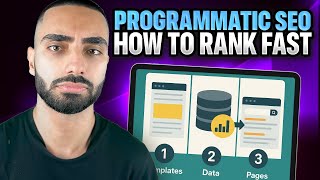
One template plus one thousand rows of data becomes one thousand pages, each targeting a slightly different search query.
Quick Summary
- Programmatic SEO lets one team publish thousands of pages that no editorial team could manually write.
- It works best when each page is backed by genuinely unique data, not just a find-and-replace of one word.
- Google's March 2024, 2025, and May 2026 core updates all sharpened enforcement against "scaled content abuse", thin, near-identical pages with no real value.
- The core workflow is: find a repeating keyword pattern, build a dataset, design a template, render pages, then prune thin ones.
- High-intent patterns like "[city] [service]" or "[tool] vs [tool]" convert at 3 to 5 times the rate of generic blog posts.
Why Search Behavior Is "Fractal"
Nobody just searches "project management software" once. They search "Asana vs Trello," "Asana vs ClickUp," "Asana vs Monday," and dozens more. A human content team might write two of those per week. A programmatic system can publish all of them in one afternoon.
This works because search intent follows a pattern: one "head" keyword (e.g., "CRM software") splits into dozens of modifier variations. Common modifier types include:
- By city or location
- By price tier
- By competitor comparison
- By use case
Each variation is its own long-tail query with lower competition and higher purchase intent.
What is a long-tail keyword? A long-tail keyword is a specific, multi-word search phrase like "best CRM for freelance designers under $50/month." These get fewer searches than broad terms, but the people searching them are much closer to making a decision, which means they convert better.
Real Company Results
Case Study 1: AI Image Generator (2024-2025)
An AI image generator platform worked with the agency Omnius from March 2024 to January 2025. The goal: use programmatic SEO to drive signups.
They built a keyword matrix using variables like object type, format, orientation, and use case, generating queries like "ai image generator for ecommerce" and "free anime ai image generator." Then they published over 15,000 pages in under 90 days using WordPress with Advanced Custom Fields (ACF), batching 100-200 pages per week.
Results after 10 months:
- Organic traffic: 102 to 8,500 clicks per month (850% growth)
- Monthly signups: 67 to 2,100+ (a 3,035% increase)
- Keywords ranking on page one: 305+
- Conversion rate: 10.4% to 24.81%
The pages worked because each one matched a specific tool use-case query and led directly to a working product, not a generic landing page.
Case Study 2: Zapier's Integration Pages
Zapier built a programmatic page for every app it supports and every two-app combination, patterns like "Connect Notion to Slack" and "Gmail to Google Sheets." Each page pulls real triggers, actions, and workflow templates from Zapier's own product database.
As of 2025, Zapier ranks for roughly 1.3 million keywords and pulls around 16.2 million monthly organic visitors. Salt Agency's case study documents how this approach quadrupled Zapier's organic growth over the program's lifetime.
Why Zapier's pages work: Each "Connect [App A] to [App B]" page is genuinely unique, the triggers, actions, step-by-step instructions, and template screenshots all come from real product data. Google sees 1.3 million distinct, useful pages, not 1.3 million copies of the same text with names swapped.
How Programmatic SEO Actually Works
Here is the step-by-step process:
Step 1: Find a Repeating Keyword Pattern
Look for search templates that Google fills in over and over. Good sources:
- Google autocomplete (type a partial query and watch the suggestions)
- "People Also Ask" boxes in search results
- Ahrefs or Semrush keyword explorer filtering for "modifier + entity" queries
Strong patterns need all three of the following:
- Consistent structure across many variations
- Real search volume across those variations
- A dataset you can actually build or buy
Step 2: Build Your Dataset
Each row in your dataset becomes one page. Common data sources:
- Your own product or integration database (like Zapier)
- A Google Sheet with location + service data
- A third-party API (real estate listings, restaurant data, job postings)
- User-generated content (reviews, Q&A, ratings)
The rule: every row needs at least one genuinely unique data point, not just the city name, but also local reviews, real prices, actual listings, or verified ratings.
Step 3: Design the Template
One template with slots for the dynamic data. The template needs:
- A dynamic H1 tag (e.g., "Best [Service] in [City]")
- Dynamic meta title and description
- At least one data-driven section that differs per page (a table, a list, a map, a calculator)
- Enough hand-written framing copy that the page reads like a human wrote it
Step 4: Render and Publish
Common tech stacks used in 2025:
- WordPress + ACF (Advanced Custom Fields): most accessible, large plugin ecosystem
- Next.js or Astro: best for developers, fast static output
- Webflow CMS: good no-code option for designers
- Airtable or Google Sheets as a CMS via a static site generator
Publish in batches and run QA on a staging environment first. Aim for 100-200 pages per batch so you can catch template errors before they affect thousands of URLs.
Step 5: Index Infrastructure
- Create XML sitemaps and split them into chunks of 10,000 URLs max (Google's limit per sitemap file)
- Build "hub pages" that link to groups of programmatic pages (e.g., a "Restaurants in California" hub page linking to each city)
- Submit your sitemap in Google Search Console and monitor for crawl errors
The Google Line You Cannot Cross
Google's March 2024 core update introduced the term "scaled content abuse" in its official spam policies. This describes pages that are mass-generated with no unique value. The January/February 2025 and May 2026 follow-on updates tightened enforcement further, the May 2026 update used Gemini-powered quality models to detect thin template variation at scale and hit sites with -40% to -90% traffic drops within 72 hours, with collateral damage spreading to editorial pages on sites where programmatic content made up most of the domain.
What crosses the line: pages where the only difference between them is one swapped word (the city name, the product name), with no real data, no unique copy, and no reason to exist beyond capturing a keyword.
What does NOT cross the line: pages backed by genuine data assets, real listings, real user reviews, real product integrations, real pricing, where each page would still be useful even if you removed the keyword optimization.
Common mistake: indexing everything you generate. If you publish 50,000 pages but only 8,000 have meaningful unique data, the 42,000 thin ones drag down the quality signal for your entire domain. Use noindex on every row that falls below your data threshold. Exclude thin pages from your sitemap entirely. This is the single most common reason programmatic sites get penalized after core updates.
Building a Quality Gate
Zapier's integration-directory pages (Connect App A to App B) With well over a million possible app-pair combinations, publishing every combination automatically would flood the index with pages nobody needs Zapier only generates a page once the pair has enough proprietary data (real triggers, actions, and 4-8 workflow templates pulled from its own product database) to be genuinely distinct, and pages sit on noindex until early engagement signals justify indexing them
Result: The directory scaled to just over 50,000 published pages ranking for roughly 3.6 million keywords, growing from 1.19M to 5M monthly organic visitors between 2020 and 2024 and crossing 9M by 2025 (2020-2025).
SourceA quality gate is a check built into your template that counts how many unique data fields are available for each row, and blocks the page from rendering if it falls below a minimum.
For example: if your dataset has 8 unique fields per city (reviews, address, hours, photos, price range, category, rating count, last-updated date), set your quality gate at 5. Any row with fewer than 5 populated fields gets a noindex tag or returns a 404.
SEO consultant Aleyda Solis calls this the "minimum viable page" filter. Sites that implement it consistently tend to survive Google core updates.
Sites that skip it tend to see sudden traffic cliffs, a loss of 30-60% of programmatic traffic that happens within days of a Google update.
Pro tip, add "freshness signals" to your template. Include a "Last updated" date that reflects when your data was actually refreshed. Pages with stale data (price data from 2021 on a 2026 page) get flagged as low-quality. If your data source updates, your pages should re-render automatically.
Choosing the Right Keyword Pattern
Thinkific's course-creator landing page program Course creators all needed near-identical page types (course sales pages, webinar registration pages, promo pages) that a small marketing team could never hand-build one by one Thinkific's marketing team templated the recurring page pattern and published over 700 landing pages built on the same repeatable structure
Result: Drove more than 150,000 conversions in under two years, including one two-week promotional push that brought in 600 new Thinkific Pro signups and doubled traffic and conversion rate versus the year before (under 2 years).
SourceNot all repeating patterns work equally well. Here is how to evaluate one:
Patterns that tend to perform well:
- [Tool A] vs [Tool B]: high commercial intent, large number of pairs
- [Service] in [City]: local intent, easy to build with location data
- How to connect [App A] to [App B]: integration intent (the Zapier model)
- [Product] for [Use Case]: buyer-stage queries, strong conversion rates
- [Job Title] salary in [City]: data available from public sources, high volume
Patterns that tend to fail:
- Best [generic category]: too broad, too competitive, hard to differentiate
- What is [concept]: informational intent, hard to turn into unique pages at scale
- Any pattern where your dataset has fewer than 3 unique fields per row
The One-Line Takeaway
Programmatic SEO is not about publishing more pages, it is about finding patterns in how people search and having the data to answer each variation better than anyone else.
Related Concepts
- Content Clusters, programmatic pages need hub pages to link them together. Clusters are the architecture that makes the directory crawlable.
- Technical SEO, sitemap chunking, canonical tags, and crawl-budget management are what keep a 50,000-page site indexable.
- Keyword Research, the entire strategy lives or dies on finding a repeating search pattern with real volume behind it.