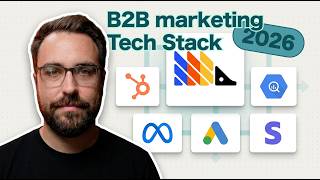
The Old Way vs. The Composable Stack
Ten years ago, marketing data lived in silos. Google Analytics in one dashboard, Salesforce reports in another, ad performance in Facebook Ads Manager. You exported CSVs, merged them in Excel, and made decisions on stale data.
The modern marketing data stack (2026) is different. Data flows through one unified warehouse. You transform it once, activate it everywhere. A marketer never touches CSV again.
This shift happened because cloud warehouses got cheap, ETL tools automated data movement, and reverse-ETL pushed enriched data back to where it's used. The result: one source of truth, no duplicated effort, and real-time activation.
Layer 1: Source Systems
Your data starts in the tools you already use. Don't try to replace them, pipe their data out.
Website and app analytics. Google Analytics 4 (GA4) sends events, page views, clicks, conversions, custom events. You own the raw event stream. Segment and mParticle are tag managers that collect GA4, Amplitude, Mixpanel, and custom events into one stream.
CRM. Salesforce and HubSpot hold your accounts, contacts, deals, and pipeline. This is the single source of truth for revenue, don't guess it.
Ad platforms. Google Ads, Meta Ads, LinkedIn Ads, each has its own performance data: spend, impressions, clicks, conversions. Each platform's data is siloed unless you pull it out.
Product analytics. Mixpanel and Amplitude track user behavior inside your app, funnels, cohorts, feature adoption. This tells you which customers are active, which are churning.
Email. Mailchimp, HubSpot, or Klaviyo track opens, clicks, replies. This behavior reveals intent.
Billing and CRM integrations. Zendesk (support), Stripe (billing), Intercom (customer comms) all have data worth centralizing.
The rule: if you log into it to check a metric, its data should live in your warehouse.
Layer 2: ETL/ELT, Getting Data In
You don't manually pull data from 12 sources. Connectors do it automatically.
Fivetran (founded 2013, acquired by Datadog 2023) is the oldest and most trusted. You connect your Salesforce account, your Google Ads account, your Stripe account. Fivetran runs on a schedule (every hour, every 6 hours, daily, you choose). New data lands in your warehouse automatically. Fivetran is fully managed, they handle schema changes when platforms update.
Airbyte is open-source and free if you self-host, or managed if you use Airbyte Cloud. It has more connectors than Fivetran because anyone can build them. You get more flexibility but less hand-holding.
Stitch (now part of Talend) is cheaper and good for small stacks.
Custom scripts, if a tool has an API but no pre-built connector, write a Python script that calls the API and writes to your warehouse. This is common for proprietary tools or niche platforms.
The pattern: Source → Connector → Warehouse. Data lands raw and untransformed. You clean it up in the next layer.
Layer 3: The Warehouse
This is where all your data lives, clean, queryable, indexed.
BigQuery (Google's data warehouse, 2010) is the most popular in marketing. You get 1 TB of query free per month. Storage costs $0.02/GB/month. It integrates with Google products (GA4, Google Ads) natively. If you use Google Cloud already, BigQuery is your obvious choice.
Snowflake (founded 2012, IPO 2020) is the premium option. It's slightly faster and has strong support for complex workloads. It's more expensive ($2–4 per credit, and you consume credits per query). Snowflake is common in enterprises because it handles massive data volumes elegantly.
Databricks (founded 2013, acquired by Elon Musk's team) is the newcomer. It combines data warehousing with machine learning. If you plan to build predictive models (churn prediction, lead scoring), Databricks is stronger than BigQuery.
All three are column-oriented (optimized for analytics, not transactions), support SQL, and integrate with every activation tool downstream.
The reality: pick the one your company already uses. If you're on Google Cloud, BigQuery. If you're AWS-native, Redshift. If you want vendor independence, Snowflake.
Layer 4: Transformation, dbt (Data Build Tool)
You have raw data in the warehouse. Now you transform it.
Transactions from Salesforce arrive with fields like created_date_unix_ms. You convert it to account_created_date, add a days_since_created column, and join it to the accounts table. Email opens from Mailchimp arrive at the contact level; you aggregate them to the account level. Ad spend arrives separately from conversions; you join them by utm_source and utm_campaign.
dbt (founded 2017, raised $450M at $2.2B valuation) is how you do this. You write SQL. dbt turns your SQL into tables and views in the warehouse. It tracks dependencies, if you change one transform, dbt knows which downstream tables to rebuild. It also tests your data: "Does this table have any null account IDs?" Fail the transform if it does.
dbt runs on a schedule (usually every 6 hours or daily). After it finishes, your transformed data is clean, consistent, and ready to activate.
Example: you write a dbt model that says "Create a table marketing_qualified_leads with account ID, lead count, average engagement score, MQL created date, and CRM deal stage." You reference this model in your activation tools downstream. One source of truth.
Layer 5: Activation (Reverse ETL)
Data team and a new outbound automation team combining data engineers with marketers Every time marketing wanted enriched Snowflake data inside Salesforce or HubSpot for personalization, the data team had to hand-build and maintain Python scripts to move it. Adopted Hightouch to sync Snowflake data directly to Salesforce and HubSpot, standing up a new outbound automation team that pairs data engineers with marketers to target and personalize outbound at scale.
Result: That new channel now drives 25% of all of Ramp's sales pipeline (ongoing since adoption).
SourceYou've cleaned and modeled your data. Now push it back to where it's used.
Reverse ETL tools move data from your warehouse to business apps:
Hightouch (founded 2021, $110M raised) is the largest. You define a "sync": pull audience from BigQuery, sync to Salesforce as a custom field, or to your ad platform as a lookalike audience, or to your email tool as a segment. Syncs run on a schedule or in real-time (usually hourly).
Example use case: Your dbt model surfaces high-propensity leads. Hightouch syncs them to Salesforce as a "hot lead" flag. Sales sees it in their CRM. Simultaneously, Hightouch creates a lookalike audience in Google Ads and a segment in HubSpot email.
Census (founded 2020, $60M raised) is similar. Slightly stronger integrations with some platforms, slightly different pricing.
Segment (founded 2011, acquired by Twilio 2021) was the original reverse-ETL tool. It's now focused on customer data platforms (CDPs) more than pure activation, but it still works.
Why Reverse ETL Matters
Marketing and growth team running nurse-recruitment campaigns Needed to run rigorous incentive experiments and build precise audiences without waiting on engineering for a fresh export every time. Used Hightouch to sync Snowflake-modeled churn scores, CLV, and experiment cohorts directly into Google Ads, Facebook Ads, and Marketo, then ran a controlled bonus-amount experiment on the synced audiences.
Result: Saved $1M annually in marketing spend, including a $260K reduction on one bonus-amount experiment alone, while growing 360% year-over-year (2020-2021).
SourceWithout reverse ETL, your activation tools live in the dark. Your Facebook Ads account doesn't know which audiences are valuable because that analysis lives in your warehouse. You have to export a CSV, upload it manually every week, or it goes stale.
Reverse ETL wires your insights directly to your activation channels. You build a model once ("high-intent accounts based on engagement + firmographic data"). Every 6 hours, that audience syncs to Google Ads, LinkedIn Ads, and your email tool. Stale audiences die. You sell based on real-time intent.
Layer 6: Visualization
Data in a warehouse is useless if humans can't see it.
Looker (acquired by Google 2019, now free with BigQuery) lets you build dashboards and exploratory reports on top of your warehouse. You define "explores", views that business users can query without writing SQL. A marketer clicks a few filters and gets "Leads by source, this month vs. last month." Looker is best if you're on Google Cloud.
Metabase is open-source and free. You self-host or use their cloud. Set-up is 5 minutes. You connect your warehouse and get instant dashboards. Metabase is scrappy and fast.
Tableau (acquired by Salesforce 2019) is the premium option. It handles massive datasets and complex interactivity. Cost: $70–140/user/month.
Mode is a good middle ground, collaborative SQL notebooks where analysts and stakeholders write and share queries.
Pick one: Looker if you want it native to Google Cloud, Metabase if you want free and simple, Tableau if budget doesn't matter and you need bulletproof performance.
Why This Beats Point Solutions
Imagine your ad platform had a CRM built in. You'd use it, for a day. Then you'd realize you want to slice conversions by customer segment, or compare performance against forecast, or build a custom audience using historical support tickets. One tool can't do all that.
The composable stack philosophy: one source of truth. All your data in one warehouse. You transform once. You activate to 30 different places. If your Salesforce definition of "qualified lead" changes, you update dbt and every downstream tool updates automatically.
Point solutions duplicate data and logic. You define "qualified lead" in HubSpot and again in your ad platform. They drift. One tool marks someone as qualified; the other doesn't. You make bad decisions based on conflicting signals.
The composable stack eliminates this. One definition of truth. All tools sync from it.
What Marketers Own vs. What Data Engineers Own
Your data team owns the infrastructure: choosing the warehouse, maintaining connectors, writing dbt transforms, deploying reverse-ETL syncs. Marketers don't need to know how; they just use the data.
But here's what marketers should understand:
Know the transformation schedule. If dbt runs daily at 2 AM, your dashboards show yesterday's data. If a campaign launches at 3 AM, the warehouse might not have 24 hours of data until tomorrow evening. Plan reporting and activation around the schedule.
Understand audience definitions. Ask: "What's in this segment?" Your data engineer should have documentation in dbt. "MQL = contact with 3+ engagement points AND account with $10M+ revenue AND created in last 90 days." This matters because you'll use it in campaigns.
Know data freshness. Some data updates every 6 hours. Some updates daily. Real-time syncs (email, ad platforms) get fresh data. Batch syncs (Salesforce integrations) might lag. Plan your activation around freshness.
Care about data quality. If your warehouse has 40% null values for a field, it's garbage. Ask your data team: "What's the quality bar for this source?" A missing revenue field might mean "we never collected it" or "the CRM broke during migration." Know the difference.
The Bottom Line
In 2026, a marketing data stack means one warehouse connected to everything. You stop exporting CSVs. You stop arguing about what "qualified" means. You build your ideal audience once and activate it to Google, Meta, LinkedIn, and your email platform in parallel. Your data is stale at exactly 6 hours old, not 6 days old.
This isn't just cleaner. It's faster. It's more accurate. And it's how you scale.