Strategy vs. Tactics
What It Is
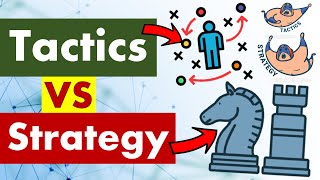
Strategy and tactics are two different levels of planning. A strategy is your overall plan: the goal you want to reach and the approach you will take to get there. A tactic is a specific action you take to carry out that plan. Strategy answers "why and who." Tactics answer "what and how."
Think of it this way: if you are lost in a city, your strategy is "get to the train station by heading north." Your tactics are "turn left at the pharmacy, walk two blocks, cross at the lights." The tactics change as you navigate. The strategy stays the same.
In marketing, businesses mix these up constantly. They jump straight to tactics: "Let's run Instagram ads, post on LinkedIn, and try a podcast." But without a strategy, those actions pull in different directions. They waste budget and produce no lasting result.
Real-World Example
In 2022, Airbnb cut its performance marketing budget by roughly $800 million and shifted its strategy away from paid search to brand building. Instead of bidding on millions of keywords (a tactic), the company invested in TV campaigns and PR that told the emotional story of belonging. By 2023, direct and organic traffic made up over 90% of Airbnb's total web visits, and the company posted a full-year net income of $4.8 billion, its first profitable year as a public company.
Airbnb: Brand Strategy over Paid Tactics (2022-2023)
Airbnb stopped chasing clicks and started building brand recognition. The strategy was to make Airbnb a household name. The tactic was mass-reach TV and editorial content, not performance ads. Organic traffic climbed to over 90% of all site visits. Net income reached $4.8 billion in 2023. Strategy set the direction. Tactics followed.
Why It Matters
Most marketing failures are not execution failures. They are planning failures: the team executed the right tactics for the wrong strategy, or had no strategy at all.
Wise plc FY2024 annual report Wise's documented strategy is to make cross-border money movement radically transparent and cheap, so word-of-mouth referral, not one-off acquisition tactics, becomes the primary growth engine. A pricing and transparency strategy applied consistently across every product and market, rather than a rotating set of acquisition campaigns.
Result: Revenue grew 24% to £1.05 billion and gross profit rose 71% year-over-year, with roughly 65% of new customers arriving through referrals (Fiscal year 2024 (April 2023 - March 2024)).
SourceA 2024 Content Marketing Institute study found that only 40% of B2B marketers have a documented marketing strategy. The other 60% are running tactics with no coherent plan connecting them. Research from KEO Marketing shows that companies with a documented strategy outperform those without by nearly 3x on ROI: roughly $290,000 returned on a $50,000 budget versus $105,000 for teams with no written strategy.
When you know your strategy, every tactic decision becomes easier. You can quickly say yes or no to new ideas by asking: "Does this move us toward the goal, or away from it?"
How It Works
Super Bowl LVI broadcast Coinbase's strategy was to convert one moment of mass-market attention into legitimacy and mainstream trust for crypto; the QR-code spot was one tactic executing that strategy, not the strategy itself. A 60-second ad showing only a bouncing QR code on a black screen, linking to a landing page offering $15 in free Bitcoin for new signups.
Result: 20 million hits on the landing page within one minute, and the Coinbase app jumped from 186th to 2nd place on Apple's App Store within hours (Single broadcast night).
SourceA clean way to think about this is the three-layer model: Goal at the top, Strategy in the middle, Tactics at the bottom. Each layer serves the one above it.
Start with the goal. Define the strategy: who you are targeting, what position you are taking, and how you will win against alternatives. Then choose tactics that serve the strategy. Finally, track metrics that tell you whether the tactics are working. If they are not, you change the tactics, not the strategy. You only change the strategy if the goal itself shifts.
Common Mistakes
The biggest mistake: treating a tactic as a strategy.
"Our strategy is to be on TikTok" is not a strategy. TikTok is a channel, a tactic. A strategy would be: "We will win 18-24 year old buyers by positioning our brand as the affordable alternative to premium competitors, using short-form video to demonstrate value in under 30 seconds." Tactics follow from that. If you find yourself naming a platform, a tool, or a campaign when someone asks for your strategy, stop and go one level up.
The One-Line Takeaway
Strategy decides where you are going and why; tactics are simply how you get there, and you must have the first before you choose the second.