Mission, Vision, Values
What It Is
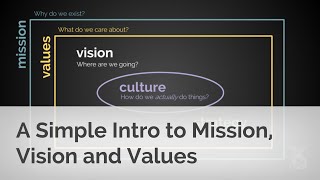
Every company has a reason it exists, a picture of where it is going, and a set of beliefs that guide how it operates. These three things, mission, vision, and values, are the foundational documents of any brand.
Your mission answers: "Why do we exist right now?" It describes what the company does, who it serves, and what problem it solves today. Your vision answers: "Where are we going?" It is a picture of the future the company is trying to build, often 5 to 10 years out. Your values answer: "How do we behave along the way?" They are the non-negotiable principles that guide every decision, hire, and campaign.
Most companies write all three in an afternoon, print them on the wall, and forget about them. The companies that treat these as living strategy documents, and use them to filter product decisions, hiring, and marketing messages, consistently outperform those that do not.
Real-World Example
Patagonia is the clearest case study. In 2022, founder Yvon Chouinard transferred ownership of the entire company, worth roughly $3 billion, to a trust and nonprofit dedicated to fighting climate change. This was not a sudden PR move. It was the logical end of a mission they had held since 1973: "We're in business to save our home planet." Every product decision, supplier choice, and ad campaign for decades pointed toward that sentence. When the ownership transfer happened, it made global news and drove a measurable spike in brand searches and sales, because the act was completely consistent with what they had always said.
Patagonia: Mission as Strategy
Patagonia's 2022 ownership transfer to an environmental trust was valued at $3 billion. The company had publicly committed to donating 1% of sales to environmental causes since 1986. Their "Don't Buy This Jacket" 2011 Black Friday ad, which told customers to buy less, increased sales by 30% the following year because it was seen as completely authentic. The mission was not marketing copy. It was the operating system.
Why It Matters
HelloFresh's internal culture, built around values like an 'egoless' data-led decision culture and employee development budgets Meal-kit delivery has thin margins and high operational churn risk, so HelloFresh needed its stated values to actually change day-to-day behavior, not just sit in a handbook. Backed the values with concrete mechanisms: a quarterly all-staff engagement survey, an annual per-employee development budget, and a stated preference for data-led debate over hierarchy.
Result: 70% of HelloFresh employees say it's a great place to work, versus 57% at a typical U.S.-based company, and the company's mission and values are cited as a direct motivator by a third of staff. (Ongoing, measured via quarterly survey).
SourceA clear mission, vision, and values set solves three real business problems.
First, it filters marketing messages. When a brand knows what it stands for, copywriters and campaign managers have a reference point. Instead of arguing over tone in a meeting, the team checks the values document and moves on.
Second, it drives employee performance. Research from Gallup shows that employees who feel their job is important because of the company mission are 68% more likely to be engaged at work, and highly engaged teams show 21% greater profitability (Gallup, 2024). Engaged employees become brand advocates. They recommend products, speak positively about the company, and stay longer.
Third, it builds customer trust. Consumers increasingly buy from brands whose stated beliefs match their own. A company with a clear, consistent mission gives customers a reason to stay loyal beyond price.
How It Works
DoorDash's mission statement, 'we want to shrink every city by bringing people anything, faster, fresher, and from farther away' Gig-economy logistics companies face constant pressure to justify expansion and automation moves; DoorDash ties each one back to the mission to keep decisions coherent instead of opportunistic. CEO Tony Xu has publicly framed major bets, including the 2024 grocery-delivery push and safety/automation pilots, as direct extensions of the mission rather than separate side projects.
Result: 58% of DoorDash employees say the mission, vision, and values motivate them at work, and 9% cite the mission specifically as the reason they stay, a direct link between a pressure-tested mission and retention. (Ongoing, cited through 2024-2025).
SourceWriting mission, vision, and values is a process, not a brainstorm. It requires honest input from leadership, frontline staff, and sometimes customers. Here is a practical framework:
The pressure test in step five is the most important part. If your last ten big decisions do not reflect your stated mission, one of two things needs to change: the words or the behavior. Most companies change neither, which is why most mission statements are ignored.
Common Mistakes
The biggest mistake: writing for the brochure, not the boardroom.
Most mission statements are written to impress investors or customers, not to guide decisions. The result is vague phrases like "delivering world-class solutions" or "empowering communities." These mean nothing to an employee deciding whether to cut corners on a supplier audit, or to a marketer deciding whether to run a controversial campaign. Write your mission and values so specifically that someone could use them to make a real decision under real pressure. If the sentence works for any company in any industry, rewrite it.
Test your values against a hard hire.
Pick someone you almost hired but decided not to. Can you explain that decision using your values document? If you cannot, your values are not actually driving behavior, they are decoration.
The One-Line Takeaway
A mission, vision, and values set is only as powerful as the decisions it changes, if it lives only on the wall, it is not strategy, it is wallpaper.