Jobs To Be Done
People don't buy products. They hire them to get something done. A person buying a milkshake at 7am isn't buying a milkshake. They're hiring something to make a boring commute bearable and keep them full until lunch.
That's the core idea behind Jobs To Be Done (JTBD): customers have a recurring struggle or goal, and they "hire" your product to handle it. When you understand the job, you stop competing on features and start competing on fit.
Quick Summary
- Customers don't buy products. They hire them to accomplish a specific goal called "the job."
- Two people with identical demographics can hire completely different products for completely different jobs.
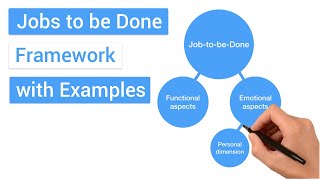
- Every job has three layers: functional (what they need to do), emotional (how they want to feel), and social (how they want to appear).
- JTBD research requires real interviews with recent buyers. Surveys alone won't reveal jobs you didn't know existed.
- Products that improve job completion by 20% or more are very likely to win in the marketplace (Strategyn research across hundreds of engagements).
Why Demographics Alone Fail
The JTBD framework was developed by Clayton Christensen at Harvard Business School. His research showed that demographic targeting often fails because two people with identical profiles can hire completely different products for completely different jobs. A 35-year-old parent and a 35-year-old entrepreneur might both use Slack. But one hired it to replace chaotic group texts for a home renovation. The other hired it to coordinate a remote team. Same product, different jobs, different reasons to stay or leave.
What makes JTBD powerful for advanced marketers is the shift it forces: from describing who your customer is to understanding what they're struggling with, what they've already tried, and what would make them fire your product tomorrow. It is a research lens, a messaging framework, and a product strategy tool all at once.
Marketers who apply it stop writing copy about features and start writing copy about the specific moment a customer's life gets easier.
Tony Ulwick pioneered JTBD in the 1990s at Strategyn under the name Outcome-Driven Innovation (ODI). Clayton Christensen later popularized the framework with his milkshake research at Harvard. Bob Moesta (Christensen's collaborator) developed the Switch Interview method for applying JTBD to sales and marketing. The framework has since been validated across hundreds of company engagements, with an independently verified 86% success rate, compared to an industry average of roughly 17% for standard product development approaches.
The Three Job Layers
U.S. drive-thru restaurants, milkshake product line Clayton Christensen's research team was hired to find out why the standard 'improve the product' fixes, thicker shakes, more flavors, weren't moving milkshake sales, despite extensive customer surveys and focus groups. Researchers staked out restaurants and found roughly half of milkshakes were sold before 8:30am, to solo commuters who bought nothing else and drove off immediately. The functional job wasn't 'satisfy a dessert craving,' it was 'give me something filling and one-handed to make a boring commute bearable.' McDonald's made the shake thicker (so it lasted the whole drive) and moved the dispenser for a faster morning purchase, instead of adding flavors aimed at afternoon dessert buyers.
Result: A fourfold to sevenfold increase in morning milkshake sales at the restaurants where the fix was applied (Research conducted in the 1990s, popularized in Christensen, Cook and Hall's 2005 Harvard Business Review article 'Marketing Malpractice: The Cause and the Cure').
SourceEvery job a customer hires your product to do has three layers stacked on top of each other:
- Functional job: The practical task. Example: "track my team's project deadlines."
- Emotional job: How they want to feel. Example: "in control, not stressed on Sundays."
- Social job: How they want to appear to others. Example: "a manager who has it together."
Most marketing only addresses the functional layer. That's why emotionally resonant competitor ads often outperform technically superior products. The company that speaks to all three layers wins, even when their product is objectively similar.
Real Company Examples
Arm and Hammer, 30%+ Revenue Growth in One Year
Arm and Hammer used JTBD interviews to discover over 100 different jobs consumers were hiring their baking soda for:
- baking
- cleaning
- deodorizing
- personal care
- and more
Each job was a separate market segment they hadn't been speaking to. Once they mapped those jobs and aligned product lines to them, every product line delivered double-digit growth within a year, with overall revenue growing more than 30% (Strategyn, verified case study).
The lesson: your product may already be doing jobs you've never marketed for. JTBD research surfaces those hidden use cases before a competitor does.
Intercom, From $1M to $50M ARR in Four Years
Intercom (a customer messaging platform) built their entire product strategy around JTBD research. Instead of targeting "SaaS companies with 50-500 employees," they interviewed customers to find the actual jobs being hired: "help me answer customer questions without hiring more support agents" and "help me onboard new users without a phone call."
That research directly shaped their messaging, away from "live chat software" and toward outcome-driven copy like "the business messenger built for growth." Intercom grew from $1M to $50M ARR between 2012 and 2016, with trial-to-paid conversion improving significantly once messaging matched the language customers used in interviews.
Spotify identified that people don't hire a music service to "access songs." They hire it to handle a specific emotional job: manage their mood without friction. "Help me feel energized on my morning run" is a job. "Help me focus while I work" is a different job. "Help me wind down after a stressful day" is a third job entirely. Spotify built playlists, features, and marketing campaigns around each of those emotional jobs, not around the technical feature of having 100 million tracks. That framing is why "Discover Weekly" became a retention tool, not just a recommendation engine. It solved the job of "surprise me with music that fits me without me having to search."
How to Run JTBD Research
Start with Switch Interviews, not surveys. JTBD research requires open-ended conversations with recent buyers, specifically people who switched to your product within the last three to six months.
The goal is to reconstruct the timeline of their decision: what triggered the search, what they tried first, what almost won, and what finally pushed them to buy. This "Switch Interview" method was developed by Bob Moesta and surfaces the exact language and emotional context customers use.
The interview has four phases:
- First thought: "When did you first realize you needed to solve this?" Surfaces the trigger event.
- Passive looking: "Were you aware of alternatives before you started actively searching?" Reveals context.
- Active looking: "What did you try first? What almost won?" Identifies your real competitors (often not who you think).
- Decision: "What happened the day you decided to buy?" Captures the final push, the "hiring" moment.
A typical JTBD research project involves 30 to 40 interviews, each 45 to 60 minutes long. You are looking for patterns in language, not just patterns in behavior. When five customers use the same phrase to describe their struggle, that phrase belongs in your ad copy, not in your internal jargon.
Where to Apply JTBD in Your Marketing Funnel
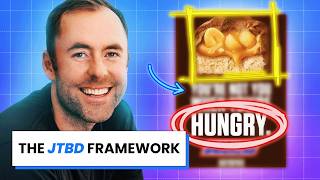
Global TV and digital advertising, 58 markets Snickers' category was crowded with candy bars competing on flavor and price, so the brand looked for the trigger moment that actually created the craving: the exact instant someone got irritable or 'not themselves' from hunger. The 'You're Not You When You're Hungry' campaign targeted that trigger moment directly in the ad itself, casting celebrities playing 'hangry' versions of ordinary people who were instantly cured by a Snickers bar, instead of running generic taste-focused ads.
Result: 15.9% increase in global Snickers sales in the campaign's first full year, with market share growing in 56 of the 58 markets running it (First full year after global launch).
SourceOnce you have mapped the job, align every stage of your funnel to the job's context:
- Ads: Target the trigger moment, the event that made the job urgent. "Finally fed up with spreadsheets?" speaks to the push force that starts the hire decision.
- Landing pages: Address the competing alternatives customers considered. Name what they tried before finding you.
- Onboarding: Remove the anxieties that stall activation. Anxieties are the emotional brakes that slow down or prevent the hire.
- Retention messaging: Reinforce the progress customers feel. Show them the job is getting done. Remind them of the pain they no longer have.
When to Reach for JTBD
JTBD isn't a framework you run once and archive. Reach for it when:
- Your messaging isn't converting despite strong traffic. This signals copy is describing features rather than solving a felt need.
- You're losing deals to "no decision", customers who agree they have a problem but don't hire anyone to fix it.
- Your buyer personas feel hollow. Demographic profiles that don't help you write better ads or emails are missing the job layer.
- You're entering a competitive market and need to find underserved jobs that incumbents are ignoring.
- You have churn you can't explain. Churn is often a fired product, the job changed, or a better hire appeared.
Common Mistakes
"Help me send better emails" is not a job. It's a feature request. The job is "help me look credible to clients so I can close more deals without hiring a designer." Features describe what the product does. Jobs describe what the customer is trying to accomplish in their life. Write your positioning around the job. The feature becomes the proof point, not the headline.
Surveys can confirm a hypothesis but cannot discover a job you didn't know existed. JTBD research requires the awkward follow-up question: "why did that matter to you?", which you can't ask a checkbox. Teams that skip real interviews end up with JTBD frameworks built on assumptions. Those are just slightly fancier versions of the personas they were trying to replace.
Ask customers what they were using before they hired your product, and what almost beat you in the final decision. "What did you almost go with instead?" is the single most valuable JTBD interview question. The losing alternative tells you exactly who you're competing with in the customer's mind, often not who you think. The reason they chose you over that alternative becomes your most credible differentiator and your sharpest ad hook.
The One-Line Takeaway
Your customer doesn't want your product. They want their problem gone. Find the job, and you've found your message.
Related Concepts
- Buyer Personas, JTBD doesn't replace personas. It makes them functional by adding the "why they hire" layer that demographics alone can't provide.
- Value Proposition, Once you know the job, your value proposition becomes a direct answer to the struggling moment that triggered the hire decision.
- Product-Market Fit, PMF is really job-market fit: you have it when your product reliably does the job better than any alternative your customer has tried.