AIDA & the Marketing Funnel
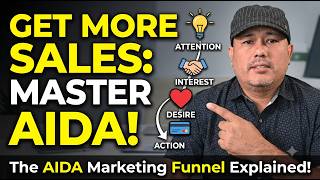
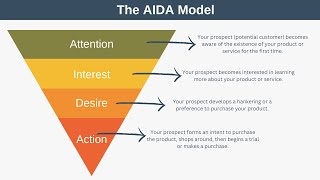
AIDA stands for Attention, Interest, Desire, and Action. It describes the mental journey a person travels from first seeing your brand to actually buying. An advertising executive named Elias St. Elmo Lewis sketched this model in 1898. Despite over a century of new technology and marketing channels, the basic sequence still holds. People do not go from "never heard of you" to "here is my credit card" in one leap.
Quick Summary
- AIDA maps the four mental steps every buyer goes through: Attention, Interest, Desire, Action.
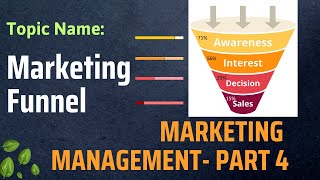
- The "funnel" shape reflects reality: many people see your ad, fewer engage, fewer still buy.
- Each stage needs different content, different channels, and different success metrics.
- Skipping a stage almost always kills the campaign, cold audiences cannot be pushed straight to purchase.
- Use AIDA as a diagnostic tool: find which stage is leaking, then fix that stage specifically.
Why This Model Is Still Taught in 2025
AIDA has survived 127 years because it maps human psychology, not technology. Technology changes. The way humans make decisions does not change much. A person still needs to notice something before they can care about it. They still need to care before they will want it. They still need to want it before they will act.
In 2024-2025, AI and automation have been layered on top of AIDA, not replacing it. Modern platforms track where a user is in the AIDA sequence and serve different content automatically. The model underneath is still the same four stages. Knowing the model lets you understand what the AI is actually optimizing.
The Four Stages Explained Simply
TikTok, the #eyeslipsface hashtag challenge Traditional beauty ads get scrolled past in under 2 seconds; e.l.f. needed a hook built for TikTok's native format instead of a repurposed ad e.l.f. commissioned an original 15-second song and challenge format designed specifically for TikTok, rather than running a standard product ad
Result: The hashtag accumulated nearly 1.2 billion views and drove a measurable lift in website traffic and sales (Launched October 2019).
SourceThink of a person scrolling through Instagram at 10pm. They are not looking for your product. They are just scrolling.
Stage 1: Attention, Your only job here is to interrupt the scroll. One sharp visual, one surprising headline, one unexpected hook. You have about 1.7 seconds (the average time before a user scrolls past a post, per Facebook's internal research). This is not the moment for product details. It is the moment to make them stop.
Stage 2: Interest, They stopped. Now they are reading. Your job is to explain what you do and why it matters to them specifically. Blog posts, product pages, explainer videos, and email welcome sequences live here. The key word is relevance: people stay interested when the content feels written for their exact situation, not a generic audience.
Stage 3: Desire, Interest is intellectual ("this seems useful"). Desire is emotional ("I want this for my life"). This is the hardest stage to create. Customer reviews, before-and-after comparisons, case studies, and social proof do the heavy lifting. The shift from Interest to Desire is the shift from "maybe" to "yes, but..."
Stage 4: Action, This is what you measure. A purchase, a sign-up, a demo booking, a free trial. The most common mistake at this stage is adding friction: complicated checkout flows, too many required fields, unclear next steps. Once Desire exists, your job is to get out of the way and make the action as easy as possible.
The Funnel Shape: Why Most People Never Reach Action
This is why "just run more ads" rarely solves a conversion problem. If you are losing people at the Interest stage (high clicks, low time-on-page), running more ads just sends more people into a leaky pipe. Fix the leak first.
Real-World Example 1: Dollar Shave Club
Dollar Shave Club launched in 2012 with a single YouTube video titled "Our Blades Are F***ing Great." The video cost roughly $4,500 to produce and ran 1 minute 33 seconds.
- Attention: An absurdist opening hook in the first 5 seconds. The founder walks toward camera saying "Hi, I'm Mike. And I'm here to talk to you about shaving."
- Interest: He explains exactly why Gillette blades are overpriced and why that is not your fault.
- Desire: A $1/month subscription feels like obvious common sense by the end of the video.
- Action: A single URL repeated twice. No other options.
The result: 12,000 orders within 48 hours of posting, 27 million YouTube views over time, and a $1 billion acquisition by Unilever in 2016. One video. Every stage of AIDA in under two minutes.
Real-World Example 2: Apple iPhone Launches
Apple's product launch strategy is a textbook application of AIDA executed across months, not minutes.
- Attention (months before launch): Leaked specs, cryptic teaser images, and a single "One more thing..." reveal at a keynote. In 2023, pre-launch coverage of the iPhone 15 generated hundreds of millions of media impressions before Apple spent a dollar on paid advertising.
- Interest (launch day): The keynote itself runs 90 minutes of feature-by-feature explanation. Apple's website updates with detailed specs and comparison tables. The content is deep because the audience is already paying attention.
- Desire (first 2 weeks): Review units go to top YouTube creators and tech journalists. Real-world camera comparisons, battery test videos, and unboxings generate organic social proof. This is Apple letting other people create the Desire content so it feels credible.
- Action (pre-order): The pre-order button goes live the moment the keynote ends. Apple's checkout is 3 clicks. Trade-in calculators reduce perceived cost. The Action step has near-zero friction.
The iPhone 15 lineup sold 50 million units in its first 3 months (Q4 2023, per Apple's earnings report). The AIDA sequence did not happen in a video. It happened across a multi-month, multi-channel campaign, but the stages were still the same four.
How to Apply AIDA to Your Own Campaigns
The simplest way to use AIDA is as a content audit checklist. For any campaign, ask these four questions:
- Attention: What is the very first thing someone sees? Would a stranger stop scrolling for it? Test 3 different hooks and measure which gets the highest click-through rate (CTR).
- Interest: Does the landing page or email body explain what this is and why it matters to this specific audience in the first 10 seconds? Measure time-on-page and scroll depth.
- Desire: Are there real customer reviews, specific results, or before-and-after evidence? Measure add-to-cart rate or "request a demo" clicks.
- Action: Is the call to action (CTA, the button or link that asks the person to do something) a single clear instruction? Is the form as short as possible? Measure final conversion rate.
Common Mistakes
Mistake 1: Sending conversion messages to cold audiences.
Showing a "Buy Now, 20% Off Today Only" ad to someone who has never heard of your brand is one of the most expensive and common errors in paid advertising. Cold audiences (people who do not know you) need Attention and Interest content first. Discount codes work on people who already have Desire. Sending them early does not create Desire, it just wastes budget and trains your audience to only buy when discounted.
Mistake 2: Measuring only the Action stage.
If you only track conversions, you cannot see where the funnel is leaking. A campaign might generate enormous Attention (high impressions, high CTR) but lose everyone at Interest (high bounce rate, low time-on-page). If you look only at conversions, you might conclude the ad failed, and turn off a perfectly good ad. Track at least one metric per stage: reach for Attention, engagement rate for Interest, add-to-cart or demo requests for Desire, and conversion rate for Action.
The Trust Gap: From Desire to Action
Warby Parker's Home Try-On program, glasses shipped free for a 5-day at-home trial before purchase Buying glasses sight-unseen online creates the exact 'what if it does not work for me' hesitation this lesson describes at the Desire-to-Action gap Warby Parker let customers try 5 frames at home for free before committing, removing the risk of an online purchase instead of adding a discount
Result: Shoppers who shared their try-on experience on social media were 50% more likely to complete the purchase (Program ran from Warby Parker's 2010 launch through 2025).
SourceBasecamp (a project management tool) ran an experiment in 2019. They removed discount codes entirely and replaced them with a longer free trial and more prominent customer testimonials. Their conversion rate from free trial to paid subscription improved.
The lesson is important: the gap between Desire and Action is almost always a trust problem, not a price problem. A person hesitating at checkout is not usually thinking "this costs too much." They are thinking "what if it does not work for me?" A real customer review that addresses that specific fear removes hesitation faster than a 10% coupon, and it does not train your audience to wait for sales.
Before you add a discount to lift conversions, add social proof first. Add a testimonial that speaks to the specific fear your hesitating customer has. "I was worried it would take too long to set up, it took 20 minutes" is worth more than a $10 coupon. Trust is free to add and compounds over time. Discounts cost margin and train buyers to wait.
AIDA in the Age of AI (2024-2025 Update)
Modern ad platforms, Meta Ads, Google Ads, TikTok Ads, now use machine learning to automatically identify where each user is in the AIDA sequence and serve them the right content. A user who clicked your ad last week but did not buy is in the Desire-to-Action gap. The platform retargets them with social proof content. A brand-new user sees the Attention-stage creative.
This makes AIDA more important to understand, not less. You need to create content for each stage and label it correctly in your campaign structure. The AI cannot invent content, it can only route the content you have built. Marketers who understand AIDA build better creative libraries for the AI to work with.
The One-Line Takeaway
When your campaign fails, AIDA tells you exactly which of the four stages broke, so you fix the right problem instead of guessing.
Related Concepts
- Customer Journey, AIDA maps the psychology; the customer journey maps the actual touchpoints and channels where each stage plays out
- Brand vs. Performance Marketing, Top-of-funnel work (Attention and Interest) is brand marketing; bottom-of-funnel (Desire and Action) is performance marketing. AIDA explains why you need both.
- Jobs to Be Done, JTBD explains why someone enters the funnel in the first place. Combine it with AIDA to write messaging that resonates at every stage.