The Marketing Flywheel
For decades, marketers drew a funnel: pour leads in the top, push them through stages, count closed deals at the bottom. In 2018, HubSpot CEO Brian Halligan stood on stage at INBOUND and declared the funnel dead. He replaced it with a flywheel. By 2025, that model had evolved into a continuous loop. If you still plan campaigns as a funnel, you are designing for a buyer who no longer exists.
Quick Summary
- The flywheel is a circular growth model where happy customers generate new customers automatically.
- Three forces drive it: Attract, Engage, and Delight.
- Friction (slow support, bad onboarding) slows the wheel. Force (great content, referrals) speeds it up.
- Retaining customers by just 5% can increase profits by 25-95% (McKinsey).
- The customer is not the end of your process. The customer is the engine of your growth.
What Is a Flywheel?
ThredUp's resale marketplace, cited in its own Q4 2025 investor materials A resale marketplace only grows if buyer demand and seller supply reinforce each other, so ThredUp names this loop explicitly as its own flywheel rather than a funnel ThredUp describes its 2026 strategy as strengthening 'the structural drivers of its flywheel: full-funnel buyer growth, high-quality supply, and AI-driven innovation'
Result: Q4 2025 revenue reached $79.7 million, up 18% year-over-year, with gross profit up 17% to $63.4 million (Q4 2025 results, reported early 2026).
SourceA flywheel is a heavy spinning disc used in engines. Once it is spinning, it keeps going with very little extra energy. Marketers borrowed this idea to describe how a business can build momentum where each happy customer makes it easier to get the next one.
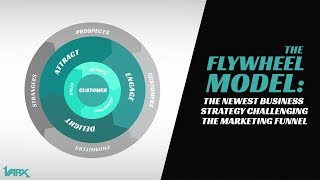
In the flywheel model, three forces spin around the customer at the center:
- Attract: You pull in strangers with useful content, SEO (search engine optimization, getting found on Google), social media, or ads.
- Engage: You convert those visitors into customers with a good sales experience, clear pricing, and easy onboarding.
- Delight: You make existing customers so happy that they tell others. Those referrals feed back into Attract, and the wheel keeps spinning.
Jim Collins introduced the flywheel concept in his 2001 book "Good to Great." He argued that great companies do not rely on one big breakthrough. They push a heavy flywheel one turn at a time until momentum takes over. HubSpot applied this thinking to marketing in 2018.
Why the Funnel Is Broken
The old funnel treats customers as the exit point. Once someone buys, they fall out of the bottom and you go find new leads. This creates a problem: you have to keep filling the top, forever, just to stay flat.
The funnel also ignores something important: 81% of consumers trust recommendations from friends and family over any ad (HubSpot Research). And 65% of consumers do not trust paid ads at all (HubSpot Research). That means the most powerful marketing channel you have is not Google Ads. It is a happy customer.
The funnel wastes that asset. The flywheel puts it to work.
The Economics Behind It (Real Numbers)
The flywheel is not just a nice idea. The math is compelling:
- McKinsey research shows a 5% increase in customer retention can lift profits by 25-95%.
- 84% of B2B decision-makers start the buying process with a referral (ReferralRock, 2025).
- 91% of B2B buyers are influenced by word-of-mouth when making purchasing decisions (ReferralRock, 2025).
- Customer acquisition costs (CAC) in B2B rose by 62% on average between 2020 and 2024 (Forrester, 2024).
- ChartMogul's 2024-2025 SaaS benchmarks show top-quartile B2B companies achieve over 120% Net Revenue Retention (NRR): meaning existing customers alone grow revenue past 100%, before adding a single new customer.
When CAC keeps rising and referrals are free, the flywheel is not a strategy choice. It is a survival mechanism.
Real Company Examples
Amazon (2001 to present)
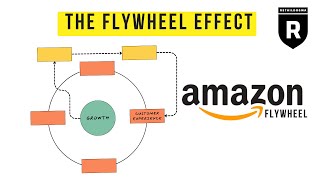
Jeff Bezos sketched the Amazon flywheel on a napkin in 2001 after reading Jim Collins. The idea: lower prices attract more customers. More customers attract third-party sellers who want access to that audience. More sellers expand product selection. Broader selection brings more customers. Lower costs from scale allow even lower prices. The wheel feeds itself.
The result: by 2024, third-party sellers accounted for 58% of all paid units sold on Amazon, up from nearly zero in 1999. Amazon did not acquire those sellers with ads. The flywheel pulled them in.
HubSpot (2018 to present)
HubSpot built its entire product suite around the flywheel. The free CRM (customer relationship management tool) attracts new users. Paid features engage growing teams. Their customer community, knowledge base, and HubSpot Academy delight users and generate referrals. Companies that switched from funnel-style planning to the flywheel model reported 2.1x more referral-driven revenue within two years (HubSpot research). HubSpot's own growth proved the model, it crossed $2.6 billion in annual revenue in 2024 with a business largely driven by inbound, word-of-mouth, and product-led growth.
Notion is a clear flywheel in action. A Notion user builds a project management template, posts it on X (formerly Twitter), and 200 people sign up to copy it. That one customer just did more marketing than a paid ad campaign, for free. Notion users have shared millions of templates publicly. Each template is a mini-flywheel spin. This community-driven growth helped Notion reach an $11 billion valuation by late 2025 and cross $600 million in ARR, demonstrating how product-led and community-led growth build immense, compounding value.
How to Build Your Flywheel: A 4-Step Playbook
Step 1: Map the Three Arcs
Draw your current version of each stage:
- Attract: What content, channels, or tactics bring people to you? (blog posts, YouTube, LinkedIn, paid search)
- Engage: How do people become paying customers? (free trial, demo, consultation, self-serve checkout)
- Delight: What happens after the sale? (onboarding email sequence, support chat, community forum, customer success calls)
Step 2: Audit Your Friction Points
Friction is anything that slows the wheel or makes customers leave. Pull your data and look for:
- High churn rate in the first 30 days (broken onboarding)
- Long support response times (kills Delight)
- Confusing pricing page (kills Engage)
- No referral program (wasted Delight energy)
Every friction point is a leak in your wheel. Fix leaks before adding more force.
Step 3: Find Your Force Multipliers
PayPal's 1999-2000 sign-up bonus referral program PayPal needed to out-compete rival services without matching their ad budgets, so it looked for a force multiplier instead of more Attract spend PayPal paid $10 to a new sign-up and $10 to the friend who referred them, turning every user's own network into a distribution channel
Result: The program drove a 7-10% average daily growth rate and roughly 1,650% average annual growth, taking PayPal from 1 million to 100 million users (Program ran 1999-2000, cited in retrospectives through 2024).
SourceForce multipliers are things that spin the wheel faster. Look for:
- Referral programs (Dropbox famously grew 3,900% in 15 months using a simple "give a friend 500MB, get 500MB" referral)
- User-generated content (templates, reviews, tutorials made by customers)
- Integrations with other tools (every integration is a new discovery channel)
- Community (Slack groups, Discord servers, forums where customers help each other)
Step 4: Reallocate Budget Toward Delight
Most companies spend 80% of their marketing budget on Attract. Consider shifting 10-20% toward retention, onboarding improvement, and customer advocacy programs. The return on Delight spending is almost always higher than the return on more ad spend.
The Metrics That Actually Matter
If you track only funnel metrics (leads, MQLs, SQLs), you are measuring the funnel even if you call it a flywheel. Track these instead:
| Metric | What It Measures | Why It Matters |
|---|---|---|
| NRR (Net Revenue Retention) | Revenue kept and grown from existing customers | Below 100% means the wheel is leaking |
| CAC Payback Period | Months to recover acquisition cost | Shorter means faster momentum |
| Referral-Sourced Pipeline | % of new leads from existing customers | The purest measure of flywheel spin |
| NPS (Net Promoter Score) | How likely customers are to recommend you | Leading indicator of future referrals |
| Time-to-Value | How fast a new customer gets their first win | Predicts long-term retention |
Do not draw the flywheel and keep measuring funnel KPIs (key performance indicators). If your weekly review only covers MQLs (Marketing Qualified Leads) and SQLs (Sales Qualified Leads), you have a funnel with new branding. The flywheel only works if your scoreboard includes retention and referral metrics. Otherwise you will keep spending on Attract while the wheel leaks at Delight.
HubSpot's Loop Framework: What Replaced the Flywheel
HubSpot did not stop at the flywheel. At GROW Europe in November 2024, executives argued that traditional funnels, and even the original flywheel, are insufficient for an AI-mediated buyer journey. In late 2025, HubSpot officially replaced the 15-year-old Attract, Engage, Delight model with the Loop Marketing Framework: Express, Adapt, Amplify, Evolve. Heading into 2026, HubSpot's own State of Marketing research frames Loop as the default playbook for a world where buyers research with AI, get answers before they ever click a link, and discover brands across scattered channels like TikTok and podcasts.
The Loop is designed for non-linear, feedback-driven, AI-era marketing. The core idea remains the same: customers generate customers. But the Loop adds explicit AI feedback loops and personalization at every stage.
The practical takeaway: ship the flywheel first. Get NRR above 100%. Build your referral program. Then layer AI personalization on top once the fundamentals are solid.
Common Mistakes
- Putting Sales at the center instead of the customer. The wheel only spins if customer success is the axis. Otherwise you are running a circular funnel.
- Ignoring friction inside Delight. A 48-hour support response time on a product with a 14-day free trial kills the wheel before it starts. Measure time-to-value, not just time-to-close.
- Treating it as a one-time reframe. The flywheel requires ongoing audits. Friction points change as your product and customer base grow. Set a quarterly review.
- Skipping the referral program. Most companies know referrals matter but never build a formal program. Even a simple "give $20, get $20" referral incentive can double referral volume.
The One-Line Takeaway
Stop treating customers as the finish line, make them the engine, and your best growth channel is already in your CRM.