Anchoring and Framing
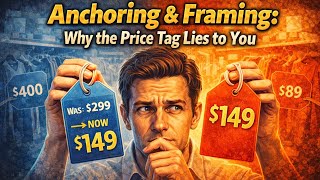
The first number a customer sees becomes the gravitational center of every price they evaluate after it. The first words they read become the lens through which they judge every benefit. Anchoring and framing are not optional flourishes on a pricing page, they are the silent referee deciding whether your offer feels generous or greedy.
The Origin (Real Research)
Amos Tversky and Daniel Kahneman introduced anchoring in their landmark 1974 paper, 'Judgment Under Uncertainty: Heuristics and Biases', published in Science. In their most famous demonstration, they spun a wheel of fortune that produced a random number between 0 and 100, then asked participants what percentage of African countries were in the United Nations. Participants whose wheel landed on 10 guessed 25% on average; those who saw 65 guessed 45%. A number everyone knew was random still bent their judgment.
A companion experiment had subjects estimate, in five seconds, the product of either 1 x 2 x 3 x 4 x 5 x 6 x 7 x 8 or 8 x 7 x 6 x 5 x 4 x 3 x 2 x 1. The ascending group's median guess was 512. The descending group's was 2,250. Same numbers, different starting anchor, four-fold gap in estimation.
Framing came a few years later. Tversky and Kahneman's 1981 paper on the 'Asian disease problem' showed that describing the same outcome as '200 lives saved' versus '400 lives lost' flipped majority preference, even though the math was identical.
How It Actually Works
iPad launch keynote, January 27, 2010 Steve Jobs displayed a $999 price on screen before revealing the real price, so $499 would be judged against that anchor rather than evaluated on its own Jobs held a $999 figure on screen, noted pundits expected the iPad to cost that much, then announced the actual starting price of $499
Result: Apple's stock, which had been trading down through most of the keynote, spiked +3.61 within minutes of the $499 reveal (single keynote event).
SourceAnchoring works because the brain is lazy with comparisons. When you see $999 next to $499, you do not independently evaluate whether $499 is fair, you evaluate whether it is a good deal relative to $999. The anchor short-circuits absolute judgment.
Framing works on the same machinery but with words. '95% fat free' and '5% fat' describe the same yogurt. The first frame triggers a positive evaluation pathway; the second triggers a risk-avoidance pathway.
Why Marketers Care (2024/2025 examples)
magazine subscription page (web-only, print-only, print+web tiers) a decoy 'print-only' tier priced identically to the 'print+web' bundle made the bundle look like a free upgrade by comparison Dan Ariely tested the three-tier page on 100 MIT students, then removed the seemingly useless print-only decoy and re-ran the choice between the two real options
Result: print+web subscriptions dropped from 84% to 32% of choices once the decoy anchor was removed, the decoy alone nearly tripled bundle uptake (MIT student sample, published in 'Predictably Irrational').
SourceApple's Vision Pro launch at $3,499 was not just a product release, it was a recalibration of the anchor for every other Apple product. A $1,599 iPhone 15 Pro Max suddenly reads as 'reasonable premium' rather than 'extravagant phone'. Steve Jobs ran the same play in 2010 when he displayed a $999 placeholder on stage before revealing the iPad's real $499 price.
Amazon stacks anchors inside a single product page using 'List Price', 'Was', 'Other Sellers from', and 'Newer Version Available' rows. Each line gives the brain another reference point that makes the current price feel like a discovery.
Booking.com frames availability instead of price: 'Only 2 left at this price' and '17 people are looking right now' anchor scarcity rather than cost. The Shopify enterprise team documents three-tier SaaS pricing where the highest tier exists primarily to make the middle tier feel sensible, a structure popularized by The Economist's famous print/web/combo subscription test.
When The Economist removed its $125 print-only option, sales of the $125 print-plus-web combo dropped from 84% to 32% of subscribers. The 'useless' print-only anchor was generating tens of thousands of extra revenue per cohort by making the combo feel like a free upgrade. Dan Ariely replicated this in his MIT classroom, same effect, same magnitude.
How to Apply It Ethically
- Lead with your highest legitimate price first, a real enterprise tier, a real premium SKU, not a fake crossed-out number you have never charged.
- Frame outcomes in the direction your product genuinely produces. 'Save 6 hours a week' and 'Cut admin time by 30%' both work; pick the one your data supports.
- On comparison tables, place your target plan in the middle column and let the cheaper and more expensive tiers do the anchoring work.
- When quoting custom deals, state the full annual figure before the monthly equivalent. '$24,000/year, billed at $2,000/month' lands very differently from the reverse.
Where It Backfires / Ethical Limits
The line gets crossed when the anchor is fictional. Made-up 'original prices' that never existed are illegal in the EU under the Omnibus Directive and have triggered class-action settlements against US retailers including Kohl's and JCPenney. 'Drip pricing', anchoring on a low headline number and revealing fees at checkout, is now a target of FTC enforcement under the 2024 'Junk Fees' rule.
Framing crosses the line when it hides material information. '95% fat free' on a product that is 90% sugar is technically true and ethically bankrupt. If the frame would collapse the moment the customer read the small print, you have built a refund engine, not a marketing strategy.
Key Takeaways
- The first number a customer sees calibrates their judgment of every number after it, choose it deliberately.
- Real anchors, not fake ones: a genuine premium tier beats a phantom 'was' price both ethically and legally.
- Framing changes the decision pathway without changing the facts; pick the frame that matches what your product actually delivers.