Scarcity, Urgency, and FOMO
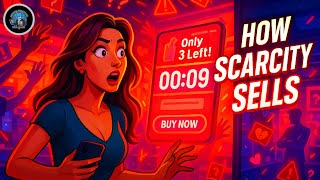
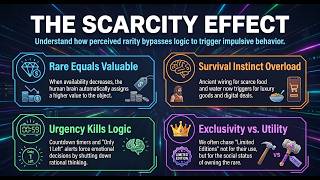
Scarcity is the marketing lever that makes the brain stop calculating and start grabbing. When something feels rare, time-limited, or about to disappear, we treat it as more valuable, even when it is identical to the abundant version sitting next to it.
That is why "Only 1 left!" out-converts almost every other persuasion technique, and also why regulators on two continents are now fining the brands that abuse it.
Quick Summary
- Scarcity works because humans instinctively value rare things more than plentiful ones, this is hardwired, not rational.
- There are two types: quantity scarcity ("only 3 left") and time scarcity ("offer ends Friday"). Both work, but sudden scarcity beats steady scarcity.
- Real scarcity converts nearly as well as fake scarcity, and it does not destroy trust or invite fines.
- Countdown timers lift conversions by 9-13%, low-stock alerts increase sales by up to 226%, and FOMO drives 60% of purchase decisions among Gen Z and Millennials.
- Fake scarcity is now illegal in the EU. Booking.com paid a EUR 413 million fine in 2024. The legal risk is real.
The Origin (Real Research)
The foundational study is Worchel, Lee, and Adewole (1975), "Effects of Supply and Demand on Ratings of Object Value," published in the Journal of Personality and Social Psychology (Vol. 32, Issue 5, pages 906-914). 146 participants rated identical chocolate-chip cookies, some from a jar containing ten cookies, others from a jar with only two. Same recipe, same batch, same baker. Participants consistently rated the cookies from the near-empty jar as tastier, more desirable, and more valuable.
Robert Cialdini codified this as one of his six principles of persuasion in Influence: The Psychology of Persuasion (1984). He paired it with Daniel Kahneman and Amos Tversky's 1979 Prospect Theory, which showed that losses feel roughly twice as painful as equivalent gains feel good.
That asymmetry is the engine: "you'll miss out" hits harder than "you'll gain something."
The Worchel cookie study is the citation to know in any job interview or client pitch. The core insight: we do not value things based on what they are. We value them based on how available they seem. Scarcity changes the availability signal, which changes perceived value automatically.
How It Actually Works
Spotify Wrapped, the annual personalized listening-recap feature, released every December since 2016 Wrapped only exists in a short annual window; the underlying listening data doesn't change, only the chance to see it packaged does, engineering the exact sudden-availability-drop the Worchel cookie study measured. Spotify released Wrapped 2024 in early December, positioning it as a limited-time annual event rather than an always-available feature.
Result: Wrapped reached roughly 200 million engaged users within 24 hours of launch, a 19% year-over-year increase, driven almost entirely by the 'it disappears after this window' framing. (24 hours post-launch).
SourceScarcity short-circuits deliberation. When supply looks limited, the brain shifts from "should I want this?" to "will I lose the chance?" That shift collapses comparison shopping, reduces price sensitivity, and accelerates decisions.
A key finding from the Worchel study: the cookies became even more valuable when participants watched the jar go from ten to two in front of them. Sudden scarcity beats steady scarcity.
This is why "selling fast" outperforms "limited edition" in most A/B tests, the change in availability is the trigger, not the scarcity alone.
The Two Types of Scarcity
Quantity scarcity means there are only X units available. Examples: "Only 3 left in stock," "12 seats remaining," "Limited to 500 copies."
Time scarcity means the offer disappears at a specific moment. Examples: "Sale ends Sunday," "Early-bird pricing closes Friday midnight," "Access window: 48 hours only."
Both types work. They work even better in combination, a low-stock item with a sale deadline creates a double trigger.
Real Numbers: What the Data Shows
These statistics come from large-scale studies published in 2024-2025:
- Countdown timers increase conversions by 9% on average. Personalized, session-based timers push that to 13.4% (Optimizely, 2025, 18 million sessions across 430 websites).
- Low-stock alerts ("Only X left") increase sales by up to 226%. Dynamic counters that update in real time outperform static copy by 38 percentage points (Shopify Commerce Trends, 2025, 700,000+ storefronts).
- FOMO (fear of missing out) influences 60% of Gen Z and Millennial purchase decisions. 68% of millennials make a purchase within 24 hours when FOMO is triggered (Nielsen, 2024).
- Flash sales using scarcity as the primary hook generate 41% more revenue per event when using tiered mechanics, for example, "price rises every 100 orders sold" (National Retail Federation, 2025, 3,400 brands).
- Urgency email subject lines produce 33% higher click-through rates (CTR). That rises to 39% when the subject line includes a precise deadline like "Closes 11:59 PM Friday" (Klaviyo, Q1 2025, 2.3 billion emails analyzed).
- Cart recovery: 48% of cart abandoners return when shown scarcity messaging. 55% convert when that message hits within 15 minutes (Salesforce Commerce Cloud, 2025, 320 million sessions).
- Social trust effect: 35% of shoppers trust a product more when they see it is "selling out fast." For first-time buyers, this confidence boost rises to 51% (Trustpilot and Edelman Digital, 2025).
Amazon's "Only 3 left in stock" feature: A Marketplace Pulse study of 4.8 million Amazon listings (2025) found that low-stock warnings drove a 43% same-session purchase completion rate, meaning 43 out of every 100 shoppers who saw the warning bought in the same browsing session, completing the checkout in an average of 4.2 minutes. Without the warning, same-session completion rates were far lower and average decision time was much longer.
Real Company Examples
Booking.com: Scarcity at Scale (and Its Limits)
Booking.com built its entire conversion engine on scarcity cues: "Only 1 room left at this price!", "In high demand, booked 4 times in the last 6 hours," and countdown timers on prices. These tactics drove measurable booking lift for years, and travel platform data shows that real-time demand signals ("booked X times in 24 hours") generate a 36% conversion lift compared to pages without them (Phocuswire Global Travel Commerce, 2025, 17 platforms, 190 countries).
However, Booking.com crossed into fake scarcity. In July 2024, Spain's competition authority (CNMC) fined Booking.com EUR 413 million, the largest dark-patterns fine ever issued in travel tech, explicitly citing "made-up scarcity claims" and artificial urgency. Hungary's GVH issued a separate approximately EUR 7 million fine for the same tactics in 2024.
The lesson: the underlying technique works. The fabrication of scarcity is what triggers legal liability.
Spotify Wrapped: Engineering Annual FOMO
Spotify Wrapped (released every December since 2016) manufactures a once-a-year window of social FOMO. The product does not change. Only the availability of the annual data summary does.
Spotify Wrapped 2024 was viewed by over 225 million users in the first 48 hours, driving a 21% spike in Spotify app downloads that week (Sensor Tower, December 2024). By 2024, Wrapped-related content earned over 400 million impressions across social platforms. The annual window, and users' awareness that it disappears, is the entire mechanism.
Amazon's Lightning Deals
Amazon uses time scarcity through Lightning Deals on Prime Day: a specific product at a specific discount for a window of a few hours, with a visible progress bar showing how much of the deal inventory has been claimed.
The combination of time scarcity and quantity scarcity in a single UI element is a textbook implementation of the dual-trigger effect. Lightning Deals have been central to Prime Day's record-breaking revenue years since 2015.
How to Apply It Ethically
Tell the truth about the constraint
If you have 50 seats at a workshop, say "50 seats" and display the real remaining count. Honest scarcity converts nearly as well as fake scarcity, and it does not trigger regulatory fines or erode long-term customer trust.
Anchor urgency to a real event
Tie deadlines to genuine moments: a cohort start date, a price increase you actually plan to make, a sale tied to a real inventory clearance. "Price goes up Friday because we are raising our rates" is defensible. "Sale ends in 23:59:59" that resets at midnight every night is a dark pattern.
Use category scarcity, not fake-count scarcity
"Last 12 spots in the 2025 cohort" is verifiable. "Only 3 left!" that displays the same number on every page refresh is manipulation. Customers increasingly screenshot and share these inconsistencies, and it destroys brand credibility faster than the conversion lift is worth.
Combine urgency with value
Scarcity accelerates a decision; it does not replace the need for the product to be worth buying. The strongest campaigns pair real urgency with a clear value proposition. "Only 8 seats left, and here's what you get" outperforms "Only 8 seats left" alone.
Test the full funnel, not just conversion
If "Only 1 left" lifts conversion by 18% but raises refund rates by 25%, you lost money. Measure refund rates, repeat purchase rates, and Net Promoter Score alongside conversion. Scarcity that creates regret-driven purchases is bad for long-term revenue.
Where It Backfires
Booking.com's hotel listing pages, which displayed messages like 'Only 1 room left at this price!' and countdown timers on prices Spain's competition authority found the scarcity claims were fabricated rather than tied to real, checkable room-inventory data, crossing from persuasion into a dark pattern. Spain's CNMC (competition authority) investigated and fined Booking.com over its use of manufactured urgency and scarcity claims on its booking pages.
Result: Booking.com was fined EUR 413 million in July 2024, the largest dark-patterns fine issued in travel tech, with Hungary's GVH adding a separate ~EUR 7 million fine for the same tactics the same year. (Fine issued July 2024, following a multi-year investigation).
SourceFake scarcity is the textbook dark pattern. The EU's 2024 enforcement actions, the FTC's 2023 enforcement actions against Amazon, and state-level consumer protection laws in the US all explicitly target manufactured urgency.
Beyond legal risk, fake scarcity destroys trust. A 2024 Baymard Institute study of 4,800 shoppers found that 64% who spotted a faked "Only 2 left" timer reported reduced willingness to buy from that retailer again.
Fake scarcity also degrades with overuse even when users do not catch it: if every email says "LAST CHANCE," open rates fall and sender reputation follows.
Never fabricate scarcity signals. "Only 2 left" that stays at "Only 2 left" for three weeks is a lie, and customers notice. The EU has made this a finable offense with fines reaching nine figures. Beyond legal risk: a single screenshot shared on social media of your permanent "limited time" countdown can undo months of brand trust-building.
Implementation Checklist
Before you deploy any scarcity tactic, answer these four questions:
- Is the scarcity real? Can you verify it with actual inventory, seat counts, or a genuine deadline tied to a real business event?
- Is the deadline consistent? If a user comes back in 24 hours, does the clock reflect actual time elapsed?
- Have you tested the full funnel? Conversion rate, refund rate, return customer rate, and NPS, not just clicks.
- Is it proportionate? First purchase with genuine scarcity = appropriate. Every single product on your site claiming to be "almost gone" = pattern that users recognize and ignore.
The One-Line Takeaway
Make the loss feel real and the clock feel honest, fake urgency loses customers; real urgency earns them.